Latent Space: Looped Transformers

Part 2 of 4 - The Tech Behind Silent AI Reasoning
Introduction
Building on the bandwidth constraints and interception mechanics explored in Part 1: Latent Space: The Token Bottleneck , we move from the theory of latent reasoning to the practical implementation of continuous compute pipelines. This article begins to reverse-engineer its framework using interpretability papers and public scaling behaviors, without relying on leaked blueprints.
Modern frontier systems are breaking free from the sequential constraints of text-based explicit reasoning. This guide dissects the internal mechanics of Recurrent-Depth Transformers (RDTs) and Anthropic's Claude Mythos , moving beyond simple generation loops into continuous latent inference.
By understanding looped layer architectures and test-time compute allocations, practitioners achieve three operational benchmarks:
- Runtime Optimisation : Maximise execution efficiency and forecast scaling behaviours.
- Architectural Integration : Embed latent memory structures directly into complex deployment environments.
- Algorithmic Scaling : Increase task complexity via test-time compute without artificially inflating the token context window.
Frontier Model Design Speculations & RDT Mechanics
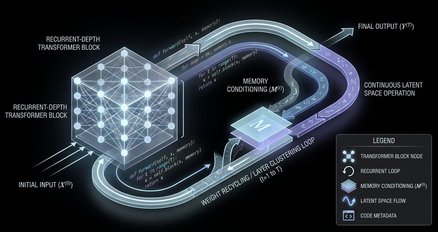
Standard Transformer architectures scale depth via a strict, linear progression of unique layers ( Layer1→Layer2→⋯→LayerN ). Frontier models bypass this linear restriction via Recurrent-Depth Transformers (RDTs) through two distinct mechanics:
- Weight Recycling : An RDT repeatedly processes a single weight-locked block over multiple iterations (R R ) within a single forward pass Two-Scale Latent Dynamics for Recurrent-Depth Transformers .
- Layer Clustering : The architecture loops a clustered subset of intermediate layers to expand computational depth dynamically.
The transformation at any iteration t t integrates memory conditioning (M(t)M(t)) to support the structural transition from pure recurrence to scratchpad-assisted looping. This state evolution is formalised via the exact mathematical operation:
h(t+1)=h(t)+TransformerBlock(h(t)∥M(t))
This looping mechanism executes computational routing entirely within a continuous latent space , bypassing the requirement to emit intermediate tokens or redundantly populate the autoregressive Key-Value (KV) cache. We evaluate the structural implementation of closed models through three primary forensic signals:
- Reverse-Engineered Metrics : Analysts decode runtime routing mechanics from public evaluations, response latency profiles, and academic scaling behaviours.
- Representation Spaces : Anthropic's interpretability research isolates specialised features governing logic tracking, persona axes, and state optimisation Scaling Monosemanticity: Extracting Interpretable Features from Claude 3 Sonnet .
- Dynamic Halt Gates : A pragmatic architectural design couples recycled-weight recurrence with termination gates, stopping the internal loop when a hidden-state tensor meets a predefined accuracy threshold.
Deconstructing the Paradigm Shift over Explicit CoT
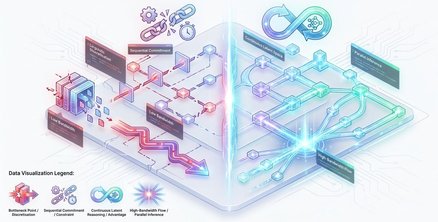
Explicit text-based Chain-of-Thought (CoT) reasoning introduces severe structural bottlenecks when applied to highly complex engineering domains. The degradation in performance stems from three primary operational vectors:
- Linguistic Discretisation : Forcing continuous, multidimensional tensor activations to be compressed into discrete vocabulary indices degrades subtle, non-verbalisable logical paths.
- Sequential Commitment : Autoregressive generation demands strict commitment to token TnTn before computing Tn+1Tn+1 , where a single sub-optimal sampling selection introduces cascading semantic compounding errors downstream.
- Low Bandwidth : Text token streams natively restrict internal state communication to roughly 15 bits per step, artificially throttling high-dimensional computational throughput.
Continuous latent reasoning resolves these structural vulnerabilities by executing multiple cycles exclusively within the hidden layer space to preserve the rich fidelity of the tensor activations Chain-of-Thought and Compressed Looped Transformers: A Memory-Budget Separation . This allows the architecture to evaluate, revise, and optimise an internal reasoning graph before crystallising logic into an output token, creating two distinct system impacts:
- Latency Trade-offs : Time-to-first-token (TTFT) increases due to silent compute cycles, but total Time-To-Final-Answer (TTFA) for complex logic decreases by up to 35% compared to explicit text approaches.
- Debugging Opacity : Intermediate states remain hidden, requiring auxiliary probe decoder heads to audit non-verbalised reasoning for security and alignment compliance.
Test-Time Compute Allocation & Latent Memory Banks
The shift from horizontal parameter inflation to test-time compute scaling defines the current operational baseline for systems like Qwen, DeepSeek , and Gemini . Modern architectures dynamically allocate internal loops based on the exact computational demands of the incoming payload, deploying two specific scaling mechanisms for complex algorithmic reasoning:
- Latent Injection : The architecture injects deeper latent thought steps to process dense logic graphs.
- Accuracy Maximisation : Extended loop iterations yield outsized accuracy gains Test-Time Compute Scaling for ASR with Depth-Conditioned Looped Transformers .
Prolonged internal looping causes degeneration of the representation space. To maintain state integrity, frontier architectures deploy latent memory banks and continuous working-memory channels that provide two functional guarantees:
- Token Bypass : The internal scratchpad routes data by bypassing traditional tokenisation loops entirely.
- Noise Insulation : The state remains localised and insulated from token selection noise, forcing deterministic code-generation sequences and stable, long-horizon operational planning.

Conclusion & Strategic Advice
Replacing explicit token chains with looped latent inference redefines architectural efficiency by allocating computational budget precisely where required. Deployment strategies must adapt to the dissolution of the autoregressive sequential lock via two core operational mandates:
- Compute Allocation : Shifting focus toward test-time compute optimisations provides superior yield over raw horizontal parameter expansion.
- Infrastructure Modernisation : Engineers must ensure probing infrastructure is modernised to support latent monitoring, keeping security linters effective despite the absence of intermediate tokens.
To explore how these transient states are maintained across multi-agent workflows, proceed to Latent Space: The Persistence Barrier.
💬 How will "silent" latent reasoning reshape our approach to multi-agent AI workflows? Share your insights below and ♻️ repost with your network!
Further Reading
- LLM Reasoning Is Latent, Not the Chain of Thought
- Towards Reasoning Era: A Survey of Long Chain-of-Thought for Reasoning Large Language Models
- DiffCoT: Diffusion-styled Chain-of-Thought Reasoning in LLMs
More From Me
- The Claude Mythos: Why Logic Chaining and Operational Length Are a Major Advance
- Beyond Mythos: Recursive Self-Correction and Temporal Endurance
- The Claude Mythos: Project Glasswing and the Rise of Autonomous Offensive AI
- The Mythos Moment: Why Restricting Frontier AI May Accelerate Its Proliferation
Original Article: Read on LinkedIn | Read on Substack