The AI Market Paradox: Hardware Deflation and the Shift to Localised Compute
Introduction
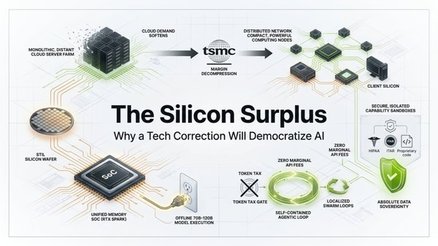
Building on the economic risks outlined in The AI Cost-Cutting Trap: Why "Same But Cheaper" is a $1 Trillion Fallacy , the technology sector approaches a critical capital inflexion point. Market anxiety currently stems from the gulf between gigawatt-scale infrastructure investments and realised software revenue.
Historical technology cycles dictate that speculative bubbles leave behind permanent physical infrastructure, fundamentally democratising access. An impending cloud CapEx contraction acts as a catalyst, redirecting leading-edge semiconductor supply chains toward localised edge ecosystems .
For capital allocators evaluating long-term portfolio risk, transitioning from centralised cloud infrastructure to decentralised hardware represents a strategic imperative driven by three operational requirements:
- Data Sovereignty : Securing sensitive information outside legally porous multi-tenant environments.
- Latency Elimination : Ensuring millisecond response times for high-frequency execution workflows.
- Cost Insulation : Protecting engineering pipelines from highly volatile operational expenditure spikes.
Evaluating the break-even thresholds of edge compute requires analysing three distinct market shifts:
- Infrastructure Overbuilds : Tracing historical precedents of speculative capital democratising hardware access.
- Wafer Reallocations : Mapping the structural diversion of TSMC capacity to client hardware tiers.
- Advanced Desktop System-on-chips (SoCs) : Assessing the emergence of hardware like the Nvidia RTX Spark to execute secure, high-volume agentic optimisation loops natively.
1. The Infrastructure Overbuild Paradox
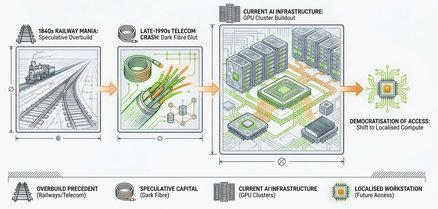
The hyperscaler AI buildout currently consumes hundreds of billions in CapEx, erecting massive GPU clusters and grid connections. History demonstrates these market deflations trigger long-term technological accessibility through two historical precedents:
- The 1840s British Railway Mania : Speculative collapses wiped out shareholder equity while physical tracks remained to drastically lower freight costs.
- The Late-1990s Telecom Crash : Liquidations sold unused " dark fibre " for pennies, laying the foundational network for the modern cloud economy.
An AI infrastructure contraction will trigger an identical paradox, driving price wars and creating historic lows for inference capabilities while leaving gigawatts of capacity intact. Enterprise and compliance-bound AI architectures must exploit the secondary effect of the bubble via two distinct strategies:
- Wafer Reallocation : Capitalising on the massive manufacturing shift that drastically lowers the acquisition cost of localised supercomputing arrays.
- Data Centre Repurposing : Navigating the complex regulatory and energy-grid hurdles required to claim abandoned capacity.
2. Wafer Reallocation: The Silicon Supply Shift
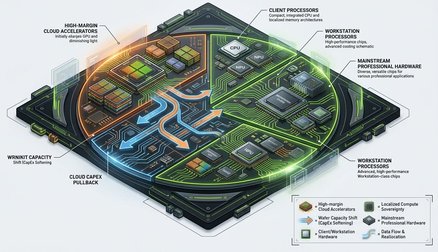
Semiconductor foundries such as TSMC currently prioritise high-margin cloud accelerators over client hardware. A softening in cloud CapEx fundamentally reverses this dynamic to maintain high utilisation rates on leading-edge 3nm and 2nm manufacturing capacity.
To amortise astronomical fabrication costs, hardware designers will systematically execute three supply chain pivots:
- Silicon Redirection : Routing advanced manufacturing capacity toward consumer, workstation, and mainstream professional hardware lines.
- Margin Decompression : Forcing High Bandwidth Memory (HBM) and DDR5 components into highly competitive pricing tiers.
- Storage Deflation : Pressuring client SSD pricing downward to shift cutting-edge compute back to the local desk.
3. The Strategic Rise of Localised Edge Hardware
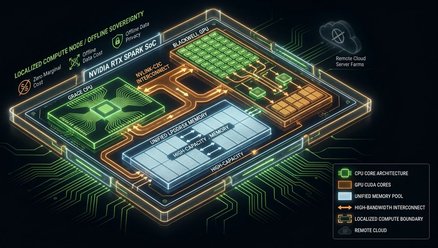
To hedge against cloud volatility, the industry accelerates high-performance client silicon designed to match cloud-tier capacities locally. The Nvidia RTX Spark, announced at Computex 2026, exemplifies this hardware deflation through three core architectural specifications:
- Processing Architecture : Fusing a 20-core Arm-based Grace CPU with a Blackwell GPU (6,144 CUDA cores ) on TSMC's 3nm node.
- Memory Integration : Utilising an NVLink-C2C interconnect to support up to 128GB of unified LPDDR5X-9400 memory on-package.
- Execution Pathways : Eliminating thin PCIe bus bottlenecks to allow zero-copy execution paths and deliver roughly 1 Petaflop of local FP4 compute.
Paired with FP4 quantisation, technical teams gain two distinct operational capabilities:
- Offline Deployment : Executing 70B-120B+ parameter models natively within a 140W-240W TDP envelope.
- Infrastructure Independence : Operating directly from standard wall outlets without requiring industrial HVAC systems.
Ultra-large 400B+ models still require multi-node clusters for inference execution. However, the 1.2 kg DGX Spark unit provides localised capability sandboxes, as detailed in the NVIDIA DGX Spark - AI Supercomputer First Impressions Video .
4. Insulation from the Cloud Token Tax
Centralised cloud APIs inherently impose a "token serialisation tax" on every model execution or agentic loop. Post-bubble token-based cloud inference introduces three critical vulnerabilities:
- Cost Unpredictability : Forcing workflows into highly variable operational expenditure models.
- Execution Latency : Introducing unacceptable multi-tenant bottlenecks for high-frequency agentic swarms.
- Data Exposure : Subjecting proprietary datasets to external multi-tenant security risks.
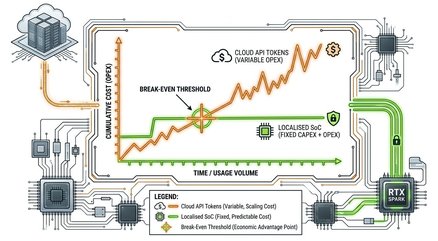
Transitioning to edge SoCs converts this volatile dependency into a fixed computing expense determined strictly by hardware acquisition and local power consumption. The break-even economics heavily favour fixed edge hardware under two specific conditions:
- High-Volume Generation : Operating enterprise swarms that execute continuous, multi-step reasoning loops generating millions of tokens daily.
- Micro-Transaction Accumulation : Reaching the threshold where multi-tenant latency and persistent API fees rapidly eclipse a one-off $15,000 CapEx, even if an overbuild price war slashes cloud inference costs by 80%.
This localised architecture allows organisations to execute complex optimisation workflows thousands of times daily with zero marginal token fees. The physical boundary of the local hardware guarantees strict intellectual property sovereignty for three data categories:
- Compliance Frameworks : Securing ITAR-regulated files natively.
- Medical Data : Processing HIPAA-protected patient records offline.
- Proprietary Assets : Maintaining sensitive enterprise codebases locally to bypass external security certifications.
Conclusion & Strategic Advice
The post-bubble technology landscape points unequivocally toward the radical decentralisation of AI. Shifting compute from capital-heavy monopolies to private, localised edge environments provides strategic insulation against market volatility and the unpredictability of multi-tenant environments.
The operational convergence of unified memory SoCs, model quantisation , and the decompression of silicon margins establishes a robust operational foundation through a strict selection matrix:
- Variable Cloud APIs : Deploying episodic, non-sensitive tasks utilising 400B+ parameter models to maximise the utility of deflated inference pricing.
- Localised Edge SoCs : Mandating RTX Spark and unified architectures for high-volume agentic loops, latency elimination, compliance-bound datasets, and ultimate data sovereignty on 70B-120B parameter models.
Evaluating the break-even threshold at which a localised, unified memory workstation undercuts cumulative API microtransactions is critical for sustainable scaling. Technical teams must model this hardware acquisition cost directly against the latency penalties of deflated cloud environments to secure architectural independence tomorrow.
Further Reading
- Dynamic Pricing for On-Demand DNN Inference in the Edge-AI Market
- Dataflow & Tiling Strategies in Edge-AI FPGA Accelerators
- Benchmarking and Exploring Accelerators for Hardware-Efficient AI Deployment
More From Me
Original Article: Read on LinkedIn | Read on Substack