Beyond Moore's Law: The Economics of Compute

Beyond Moore's Law: The Economics of Compute
Introduction
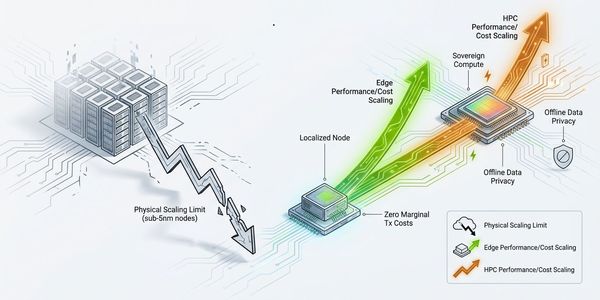
Building upon the economic arguments mapped out in The AI Market Paradox: Hardware Deflation and the Shift to Localised Compute , physical silicon scaling is colliding with fundamental atomic limits. Traditional die-shrinks yield diminishing returns, crippled by quantum tunnelling and thermal degradation.
Sustaining performance scaling mandates rigorous hardware-software co-design to replace diminishing advanced lithography returns. Resolving these physical constraints requires executing two distinct architectural strategies:
- Edge/IoT Persistence Paradigm : Delivering low-power, localised sovereignty using on-die persistent memory ( STT-MRAM and RRAM ).
- HPC/Datacenter Post-Silicon Paradigm : Deploying extreme-environment architectures via Photonic and Superconducting logic .
This guide dismantles the classic von Neumann bottleneck across both domains. Orchestrating these physical and logical capabilities—from coordinating physical cache evictions via topology-aware compilers to bypassing system buses—enables the fundamental recalibration of system latency, power consumption, and total hardware infrastructure budgets.
Sustaining Moore's Law through Co-Design
The von Neumann bottleneck is responsible for up to 80% of systemic energy dissipation and computational latency in modern architectures. Moving data across physical buses between processing cores and separate memory units severely throttles throughput.
Overcoming this structural inefficiency requires tightly coupling three core execution layers:
- Hardware Topology : Mapping execution units directly to localised memory arrays.
- Compiler Instruction Scheduling : Injecting physical memory barriers explicitly into the binary.
- Execution Runtimes : Aligning software lifetimes with physical cache flushes.
Eliminating the chasm between logic and memory lowers computational costs and extends performance scaling beyond physical silicon limits. The deployment models that dictate these optimisations vary with environmental constraints.
Dismantling the von Neumann Wall with STT-MRAM & RRAM (The Edge Paradigm)
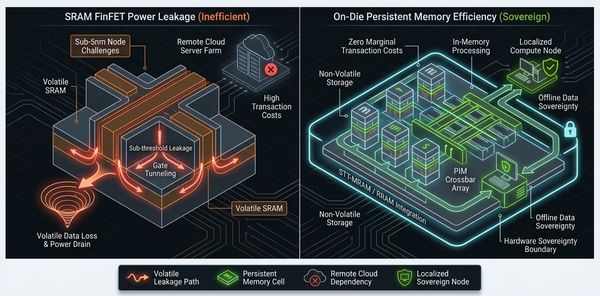
Legacy on-die memories cannot scale to meet the demands of advanced logic at the edge. The breakdown of scaling manifests across two primary memory architectures:
- SRAM Degradation : Requires a six-transistor (6T) cell design, driving critical static power leakage at sub-5nm nodes ( FinFET / GAA ).
- Embedded Flash (eFlash) Limits : Halts at 28nm because high write voltages (>10V) degrade the ultra-thin oxides of modern logic gates.
To bypass these limits, foundries deploy two distinct back-end-of-line (BEOL) persistent memory technologies directly on the processor die:
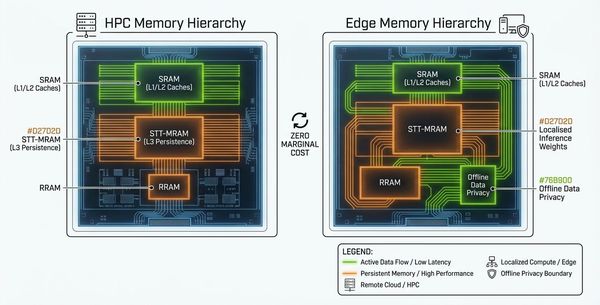
- STT-MRAM Scalability : Toggles magnetic tunnel junctions via Spin-Transfer Torque, scaling past 22nm to yield 3-4x higher density than SRAM with drastically reduced leakage [Evaluation of STT-MRAM as a Scratchpad for Training in ML Accelerators](https://arxiv.org/abs/2308.02024v1).
- RRAM Efficiency : Operates via localised oxygen vacancy migration, establishing an energy-efficient, forming-free bulk switching architecture suited for localised compute topologies [Multi-level, Forming Free, Bulk Switching Trilayer RRAM for Neuromorphic Computing at the Edge](https://arxiv.org/abs/2310.13844v1).
Exotic Core Architectures: Datacenter Scaling & Extreme Environments
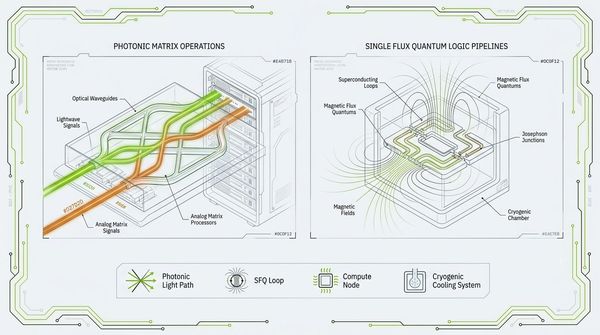
General-purpose datacenter cores hitting thermal ceilings force massive multi-megawatt facilities to adopt two extreme-environment logic pipelines:
- Photonic Matrix Operations : Substitute electrical currents with lightwaves to execute analogue matrix-vector multiplications .
- Optical Coprocessing Yields : Operate devoid of Joule heating , processing deep learning workloads to slash power consumption at hyperscale [Analogue Photonics Computing for Information Processing, Inference and Optimisation](https://arxiv.org/abs/2301.11760v2).
For ultra-high-speed pipelines, Single Flux Quantum (SFQ) logic operates strictly at cryogenic temperatures . Utilising magnetic flux quanta within Josephson junctions as digital logic states, SFQ achieves switching frequencies exceeding 100 GHz; ( DigiQ: A Scalable Digital Controller for Quantum Computers Using SFQ Logic ).
Maintaining these frequencies requires immense liquid helium cooling infrastructure to sustain 4 Kelvin operating environments. These architectures mandate rigid infrastructural models that are entirely separate from localised device-deployment economics.
The Economics of Specialisation: Edge Sovereignty and Precision Limits
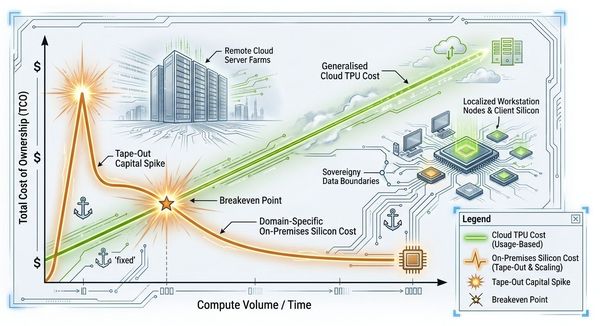
Custom domain-specific silicon drives an economic shift toward localised, low-power compute. Scaling these deployments requires calculating strict return-on-investment parameters against two critical economic factors:
- TCO Dynamics : Total cost of ownership (TCO) decreases sharply across high-volume edge environments.
- Tape-out Barriers : Custom silicon demands massive upfront tape-out capital, requiring precise volume forecasts to justify initial fabrication expenses.
Within these environments, Analogue Compute-in-Memory (CIM) architectures map neural network weights directly to the physical conductances (G = 1/R) of RRAM crossbars. Input values operate as voltages (V), calculating outputs natively as currents (I = V \times G) via Ohm's Law and Kirchhoff's Current Law [An RRAM compute-in-memory architecture for high energy-efficient processing of binary matrix-vector multiplication in cryptography](https://arxiv.org/abs/2501.10702v5).
Executing math directly in the memory array eliminates instruction fetch cycles, yet exposes the architecture to three debilitating physical realities:
- Conductance Drift : Physical degradation shifts resistance values, altering the mathematical output over time.
- Thermal Interference : Uncontrolled thermal noise creates low signal-to-noise ratios (SNR) .
- Precision Capping : These drifts restrict RRAM crossbars strictly to highly quantised environments (e.g., 4-bit or 8-bit inference workloads).
These physics govern edge capability constraints. The RRAM crossbars operate efficiently for fixed neural network weights, disqualifying them entirely from generalised, high-precision mathematical workloads.
The Software Paradigm Shift: Compiling for Heterogeneous Topology
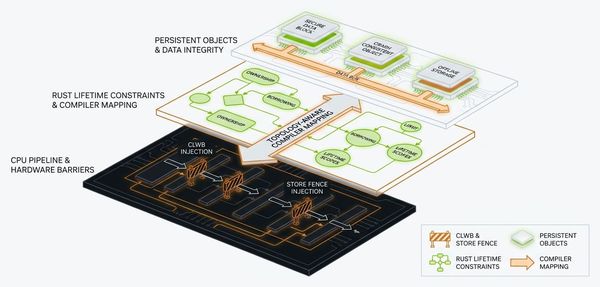
Exotic physical architectures and on-die persistence require compilers programmed with explicit mappings to hardware topologies. A persistent memory pointer referencing a volatile address (stack or heap) instantiates a dangling pointer immediately following a power cycle.
Relying exclusively on software abstractions like Persistent Memory Objects , introduces severe structural vulnerabilities. Ensuring byte-addressable persistent memory safety requires merging logical constraints with two hardware-level enforcements:
- Logical Validation : Leveraging compile-time lifetime analysis, such as Rust's borrow checker , to secure cross-domain memory references.
- Physical Eviction Coordination : Evolving compilers into "topology-aware" engines that map logical lifetimes to physical CPU cache evictions.
Achieving crash consistency prevents data corruption across ungraceful power cycles. The compiler must inject precise hardware execution barriers (such as CLFLUSH or CLWB for cache line write-backs, paired with strict memory store fences) directly into the execution pipeline, guaranteeing byte persistence before power loss.
To enforce these boundaries at compile time, the memory pipeline can leverage Rust's phantom data and lifetime mechanics to strictly isolate non-volatile references:
/// A pointer pointing strictly to a location in Non-Volatile Memory.
/// The `'p` lifetime constraint ensures this pointer cannot point to volatile stack/heap frames.
#[derive(Clone, Copy, Debug)]
pub struct NvPtr<'p, T> {
    offset: u64,
    _marker: PhantomData<&'p T>,
}
Syncing these compiler-enforced barriers with log-based atomic commits fundamentally alters memory pipelines. Because the 'p lifetime guarantees that the underlying object graphs cannot safely point to transient volatile frames, high-overhead serialisation formats JSON , Protobuf ) become completely obsolete.
Live, physically verified object graphs remain robust across sudden power losses, routing tasks directly to byte-addressable persistent memory tiers without serialisation latency.
Conclusion & Strategic Advice
The next era of performance scaling demands hybrid memory topologies that blend SRAM for L1/L2 caches , STT-MRAM for L3 persistence, and RRAM for localised inference weights. Real-world write endurance and fabrication yields at sub-10nm nodes introduce major commercial uncertainties, driving steep tape-out costs that demand precise deployment forecasts.
The operational realities of modern compute divide strictly into two hardware trajectories:
- Hyperscale Acceleration : Datacenters adopting extreme environments governed by photonic matrices and cryogenic logic.
- Edge Persistence : Domain-specific endpoints scaled through localised, low-precision persistent arrays.
Mapping software semantics directly to physical hardware interfaces drives unprecedented operational efficiency. Coordinating cache flushes and memory barriers directly at the compiler level transitions topology-aware compilation from an optional optimisation to a strict architectural necessity.
Auditing internal compilers and memory management stacks immediately validates compatibility with heterogeneous, persistent physical topologies. For a deeper dive into verifying local execution pipelines on these topologies, proceed to the next instalment: Designing Cryptographic Signatures for AI-Generated Ledgers.
We are officially transitioning from generic processing to heterogeneous, topology-driven compute. 💬 How is your organisation preparing its infrastructure for the end of Moore's Law? Drop your thoughts below and ♻️ share this post with your network!
Further Reading
- Intel: Spin-Transfer Torque MRAM Technology
- TSMC: Embedded Memory / RRAM Development
- Rust Documentation: Validating References with Lifetimes
More From Me
Original Article: Read on LinkedIn | Read on Substack