Silicon Stagnation: Limits, Space Compute, and Data Contamination

Introduction
Building on the enterprise data starvation loop identified in The AI Cost-Cutting Trap , the artificial intelligence development ecosystem is colliding with uncompromising physical realities. The bottlenecks restricting next-generation foundation models extend beyond software architecture to terrestrial physics and deteriorating data pipelines, driven by three core systemic failures:
- Grid Saturation : Regional power grids operate at maximum capacity, with substation provisioning facing strict multiannual delays.
- Pipeline Degradation : The public web is rapidly succumbing to synthetic contamination, destroying the baseline variance required for model training.
- Capital Constraints : Physical limitations now dictate stack selection and budget models independent of venture capital availability.
Evaluating the absolute thresholds of scaling laws requires analysing two distinct architectural extremes:
- Theoretical Boundary Models : Assessing speculative architectures like migrating compute clusters into Low Earth Orbit (LEO) to bypass power constraints.
- Grounded Epistemic Strategies : Tapping into historically locked sovereign public-sector data archives to secure uncontaminated data feeds.
- The Uplink Bottleneck : Escaping the terrestrial power grid limit via orbital compute ties physical hardware constraints directly to epistemic data constraints.
This guide details the thermodynamic, infrastructural and data-quality boundaries shaping architectural strategy over the next decade. It provides a clear roadmap for stack selection and capital allocation beyond terrestrial limits.
1. The Terrestrial Wall
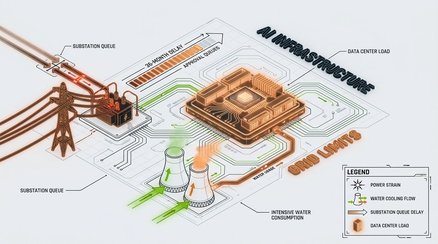
The empirical scaling laws driving AI progress model infinite compute power, parameters and dataset expansion. In reality, training next-generation models requires infrastructure consuming hundreds of megawatts , triggering three severe terrestrial constraints:
- Grid Capacity Restrictions : Regional grids operate at their absolute limits. The queue for high-voltage transformer approvals and substation connections in major technology hubs strictly enforces 36-month backlogs.
- Cooling Water Consumption : Evaporative liquid-cooling mechanisms draw millions of gallons of water daily, forcing immediate regulatory intervention and municipal blockades.
- Civic Infrastructure Friction : Sustained noise pollution from high-density cooling fans and extreme localised power draw turn mega-scale data centres into major civic liabilities.
Land-based power and water constraints dictate that macro-scale compute scaling requires architectural alternatives to standard grid-tied infrastructure.
2. Theoretical Orbital Architectures: The LEO Compute Thought Experiment
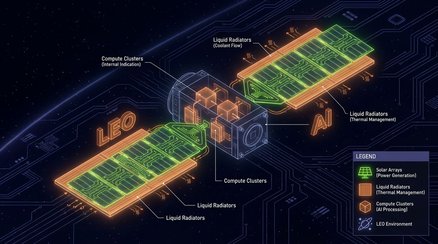
Evaluating off-grid alternatives requires analysing theoretical architectures like "Starmind", a speculative concept proposing a constellation of up to one million AI-enabled satellites in low Earth orbit (LEO). Moving infrastructure off the grid relies on three distinct operational factors to form a distributed orbital supercomputer:
- Compute Payload Deployment : Modular compute nodes replace traditional communications routers in this boundary-condition model.
- Unfiltered Power Sourcing : Speculative satellites capture continuous sunlight via massive solar arrays to bypass terrestrial power generation queues.
- Network Topology Realities : Treating orbital compute as a 1:1 replacement for terrestrial clusters ignores the massive synchronous bandwidth demands (e.g., Infiniband / NVLink ) of frontier model training.
- The Bandwidth Paradox : Distributing operations introduces optical inter-satellite link (ISL) latency that breaks standard synchronous gradient descent .
This orbital matrix remains a strict theoretical thought experiment constrained by extreme launch logistics, micro-meteoroid risks and fundamental networking barriers.
3. The Thermodynamic Realities of Space Compute
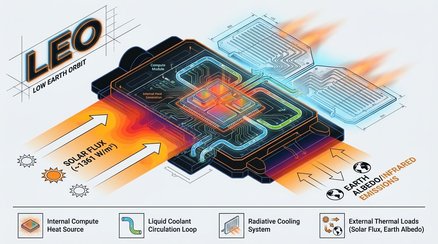
Relocating compute to orbit resolves power generation limits while triggering an extreme engineering bottleneck in heat dissipation. Convective air cooling and evaporative liquid systems are physically impossible in a vacuum, requiring strict adherence to two specific radiative cooling mechanics:
- Deployable Liquid Radiators : A macro-scale satellite compute node requires massive deployable liquid-radiator arrays exceeding 110 square meters. Heat transfers from the processors to a circulating coolant before radiating outward.
- Environmental Loads : Spacecraft in LEO do not radiate purely into the 2.7\text{K} background vacuum of deep space. Radiators must counteract immense environmental thermal loads, including direct solar flux (~1361 W/m²) and Earth's albedo /infrared emissions.
Managing environmental heat absorption operates on the same priority tier as dissipating internal compute heat. Radiative cooling mechanics are bound by Stefan-Boltzmann's law (E = \sigma T^4), strictly capping maximum thermal compute density per satellite to prevent hardware meltdowns.
4. Sovereign Data Waves: Combating the Synthetic Contamination Loop
Evaluating speculative off-world hardware against terrestrial reality exposes a strict data-gravity paradox. High-fidelity data required to train foundation models remains terrestrially bound, rendering the uplink of exabytes of primary data to LEO fundamentally impractical.
This data starvation directly accelerates a concurrent terrestrial crisis in the form of synthetic contamination, generating two specific systemic failures:
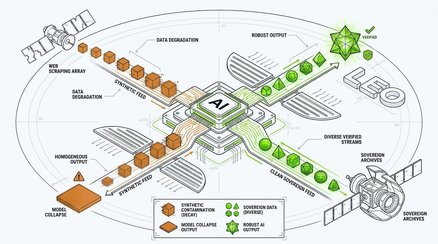
- Recursive Feedback Loops : Web scraping protocols now ingest previously generated synthetic outputs, overwriting human variance with machine-generated uniformity.
- Mathematical Degeneration : This loop triggers model collapse , a process in which algorithms drop into the low-probability tails of statistical distributions, yielding homogeneous outputs, as shown in The Curse of Recursion: Training on Generated Data Makes Models Forget .
Restoring baseline variance requires integrating unpolluted data pipelines, forcing governments to execute data provisioning via two primary channels:
- Sovereign Public Archives : State entities are unlocking anonymised, high-fidelity records, including health registries, land data and legal archives.
- Human Curation Verification : These archives inject verified, human-curated primary data directly into training pipelines to overwrite synthetic decay.
Government datasets are subject to strict legal requirements and legacy formats, which limit immediate pipeline integration. They remain the sole viable source of clean raw fuel required to sustain model progress and terminate the synthetic data loop.
Conclusion & Strategic Advice
The dual bottlenecks of terrestrial grid exhaustion and synthetic data contamination force an empirical restructuring of AI infrastructure. Speculative architectures like orbital LEO constellations provide baseline theoretical models for off-grid power, forcing severe operational tradeoffs in thermodynamics, ISL bandwidth and data gravity.
Mitigating these scaling limits demands a two-pronged architectural strategy:
- Data Provenance Moats : Integrating sovereign public archives prevents model collapse but dictates strict compliance and transformation architectures.
- Pipeline Prioritisation : Mission-critical LLM training requires securing exclusive access to verifiable human-curated primary data over generic web ingestion.
- Hybrid Infrastructure Integration : Bypassing 36-month power queues dictates evaluating dedicated terrestrial gas-turbine clusters or advanced modular nuclear deployments.
The next instalment of this series details the exact engineering physics governing thermal thresholds in The Thermodynamics of Orbit: Radiative Cooling Limits for Space Compute.
Analysing future macro-scale compute requires determining whether off-grid terrestrial clusters will dictate the infrastructure standard, or if epistemic data scarcity will rewrite fundamental scaling laws. Discuss your architectural projections in the comments.
💬 Will off-grid clusters become the new infrastructure standard, or will clean data scarcity rewrite AI's scaling laws entirely? Share your insights below and ♻️ share this post with your network!
Further Reading
- The Curse of Recursion: Training on Generated Data Makes Models Forget : Core mechanical breakdown of model collapse through synthetic ingestion.
- Privacy Measurement in Tabular Synthetic Data: State of the Art and Future Research Directions : Ground-level analysis of synthetic data boundaries and privacy metrics.
- AeroGen: Enhancing Remote Sensing Object Detection with Diffusion-Driven Data Generation : Evaluates the impact of generative models on computer vision training arrays.
More From Me
Original Article: Read on LinkedIn | Read on Substack