The Blueprint RISC-V: Unified Memory, Many-Core Scaling, and Geopolitical Sovereignty
Introduction
The structural shifts in modern processor memory design elevate open-source architectures from academic models to geopolitical requirements. Engineering leaders charting infrastructure strategy must navigate two primary operational realities:
- Software Moats : Proprietary ecosystems retain entrenched, highly optimised development stacks.
- Hardware Integration : Open alternatives mature rapidly via novel, physical-layer bridging.
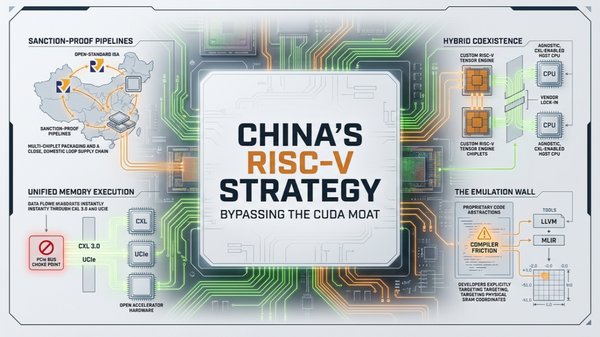
This guide provides an actionable roadmap for understanding the hybrid compute ecosystem. State-backed efforts utilise open-standard instruction sets to establish domestic sovereignty, relying on interconnects—specifically CXL and UCIe paired with agnostic host processors—to provide the unified memory and coherent infrastructure necessary to host open accelerators.
Caveat: The hybrid layouts and custom hardware-coherent chiplet architectures referenced operate as emerging designs. Immediate production implementations remain restricted to software simulation sandboxes while physical fabrication lines for domestic high-performance cores mature.
By the end of this analysis, infrastructure builders will possess the data required to evaluate unified memory scaling and next-generation stack selection.
1. The Geopolitical Pivot: Sovereign Compute Beyond Home Users
Open architectures drive their primary growth through national sovereign capability. Caught under stringent export controls, state-backed entities operate on the open-standard Instruction Set Architecture (ISA) to establish fully domestic, sanctions-proof semiconductor pipelines and bypass proprietary IP oligopolies.
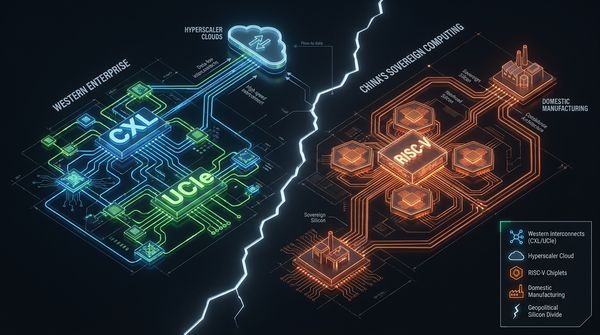
This dynamic forces a structural split into two distinct infrastructure tracks:
- The Sovereign Track : Sanctioned entities combine mature manufacturing nodes with emerging domestic host CPUs (e.g., Loongson or domestic ARM /RISC-V variants) using advanced multi-chiplet packaging to bypass lithography constraints.
- The Commercial Track : Western enterprises adopt open standards like CXL to eliminate vendor lock-in, integrating specialised chiplets into generic hyperscaler ecosystems.
Capital allocation across both tracks accelerates the iteration of open-source high-performance processors. The XiangShan Official GitHub Repository demonstrates this velocity, establishing architecture as a critical infrastructure requirement.
2. CXL and UCIe as the Stepping Stones (Unified Memory Dynamics)
When evaluating open architectures, the highly optimised software moat that encapsulates incumbent hardware is the primary barrier. Securing operational viability requires open architectures to utilise two structural bridges:
- Mature Platforms : Using high-performance platforms as integration stepping stones.
- Hardware Coherence : Bypassing proprietary ecosystems that natively block third-party accelerators on their primary packages.
Generic ARM, x86 server CPUs, and domestic hosts execute this bridging function using two open connectivity standards:
- CXL (Compute Express Link) 3.0 : Engineered for off-package, rack-scale unified memory architectures.
- UCIe (Universal Chiplet Interconnect Express) : Engineered for on-package chiplet integration.
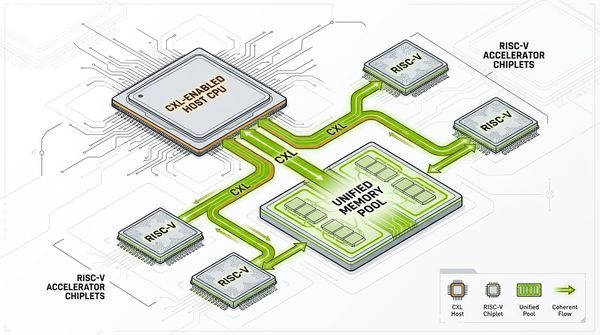
Visual Suggestion : Architectural layout showing an agnostic, CXL-enabled host CPU serving as the memory gateway for RISC-V accelerators.
Unified memory topologies fundamentally alter processor design by eliminating the physical PCIe bus bottleneck. Shifting to a unified layout via these open standards enables zero-copy execution for instant hardware sharing, establishing a clear contrast in layout mechanics:
- Traditional Layout : RAM remains restricted to motherboard slots, forcing high-latency data copying across a physical PCIe bus and creating bandwidth choke points.
- Unified Layout (UCIe/CXL) : Memory pools directly across the processor package or coherent fabric, enabling zero-copy instant hardware sharing and ultra-wide memory interfaces to prevent core idling.
Scaling these unified pools requires exact cache coherence . European research validates this approach by mapping terabytes-per-second memory bandwidth onto a 432-core open silicon design, documented in Occamy: A 432-Core Dual-Chiplet Dual-HBM2E 768-DP-GFLOP/s RISC-V System for 8-to-64-bit Dense and Sparse Computing in 12nm FinFET .
3. The Integration Mechanics: Coexistence Over Replacement
Open cores integrate via hybrid, hardware-coherent chiplet topologies to establish operational coexistence. Modern standards like UCIe execute host coherence through two specific mechanics:
- Direct Connection : Custom RISC-V matrix accelerators wire directly to the main unified memory space of an agnostic host.
- Latency Reduction : The architecture bypasses high-latency peripheral buses entirely.
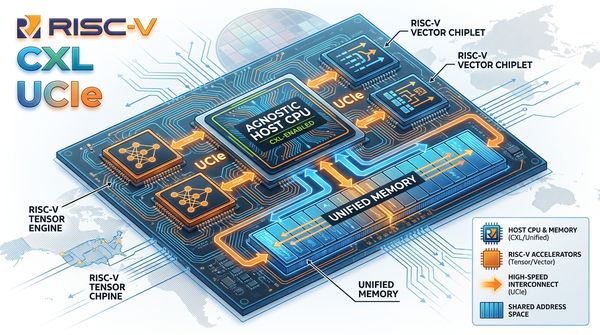
From a systems-design perspective, many-core open architectures offer distinct hardware-level customisation compared to locked proprietary accelerators. This execution flexibility manifests across three architectural realities:
- Vector Extensions : Engineers attach mathematical vector extensions onto small-footprint cores without per-core licensing fees, scaling past 1,000 low-power cores (documented in the Esperanto ET-SoC-1 Architecture).
- Branching Penalties : Proprietary accelerators deliver maximum Single Instruction, Multiple Threads (SIMT) parallelism but impose heavy penalties on complex logical branching.
- Embedded Reliance : Dominant proprietary hardware manufacturers already embed open-source microcontrollers as management engines within modern GPUs, detailed in the Frans Sijstermans Keynote at NVIDIA.
4. Toolchain Friction and the Emulation Wall
Host systems bootstrap the open software ecosystem by decoupling the underlying hardware from the application layer to route inference requests to local vector subsystems. This translation introduces immense compiler toolchain friction, requiring heavy reliance on two intermediate representations:
- MLIR : Operating as a multi-level intermediate representation layer for frameworks like PyTorch .
- LLVM : Serving as the final compiler backend for the RISC-V array.
Writing code for high-core-count open hardware eliminates traditional automated abstraction, substituting implicit thread scheduling with manual precision. Open hardware frameworks mandate exact control over two physical operations:
- Coordinate Targeting : Compilers must explicitly target literal physical coordinates on the silicon array.
- Buffer Management : Engineers manually orchestrate local SRAM buffer movements (a high-precision approach validated in Accelerating stencils on the Tenstorrent Grayskull RISC-V accelerator ).
The emulation wall currently blocks a mass-market transition. Lacking an optimised hardware-assisted translation layer (akin to Rosetta 2 ), executing legacy workflows on open architecture faces two severe bottlenecks:
- Translation Overhead : Software-based Binary Translation (BT) for x86/ARM binaries creates latency that is unviable in High-Performance Computing (HPC) environments.
- Vendor Fragmentation : Preventing a fractured vendor fork landscape demands strict alignment with ratified instruction standards (e.g., the RVA23 Profile) to secure unified upstream driver support.
Conclusion & Strategic Advice
Integrating open ISA chiplets alongside generic, CXL-enabled host processors provides a structural mechanism to bypass established software monopolies. Combining mature, agnostic host ecosystems with sovereign-controlled, open-core extensions via UCIe yields immediate computational gains.
For strategic stack selection, deploy traditional SIMT-based parallel processors for immediate algorithmic compliance. Concurrently, evaluate CXL and UCIe host platforms to integrate open, many-core spatial accelerators for custom vector operations demanding geopolitical resilience.
Unified-memory coexistence is the definitive blueprint for next-generation sovereign compute. Infrastructure leaders should execute three strategic directives to establish hardware independence:
- Ecosystem Erosion : Integrate open standards methodically to bypass proprietary ecosystems.
- Topology Preparation : Evaluate internal computing architectures immediately to prepare for hybrid, unified-memory layouts.
- Compiler Adaptation : Shift compiler targets now to bridge the hardware divide and accommodate exact physical-coordinate mapping.
Securing hardware independence means methodically eroding proprietary ecosystems and preparing for hybrid layouts today. 💬 How will your infrastructure strategy adapt to the open compute revolution? Drop your thoughts below and ♻️ share this post with your network!
Further Reading
- RISC-V for HPC: Where we are and where we need to go
- Performance characterisation of the 64-core SG2042 RISC-V CPU for HPC
- Enabling an OpenStack-based cloud on top of RISC-V hardware
More From Me
Original Article: Read on LinkedIn | Read on Substack