Optimizely Campaign: Omnichannel Automation and Transactional Pipelines
Introduction
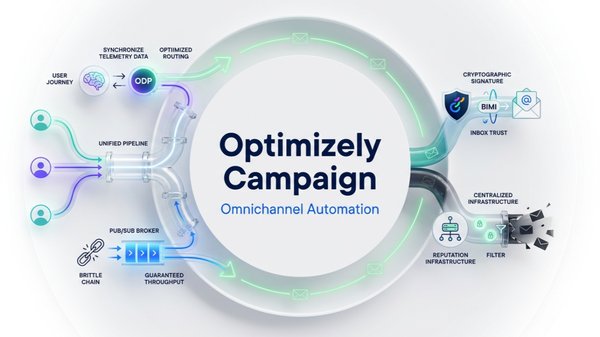
Enterprise digital stacks currently execute order confirmations through legacy SMTP relays while complex marketing journeys run in disconnected SaaS silos. This architectural split harms brand positioning, skews customer data, and cannibalises overarching marketing ROI .
When transactional and promotional pipelines lack a shared recipient schema, preference state drifts. The structural misalignment introduces two major operational risks:
- Preference Drift : Running isolated pipelines guarantees consent desynchronisation across the user base.
- Reputation Contamination : Uncoordinated IP pools place critical communications, including two-factor authentication tokens, at the mercy of domain reputation damage caused by high-volume marketing blasts.
Optimizely Campaign helps you resolve this bottleneck by consolidating transactional operations and multi-channel lifecycle automation into a single client container. The architecture achieves resilient infrastructure through two specific execution mechanisms:
- Decoupled Execution : Platform events operate independently of core web request threads.
- Guaranteed Throughput : The system orchestrates heavy operational loads without bottlenecking core web performance or risking silent data loss.
This framework shows how to integrate siloed pipelines into an event-driven Optimizely Campaign product overview ecosystem. We detail how to orchestrate scalable transactional REST triggers alongside sophisticated Smart Campaign workflows via two primary objectives:
- Delivery Assurance : Executing guaranteed, high-throughput delivery across every customer touchpoint.
- Topology Standardisation : Migrating disparate event paths into a unified, algorithmic routing core.
Core Architecture of Optimizely Campaign
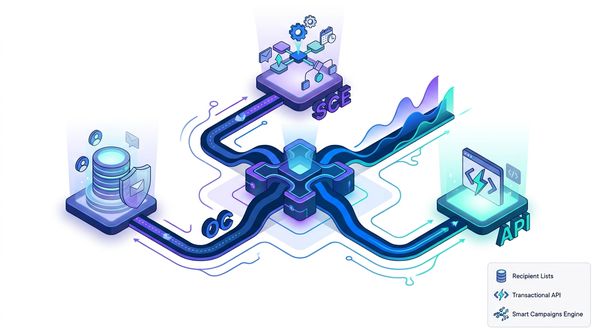
At the foundation of this unified approach is the client, designated as a "mandator" within the API . This isolated tenant environment securely hosts three operational components:
- Tenant Isolation : The client operates as a secure container for recipient lists, templates, and execution logic.
- Schema Management : Recipient lists function as tabular schemas managing contact attributes and subscription states.
- Transactional Routing : Developers must configure a specialised list explicitly marked with the Transaction API property, as detailed in the Clients documentation .
Transactional Messaging vs Smart Campaign Automation
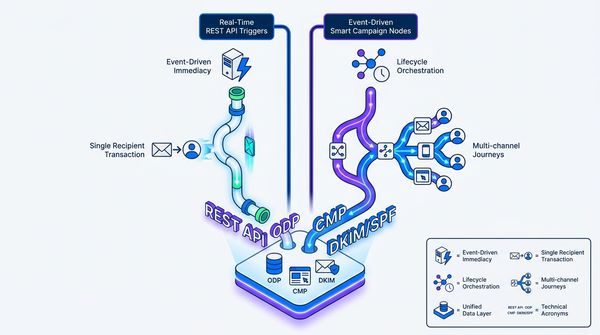
Allocating workloads to specific delivery paths prevents architectural strain. The platform executes payloads via two distinct routing mechanisms while maintaining a unified data layer:
- Event-Driven Immediacy : Built for single-recipient transactions, handling password resets and order confirmations. This relies on an HTTP form operation or the REST endpoint sendTransactionEmail to trigger near-real-time dispatch following the Send a transactional mail specification.
- Lifecycle Orchestration : Smart Campaign automation manages multi-channel journeys through automated branching and precise time delays.
- Consent Synchronisation : Both channels query the same client and consent database outlined in the REST API overview .
Decoupling Optimizely Campaign with Event-Driven CMS Integration
For enterprise C# implementations bridging Optimizely CMS & Commerce to Campaign, executing asynchronous REST API invocations directly from CMS event handlers introduces a severe distributed systems anti-pattern . When service interruptions occur, in-memory retry mechanisms like Polly circuit breakers within a web application pool fail to prevent silent data loss during app pool recycles.
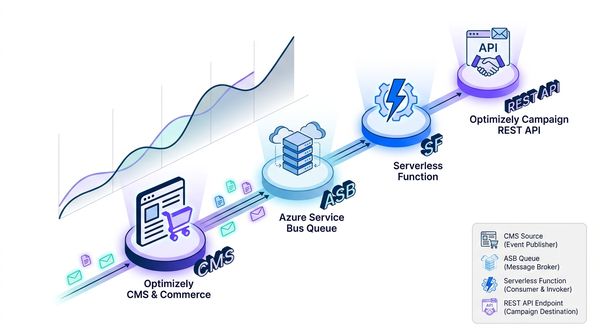
High-throughput transactional messaging requires a durable message broker . Enterprise architecture enforces resilience through three primary integration steps:
- Durable Storage : The Outbox Pattern ensures database-level persistence for outbound events.
- Event Streaming : The CMS publishes messaging events to a queue using a Pub/Sub model via Azure Service Bus , AWS SQS , RabbitMQ , or Apache Kafka .
- Serverless Execution : A decoupled background service or serverless function consumes events and handles the REST invocation for sending transactional emails .
This architecture manages backpressure and survives external outages without compromising web application threads. (Caveat: The base URL remains https://api.campaign.episerver.net/ in current developer documentation despite modern Optimizely branding).
While Optimizely Campaign processes Velocity expressions for dynamic content via Field functions / Velocity , cutting-edge architectures isolate logic errors outside the email rendering engine. Backend microservices process complex data payloads through two distinct phases:
- Pre-computation : Services compute payload structures before interacting with the delivery engine.
- Payload Transmission : Services transmit the computed data to the Campaign API as flat JSON objects.
Connecting Optimizely ODP and CMP for AI-Driven Personalisation
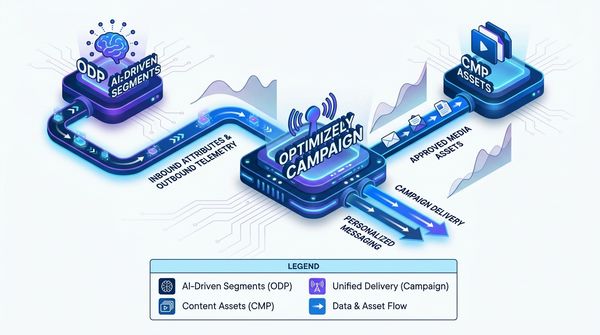
Optimizely Data Platform (ODP) operates as the central customer data hub and algorithmic orchestrator. Data exchange relies on two bidirectional integration flows:
- Inbound Attributes : The platform injects behavioural data directly into Campaign fields.
- Outbound Telemetry : The system transmits webhook events covering bounces, opens, and unsubscribes back to the ODP engine via Optimizely Data Platform Synchronisation .
Modern architectures apply ODP's Machine learning capabilities to drive deterministic routing functions. This operational model yields three structural advantages:
- Send-Time Optimisation : The system processes algorithmic lifecycle journeys based on edge-computed analytics.
- Predictive Channel Routing : The engine governs dynamic pathing using historical conversion baselines.
- Asset Governance : Approved media from the Content Marketing Platform (CMP) injects directly into templates to enforce strict brand consistency.
Deliverability, Privacy, and High-Throughput Infrastructure
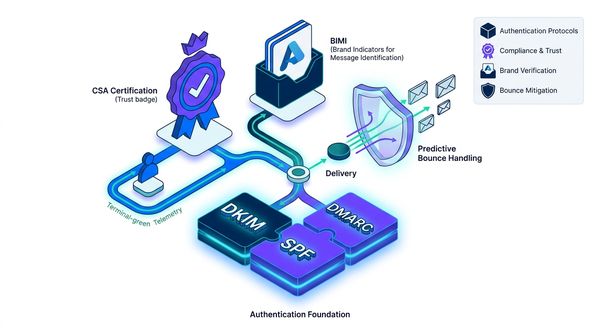
High-volume delivery mandates strict operational hygiene. Optimizely Campaign enforces Certified Senders Alliance (CSA) standards via their CSA guidelines .
Modern enterprise inbox placement requires two advanced infrastructure configurations beyond baseline SPF , DKIM , and DMARC deployment DMARC implementation Email authentication :
- Brand Verification : Senders must deploy BIMI (Brand Indicators for Message Identification) to sign and visually render brand identity within the inbox cryptographically.
- Bounce Mitigation : The system algorithmically suppresses problematic addresses before they trigger cascading damage on overarching IP reputation.
Developer Implementation Checklist & Best Practices
Rigorous staging and resilience testing are essential for a successful production cutover. Architectural teams must validate six deployment prerequisites before routing live traffic:
- Recipient Mapping : Verify and align Transaction API recipient lists.
- Domain Authentication : Implement DKIM/SPF/DMARC as baseline protocols and BIMI for advanced verification on the outbound domain; Domain setup .
- Broker Integration : Connect the CMS to a durable message broker, such as Azure Service Bus , to replace brittle HTTP connections.
- Failure Simulation : Validate dead-letter queues (DLQ) and message replayability to guarantee payload retention during prolonged platform outages.
- Backpressure Management : Test transient fault handling and load distribution thresholds directly at the broker level.
- Webhook Validation : Execute end-to-end webhook tests against a staging client to confirm accurate consent store updates; REST API getting started .
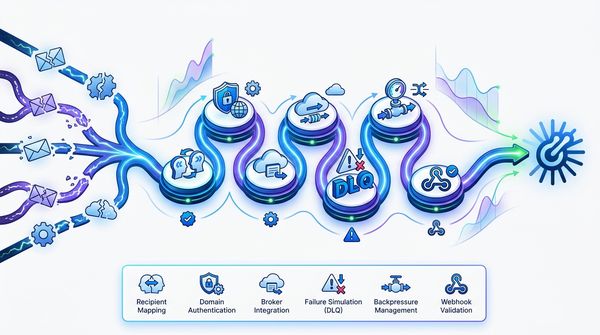
Visual Suggestion : Implementation checklist for developers encompassing DLQ testing and message broker configurations
Conclusion & Strategic Advice
By unifying transactional and promotional pathways, we ensure total data coherence and systemic resilience. Standardising on Optimizely Campaign via an event-driven architecture synchronises ODP predictive intelligence, CMP asset flows, and rigorous deliverability schemas.
The integration topology relies on a two-tier selection matrix for workload distribution:
- High-Velocity Triggers : Deploy a Pub/Sub integration feeding the sendtransactionEmail REST endpoint with pre-computed flat JSON payloads to eliminate rendering latency.
- Nurture & Lifecycle : Execute ODP's predictive analytics and the Smart Campaign orchestrator to process intelligent segments across multi-channel environments without tying up engineering resources.
This decoupled integration eliminates friction between infrastructure resilience and operational agility. This mechanism shares preference states across all boundaries and ensures message delivery, setting a strong standard for modern enterprise communication architectures.
Engineering teams must execute three architectural upgrades to secure these capabilities:
- Audit Gateways : Evaluate legacy SMTP relays for structural bottlenecks.
- Modernise Routing : Upgrade point-to-point integrations to durable message queues.
- Standardise Topology : Consolidate disparate messaging pipelines onto a unified data model.
💬 How is your engineering team balancing infrastructure resilience with operational marketing agility? Share your insights below and ♻️ repost to discuss with your network!
Further Reading
- An Optimistic-Robust Approach for Dynamic Positioning of Omnichannel Inventories (arXiv)
- Boosting Retailer Revenue by Generated Optimized Combined Multiple Digital Marketing Campaigns (arXiv)
- How to Set Up SPF, DKIM, and DMARC for Enterprise Email Deliverability (Community Guide)
More From Me
- Understanding Optimizely: Content Marketing Platform (CMP)
- Navigating Optimizely: ODP Modern Customer Data Platform 🌐
- Optimizely Forms: Custom Actors & Event Pipelines
- Generating Optimised Navigating Optimizely: Product Suite Guide🌟
- Navigating Optimizely: A DXP for Every Digital Leader 🌍
- #Optimizely #EnterpriseArchitecture #EmailDeliverability #MarTech #Omnichannel
Original Article: Read on LinkedIn | Read on Substack