Agentic CMS: Optimizely's Roadmap Signals for 2026–27
Agentic CMS: Optimizely's Roadmap Signals for 2026–27
Introduction
Enterprise content orchestration is rapidly shifting toward autonomous operations, building on the hybrid intelligence foundations explored in Optimizely Opal: Architecting Hybrid Intelligence .
However, as teams prepare for Optimizely's upcoming Agentic CMS roadmap, a definitive structural truth emerges: complete automation is not achievable. Technology scales operational speed, but human oversight and strategic intuition remain the irreplaceable core of the customer experience.
Digital architects must pivot from traditional interface design to strict governance engineering, anchoring human control within scaling pipelines:
- Market Acceleration: Rapid enterprise adoption is clear, with Optimizely's AI Agent Orchestration platform demonstrating 42% quarter-over-quarter ARR growth.
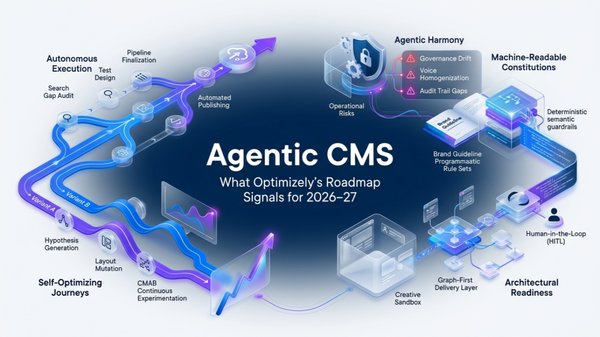
- Autonomous Execution: Incoming architectures monitor performance, design tests, and run publishing cycles—yet these must be treated as drafts or engine variants requiring human validation.
- Architectural Readiness: Evaluating these roadmap signals allows teams to build deterministic guardrails today, protecting the brand voice from unconstrained automation.
The Shift from Assisted to Autonomous
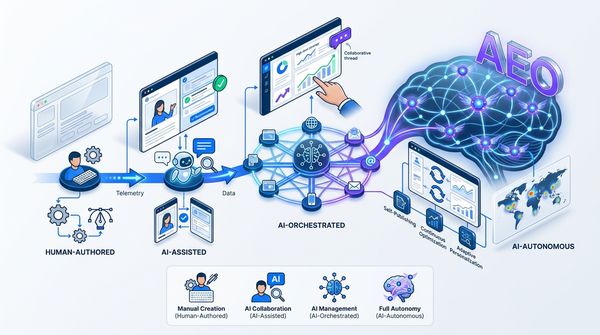
The AI integration curve in content management advances through three distinct operational phases:
- AI-Assisted (2022–2024) : Early iterations provided draft recommendations under direct human supervision.
- AI-Orchestrated (2024–2026) : Current systems execute multi-step processes utilising Human-in-the-Loop (HITL) queues.
- AI-Autonomous (2026–2027) : Our roadmap includes systems that complete entire publishing pipelines, including search-gap audits and compliance validations, without human intervention.
What Optimizely Means by "Agentic CMS"
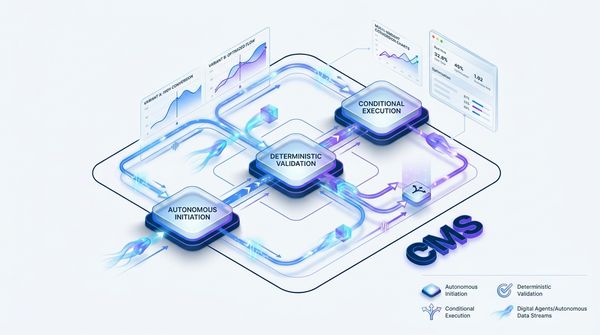
An Agentic CMS rearchitects digital agents as proactive operators that continuously monitor content freshness and statistical performance. Executing this state requires three specific architectural components:
- Autonomous Initiation : Upon detecting stale or underperforming content, the engine initiates a refresh workflow and drafts updates independent of user input.
- Deterministic Validation : The system evaluates the probabilistic output against a machine-readable brand constitution.
- Conditional Execution : Depending on established constraints, the pipeline publishes the content directly or routes it to a task queue
It is critical to separate these projected 2026–2027 roadmap capabilities from currently deployed features.
The Myth of Complete Automation: Why the Human Element Dominates
The promise of a touchless, fully autonomous enterprise publishing pipeline is an operational fallacy. While generative models process structural data and run multi-variant statistical matrices at machine speed, they lack human context, ethical grounding, and qualitative taste.
Falling into the illusion of absolute automation triggers The AI Cost-Cutting Trap: Why "Same But Cheaper" is a $1 Trillion Fallacy , where systems replace human expertise at the expense of strategic value. As highlighted in The Accountability Gap: Why Human Oversight Is a Business Imperative , delegating unvalidated execution to non-deterministic loops introduces severe architectural risks:
- The Context Gap: Proactive agents rely on historical token probabilities; they cannot synthesise real-world cultural shifts, emerging nuances, or immediate macroeconomic changes [ The Context Gap: AI Code Generation Still Demands Humans ].
- The Brand Atrophy Paradox: Without a human circuit breaker, closed feedback loops trigger generative regression. Continuous machine-to-machine iteration dilutes creative distinctiveness into algorithmic mediocrity [ AI Impacts: Preserving Skill in the Age of AI ].
- Accountability Realities: Systems execute workflows but cannot own the legal, compliance, or reputational consequences of a systemic failure. The ultimate guardrail for brand integrity remains the human supervisor.
Agentic Experimentation: Self-Optimising Digital Experiences
Agentic Experimentation engines independently hypothesise and execute continuous optimisation tests across digital touchpoints. This autonomous testing framework operates on three primary mechanisms:
- Dynamic Synthesis : The system identifies underperforming conversion journeys and generates multi-modal content variants and layout mutations for Contextual Multi-Armed Bandit (CMAB) experiments using the React SDK v4.
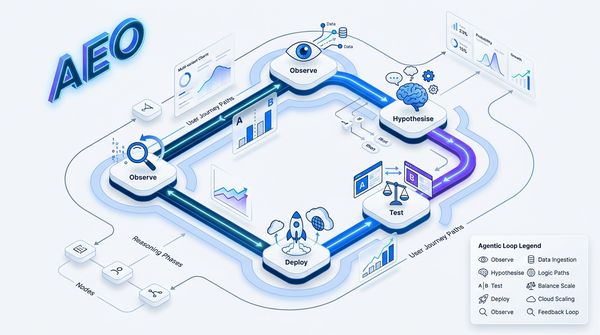
- Lifecycle Management : The platform tracks statistical significance and feeds successful variants directly back into the delivery graph.
- Embedded Governance : Systems that optimise for narrow performance metrics require strict, machine-readable governance embedded directly into the experiment-generation layer to prevent brand-inconsistent outputs.
The Three Risks to Plan For
Deploying autonomous infrastructure without structural guardrails exposes organisations to three critical operational vulnerabilities:
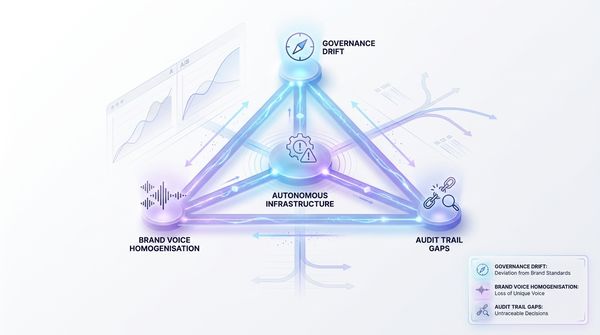
- Governance Drift : AI models deviate from base brand standards over successive generative cycles.
- Brand Voice Homogenisation : Models train iteratively on aggregated outputs, removing creative distinctiveness from the content pool.
- Audit Trail Gaps : Autonomous execution disrupts traditional publishing logs, requiring heavily regulated industries to construct machine-auditable synthetic audit trails that log agent decisions.
Mitigating the homogenisation risk requires technical infrastructure that strictly isolates ideation from deployment:
- Creative Sandboxes : Architects must build isolated environments utilised exclusively during offline training, fine-tuning , or generative drafting phases.
- Deterministic Gates : Any content generated within these sandboxes must undergo rigorous governance validation before entering the live autonomous publishing pipeline.
What to Build Now to Be Ready
To secure operational control over autonomous pipelines, architects should prioritise specific governance infrastructure builds today. Executing this transition demands four immediate engineering implementations:
- Machine-Readable Constitutions : Engineering teams must translate static brand guidelines into programmatic rule sets.
- Semantic Guardrails : Using static structured formats like YAML to constrain non-deterministic models creates architectural vulnerabilities, forcing teams to implement deterministic validations (such as LLM -in-the-middle verification or semantic routing) to parse the constitution against probabilistic outputs before execution.
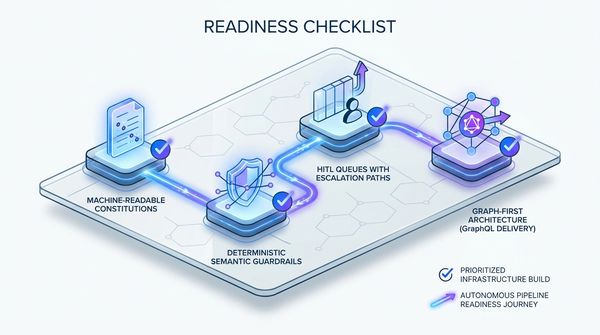
- Graph-First Architecture : Delivery layers operating on GraphQL-native structures ensure clean read and write operations.
- Operational Maturity Baselines : Establishing precise HITL queues with defined escalation paths and recording baseline traffic metrics for AI crawler behaviour help secure the environment before full automation is activated.
Where Optimizely's Agentic Vision Fits the Broader Market
Optimizely's strategy sits within a wider enterprise tier rapidly advancing toward autonomous closed-loop cycles across three primary competitors:
- Adobe Experience Manager (AEM) : Deploys autonomous journey orchestration engines via Adobe Journey Optimiser alongside Adobe Firefly for generative visual assets.
- Contentful : Builds automated composable workflows extending its headless API delivery into programmatic generation.
- Sitecore : Embeds Stream AI agents directly into complex editorial workflows.
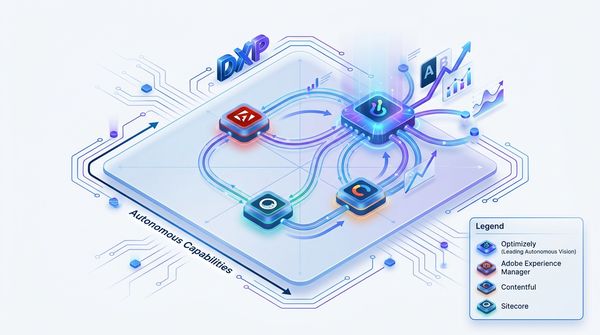
Optimizely's competitive edge is bringing content generation, automated experimentation, and search visibility together in a single, closed-loop, autonomous cycle.
Conclusion & Strategic Advice
Transitioning to an Agentic CMS demands a complete overhaul of your digital architecture. The engineering focus shifts entirely from designing static interfaces to building rigid governance guardrails for autonomous operators.
This evolution is not about removing people; it is about automating the analytical heavy lifting so human creativity can scale safely ( Your Career Runway Just Got Longer) .
Mastering this operational era requires four foundational infrastructure elements:
- The Content Model: Structuring semantic data for explicit, human-guided retrieval.
- The Brand Constitution: Enforcing programmatic rules with deterministic validation layers to prevent machine drift.
- Escalation Paths: Defining clear Human-in-the-Loop (HITL) routing for absolute edge-case resolution.
- Audit Infrastructure: Logging synthetic agent decisions for continuous compliance tracking and human review.
Deploying these guardrails ensures that automated engines serve the strategic vision of human creators rather than generating statistically plausible but brand-diluted digital experiences.
(Coming Soon) To encode these operational rules within your infrastructure, proceed to Governing Autonomous AI Agents in a CMS: The Brand Constitution as Machine-Readable Law.
💬 Is your underlying architecture ready for autonomous content agents, or is your brand voice at risk of homogenization? Share your insights below and ♻️ repost to alert your network!
Further Reading
- Caging the Agents : A Zero Trust Security Architecture for Autonomous AI in Healthcare.
- Personality-Driven Decision-Making : In LLM-Based Autonomous Agents.
- Distributed Quantum Gaussian Processes : For Multi-Agent Systems.
More From Me
- Optimizely Opal : Implementation Blueprint and Strategic Integration Roadmap.
- Generative Engine Optimisation : Enterprise GEO With Optimizely Opal.
- Optimizely Opal : Connecting to Core Enterprise Infrastructure.
- AI Impacts : The Workload Paradox & Decision Fatigue
Original Article: Read on LinkedIn | Read on Substack