Optimizely Upgrading: Fixing CMS 11 to 12 Code Breaking Changes
Introduction
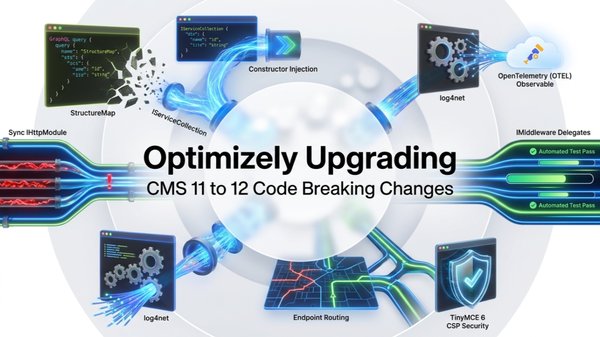
Upgrading from Optimizely CMS 11 to CMS 12 triggers a generational shift from the legacy .NET Framework to .NET 8 LTS . This migration moves us to a new architecture that supports cloud-native containerisation ( Docker / Kubernetes ), headless architecture deployment, and scalable performance.
Automated migration utilities execute basic baseline framework conversions without rewriting deeply integrated business logic.
Resolving these code-breaking changes requires structural intervention across three architectural layers:
- Systemic Refactoring : Remediating runtime failures caused by deleted APIs and the complete absence of synchronous HTTP contexts.
- Core Abstractions : Re-engineering dependency injection , request pipelines, and view rendering configurations.
- Platform Resilience : Mastering these fundamental API shifts establishes a highly observable architecture ready for distributed scaling.
1. Refactoring Dependency Injection
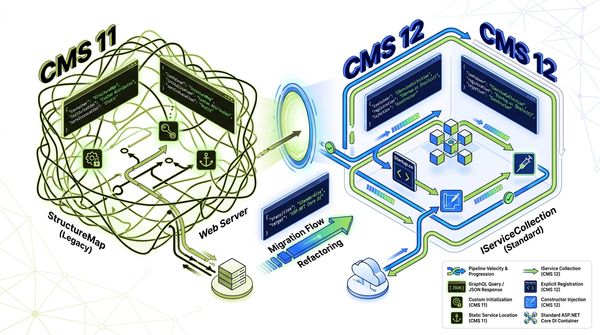
Transitioning away from legacy static locators demands full architectural alignment with native ASP.NET Core inversion of control standards:
- Container Obsolescence : Optimizely permanently deletes proprietary StructureMap container adapters and custom initialisation attributes in CMS 12.
- Registration Mechanics : Centralised registration in Startup.cs via explicit IServiceCollection extension methods overrides legacy service bindings and the static ServiceLocator.Current.GetInstance<T>() anti-pattern .
- Dependency Enforcement : Execute strict constructor injection to eliminate masked coupling and validate dependencies cleanly during containerised startup sequences.
2. Migrating Legacy Logging
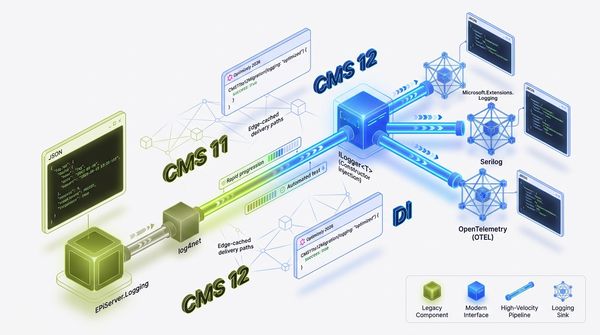
Deleting proprietary abstractions like EPiServer.Logging forces platform telemetry to route directly through standard .NET v interfaces:
- Telemetry Decoupling : Removing tight coupling to log4net requires injecting generic ILogger<T> directly into class constructors instead of requesting static instances via LogManager.GetLogger() .
- Interface Standardisation : Delegating telemetry to Microsoft.Extensions.Logging unlocks integrations with traditional sinks such as Serilog and aligns with the Optimizely Developer Documentation .
- Distributed Observability : Eliminating static logger declarations natively connects the application to OpenTelemetry (OTEL) , enforcing centralised operational oversight across cloud-native deployments.
3. Porting HTTP Modules
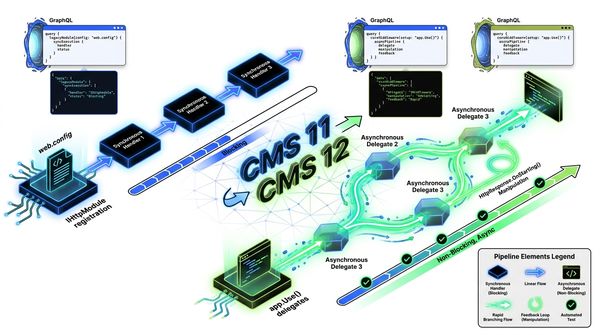
The complete elimination of the HttpApplication lifecycle requires reconstructing request interception logic into native middleware:
- Lifecycle Deletion : Legacy synchronous IHttpModule handlers registered in web.config break entirely under ASP.NET Core architectures.
- Asynchronous Manipulation : Security filters and response headers demand asynchronous manipulation via HttpResponse.OnStarting() within native IMiddleware instances or inline app.Use() delegates.
- Thread Exhaustion Prevention : Developers must eradicate .Result and .Wait() calls when porting legacy modules to enforce async/await up to the data access layer and prevent thread starvation during heavy request loads.
4. Updating Page Route Contexts
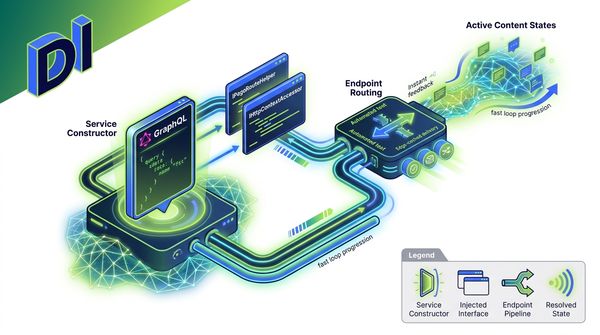
Shifting routing infrastructure requires replacing legacy global route tables with explicit accessor mechanisms:
- Context Nullification : Evaluating PageRouteHelper.Page against HttpContext.Current induces hard crashes because synchronous static resolution fails natively within modern environments.
- Injected Resolution : Decoupled Endpoint Routing demands resolution via injected IPageRouteHelper and IHttpContextAccessor interfaces directly within service constructors.
- State Identification : Bypassing static accessors guarantees custom endpoints safely and accurately identify active content states across request pipelines.
5. Fixing HtmlHelper Extensions
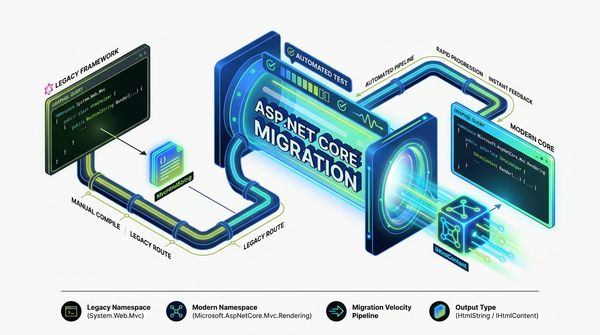
Substituting the legacy rendering namespace requires upgrading custom Razor view extensions to modern core string constructs:
- Namespace Substitution : Upgrading to ASP.NET Core invalidates legacy System.Web.Mvc.HtmlHelper signatures that generated standard MvcHtmlString outputs.
- Compliant Rendering : Modern architectures enforce Microsoft.AspNetCore.Mvc.Rendering.IHtmlHelper interfaces to generate robust IHtmlContent blocks.
- Encoding Corruption : Failing to transition namespace imports will halt builds or trigger unhandled HTML entity encoding failures across frontend interface boundaries.
6. Rewiring TinyMCE Configurations
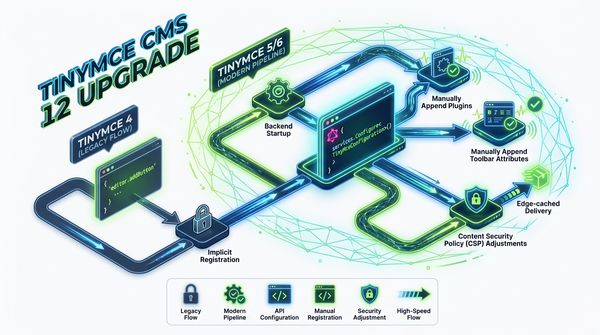
Executing a dual-version leap from TinyMCE 4 to TinyMCE 6 invalidates older editor.addButton APIs and requires explicit registry rewiring:
- Registry Syntax Shifts : Legacy automatic shortcut resolution syntax fails silently against modern TinyMCE 6 UI registry mechanics.
- Backend Bootstrapping : Editors demand explicit configuration inside the backend startup via services.Configure< TinyMceConfiguration >() to manually append plugins and toolbar attributes.
- Security Policy Constraints : Integrating new UI syntax demands strict Content Security Policy (CSP) header adjustments within ASP.NET Core middleware to authorise inline scripts and external assets.
7. Next Steps for Upgrades
Solidifying infrastructure stability demands targeted validation testing and dependency updates following baseline structural remediations:
- Dependency Synchronisation : Third-party database packages, including DbLocalizationProvider, necessitate direct upgrades to their .NET Core equivalents to guarantee continuous data synchronisation.
- Codebase Verification : Running community-driven static analysis utilities such as dxp-cortex detects lingering obsolete methods before executing full application compilation.
- Staging Isolation : Isolating these refactored pipelines within staging environments verifies that bespoke middleware and asynchronous controllers execute robustly under operational loads.
Conclusion & Strategic Advice
Executing the Optimizely CMS 12 migration dictates directly resolving core architectural breaking changes within custom codebases. Securing absolute operational resilience depends heavily on mitigating defunct dependency injection frameworks, synchronous HTTP modules, and legacy view renderers.
Implement a systematic refactoring strategy via three fundamental shifts:
- Structural Injection : Execute native IServiceCollection integration across all foundational layers.
- Pipeline Interception : Transpile global handlers into asynchronous IMiddleware blocks without invoking blocking threads.
- Content Contexts : Substitute static HTTP accessors with deeply injected IPageRouteHelper configurations.
We methodically eliminate obsolete code paths across all platform tiers to finalise this structural overhaul. By solidifying our testing protocols, we lock in these architectural improvements to protect system integrity across future release cycles.
💬 What breaking change has been your biggest hurdle during .NET 8 migrations? Drop your thoughts below and ♻️ share this guide with your dev network!
Further Reading
Review the following technical documentation to support specific migration workflows:
- Migrate HTTP modules to ASP.NET Core middleware
- Breaking changes in Optimizely CMS 12
- TinyMCE: Migration from 4.x to 6.x
More From Me
Explore additional strategic analyses regarding platform architecture and digital infrastructure:
- Upgrading Optimizely: CMS 11 to 13 Stepwise Guide
- Navigating Optimizely: A DXP for Every Digital Leader
- Future-Proofing Optimizely: Unlocking Optimizely with Frontend Frameworks
- Mastering Optimizely's Headless CMS: Unlocking Optimizely with Frontend Frameworks
- Optimizely Opal: Connecting to Core Enterprise Infrastructure
- Modern Web Architecture: Scalability and Performance, Optimizely Can Help!
- Taming Technical Debt: A Technical Architect's Guide to Website Health
- Beyond Technical Debt: Overcoming The Burden of Legacy Systems
- LLM-Powered DevOps: Code, Security, Performance
- Website Overhaul: When a Rebuild Is Better Than a Refresh
Original Article: Read on LinkedIn | Read on Substack