Microcontroller Threat: $5 Microcontrollers are Reshaping Security
- Part 1 of 6 - Disposable Silicon, 30-Day Power Budgets, and Attritable Edge Reconnaissance
Introduction
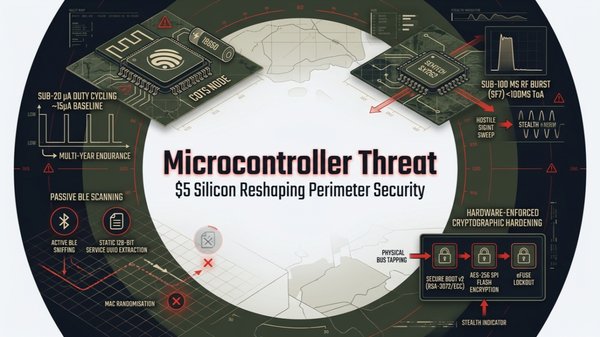
Tactical perimeter reconnaissance is shifting from monolithic, high-cost sensor pods to dense, attritable sensor meshes. Modern commercial System-on-Chips (SoCs) combine vector-accelerated edge inference , multi-protocol radios, and ultra-low-power sleep states at an expendable price point.
Deploying Commercial Off-The-Shelf (COTS) silicon in contested environments introduces distinct engineering trade-offs: consumer hardware lacks native radiation hardening and physical tamper-resistant enclosures. Securing these platforms requires rigorous cryptographic controls and strict electromagnetic discipline.
This technical deep dive evaluates the foundational architecture for building resilient, battery-operated reconnaissance nodes on modern commercial SoCs across four core design vectors:
- Sub-20 µA Duty Cycling : Implementing deep-sleep power states for multi-month field persistence.
- Protocol Fingerprinting : Bypassing mobile MAC address randomisation via persistent BLE service data.
- RF Burst Minimisation : Achieving sub-100 ms telemetry via low Spreading Factor (SF7) parameterisation to balance link margin against SIGINT evasion.
- Silicon Hardening : Enforcing hardware-level root-of-trust cryptographic controls.
The Rise of Attritable COTS Hardware in Defence
Traditional military surveillance relies on specialised sensor suites costing £10,000 to £50,000 per platform, constraining deployment scale and mandating recovery operations. Modern distributed doctrine shifts this operational model toward expendable, high-density sensor networks deployed across contested boundaries.
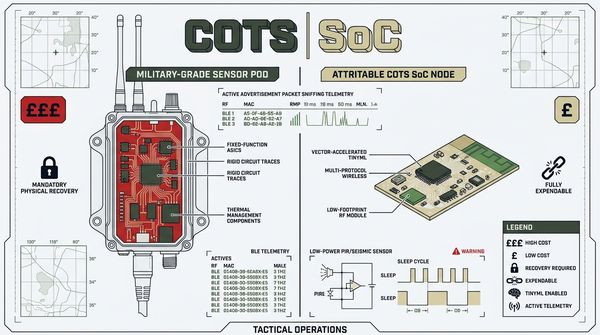
Commodity microcontrollers provide vector-accelerated signal classification and reconfigurable neural network inference directly at the tactical edge at approximately £5 per node across two primary silicon architectures:
- Espressif ESP32-S3 : Dual-core Xtensa LX7 processor featuring 128-bit vector instructions for on-device TinyML acceleration.
- Espressif ESP32-C6 : RISC-V core integrating Wi-Fi 6 , Thread , and Zigbee multi-protocol radios.
Architecture & Sleep Cycles for 30-Day Deployment
Sustaining multi-week field endurance on a standard 2,600 mAh 18650 Li-ion cell precludes continuous radio polling or sustained compute loops. The primary processor remains unpowered during idle states, delegating wake management to the ultra-low-power coprocessor and RTC controller as detailed in the ESP-IDF Sleep Modes Documentation (ESP32-S3) .
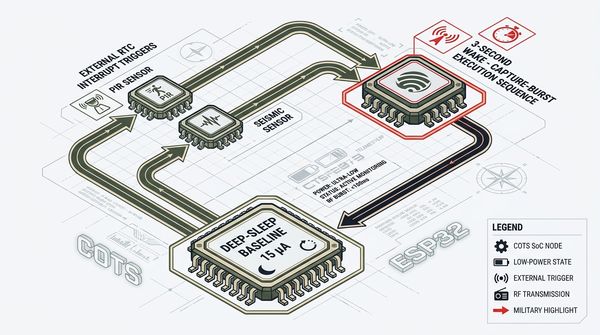
The operational duty cycle functions under four strict power-budget parameters:
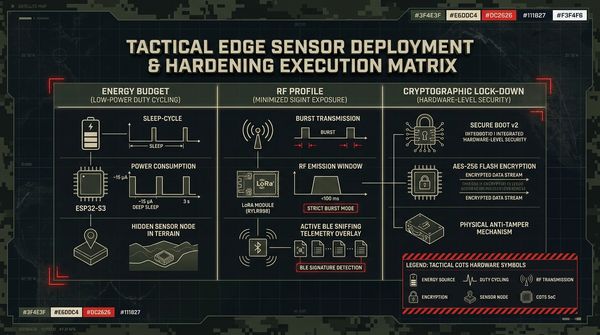
- Deep-Sleep Baseline : The SoC digital cores power down, idling at ~15 µA while maintaining state in RTC memory.
- Asynchronous Interrupts : Low-power Passive Infrared sensors (PIR, ~15 µA) or digital seismic transducers (<5 µA) trigger external RTC GPIO wake-up lines (EXT0/EXT1).
- Execution Budget : Cold-boot completes in ~100 ms, followed by payload capture (e.g., CMOS visual sensors at ~120 mA peak), inference validation, and alert transmission within a strict 3-second operational window.
- Energy Balance : At 10 alerts per day, daily consumption totals ~1.53 mAh, establishing theoretical operational lifespans exceeding 1,000 days, bounded primarily by cell self-discharge.
Bypassing MAC Randomisation via BLE Service Data
Modern mobile operating systems (iOS 14+, Android 10+) enforce periodic MAC address randomisation across Wi-Fi probe requests and Bluetooth Low Energy (BLE) advertisement frames, eliminating traditional Layer-2 hardware address tracking.
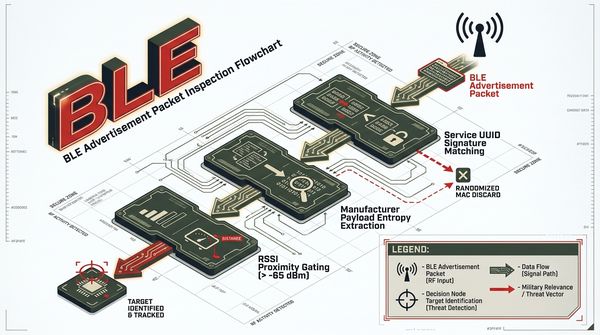
COTS reconnaissance nodes overcome this countermeasure by executing deep packet inspection across three non-randomised advertising vectors:
- Service UUID Fingerprinting : Background application daemons broadcast static 128-bit Service UUIDs and 16-bit Service Data headers that persist across MAC rotation cycles.
- Manufacturer Payload Extraction : Proprietary subsystem payloads (including Apple Continuity and Google Nearby frameworks) exhibit deterministic structural entropy patterns that can be extracted via passive asynchronous scanning within the native ESP-IDF NimBLE stack.
- RSSI Threshold Gating : Enforcing a strict Received Signal Strength Indicator (RSSI) gate (typically > -65 dBm) filters out distant emitters, reserving wake-up and processing cycles for confirmed close-proximity contacts.
Long-Range Telemetry: Reyax LoRa Modules & RF Burst Minimisation
When line-of-sight constraints restrict 2.4 GHz ESP-NOW links, sub-gigahertz LoRa transceivers (such as the Semtech SX1262-based Reyax RYLR998) provide long-range telemetry. Uncontrolled transmissions create active targets for hostile Signals Intelligence ( SIGINT ) and direction-finding systems.
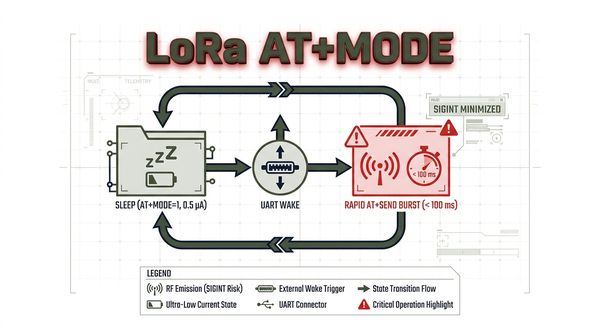
Maintaining a low probability of intercept requires four operational controls:
- Low-Power Idle : The Reyax module remains pinned in Sleep Mode (AT+MODE=1), disabling the internal RF power amplifier and drawing 0.5–10 µA.
- Triggered Burst Sequence : On alert trigger, the host MCU asserts the UART interface, transmits a single frame via AT+SEND=<Address>,<Length>,<Data>, and immediately returns the module to AT+MODE=1.
- Signature Minimisation : Total RF time-on-air remains under 100 ms to disrupt hostile pseudo-Doppler triangulation and electronic support measures (ESM) sweeps. Default SF9 configurations on the Reyax RYLR998 must be reprogrammed via AT commands (AT+PARAMETER) to lower Spreading Factors (e.g., SF7) to satisfy time-on-air thresholds.
- Bus Architecture Selection : While UART-controlled modules accelerate prototyping, high-security production nodes require driving the Semtech SX1262 transceiver directly over SPI to remove UART polling overhead during the wake phase.
Hardening Commercial Silicon for Tactical Perimeter Security
COTS nodes deployed in forward positions face capture and physical reverse engineering. Because commercial microcontrollers lack hardware-hardened tamper enclosures, silicon-level cryptographic locks are mandatory to secure onboard firmware and key stores.
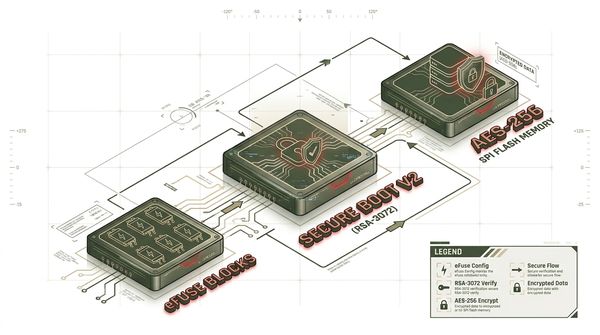
Securing commercial microcontrollers relies on three hardware-enforced primitives:
- Secure Boot v2 : Enforces an asymmetric cryptographic root of trust ( RSA-3072 / ECC ) anchored in write-protected eFuses , verifying firmware authenticity before execution per the ESP-IDF Secure Boot v2 Security Guide .
- Transparent AES-256 Flash Encryption : Encrypts external SPI flash memory using address-tweaked XOR scrambling, neutralising flash extraction and physical bus tapping per the ESP-IDF Flash Encryption Security Guide .
- Silicon Lockout : Permanently revokes JTAG probe access, ROM download utilities, and UART bootloader routines via permanent eFuse physical burns before field deployment.
Conclusion & Strategic Advice
Deploying low-cost, attritable sensor nodes requires balancing commercial silicon performance against physical and spectral attack vectors. Commercial microcontrollers lack native radiation tolerance and mechanical tamper shielding, yet enforcing hardware-based AES-256 flash encryption, Secure Boot v2, strict RTC duty cycling, and sub-100 ms RF burst profiles delivers robust perimeter reconnaissance networks at a fraction of bespoke defence hardware costs.
For operational architectures requiring long-range asymmetric capabilities, these building blocks establish persistent, unnoticeable ground awareness. The next phase in this series expands these principles into distributed mesh operations in Microcontroller Threat: Asymmetric Warfare with Cheap Silicon .
💬 As expendable commercial silicon disrupts traditional defence hardware economics, how will attritable edge sensing redefine modern tactical intelligence? Share your perspectives below and ♻️ repost to spread the insights across your network!
Further Reading
- Espressif ESP-NN: Vector-Accelerated Neural Network Library
- Semtech SX1261/SX1262 Long Range Sub-GHz Transceiver Specifications
More From Me
Original Article: Read on LinkedIn | Read on Substack