Mixture of Experts: Air-Gaps, Dual-Use, and Sovereign AI
Introduction
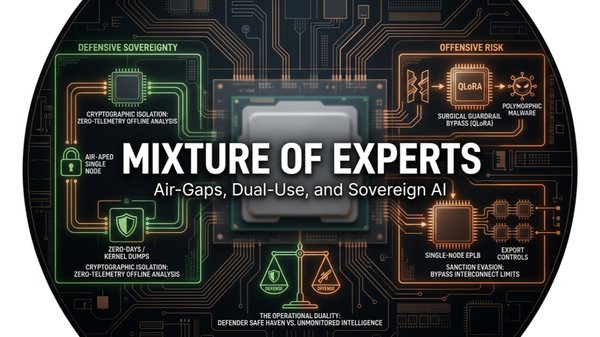
Building on the memory and routing optimisations established in Mixture of Experts: The All-to-All Bottleneck , moving sparse Mixture of Experts (MoE) execution from centralised cloud datacenters onto localised hardware constitutes a definitive geopolitical shift. The operational deployment of 600B+ parameter models on specialised nodes—such as 576GB+ Apple Silicon clusters or multi-node Grace Hopper setups—forces a revaluation of standard governance structures through three core mechanisms:
- Hardware Localisation : Moving frontier sparse execution onto localised nodes completely neutralises standard cloud AI governance, active network monitoring, and regulatory containment models.
- Offline Reasoning Execution : Security teams mandate isolated threat environments to counter the dual-use reality of guardrail-free offensive tool generation and chip export control neutralisation.
- Defensive Decentralisation : Practitioners must execute defensive air-gapping , mitigate vulnerabilities from localised quantised fine-tuning, and apply structural pivots to govern sovereign AI workloads.
1. Enterprise Air-Gapping & Zero-Telemetry Threat Analysis
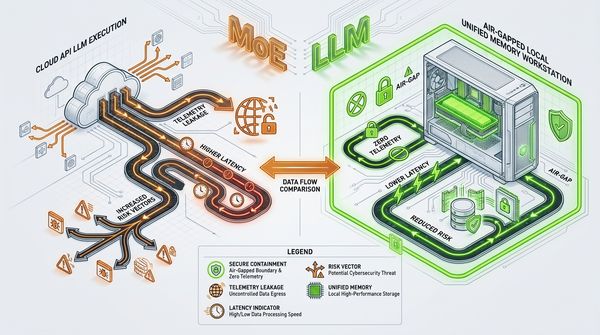
Security operations and threat intelligence teams incur severe privacy and compliance risks when submitting zero-day exploit payloads or proprietary kernel dumps to commercial cloud APIs . This exposure violates data residency frameworks and baseline standards such as the OWASP Top 10 for Large Language Model Applications through three critical failure points:
- Data Sovereignty Mandates : While platforms offer stateless processing (detailed in the Data, privacy, and security for Models sold by Azure documentation), localised deployment provides the sole cryptographic guarantee of isolation.
- Offline Quantisation Architecture : High-bandwidth unified memory architectures (scaling from 384 GB to 512GB+) and 4-bit expert quantisation execute models offline based on architectural insights from the DeepSeek-V3 Technical Report .
- Isolated State Maintenance : Memory-constrained devices dynamically load activated experts into VRAM while holding inactive parameters in NVMe storage, granting teams state-of-the-art code reasoning inside physically isolated networks without external telemetry risks.
2. Dual-Use Risks & Safety Guardrail Bypass Mechanics
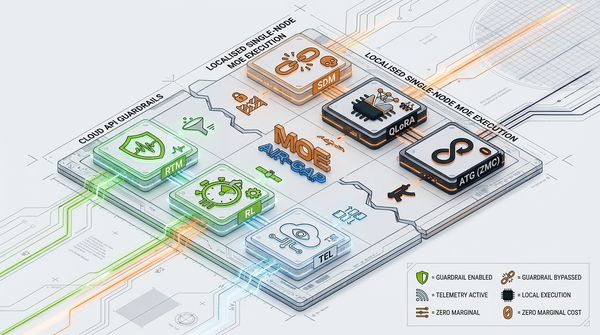
Centralised cloud infrastructure relies on real-time endpoint moderation and runtime RLHF /RLAIF refusal layers for safety governance. Deploying frontier sparse MoEs to single-node endpoints grants direct access to raw model activations, enabling the complete excision of these outer safety wrappers through three distinct bypass vectors:
- Safety Degradation Mechanics : Research in Fine-tuning Aligned Language Models Compromises Safety, Even When Users Do Not Intend To! confirms that fine-tuning aligned models compromises foundational safety systems with minimal data.
- QLoRA Sub-Network Stripping : Threat actors apply Quantised Local Expert Fine-Tuning (QLoRA) to specific expert sub-networks to strip refusal heuristics, validating findings from RASA: Routing-Aware Safety Alignment for Mixture-of-Experts Models .
- Automated Threat Generation : The absence of cloud API rate limits empowers malicious actors to execute continuous agentic loops for vulnerability scanning and polymorphic malware synthesis at zero marginal cost.
3. Geopolitical Policy & Export Control Evasion
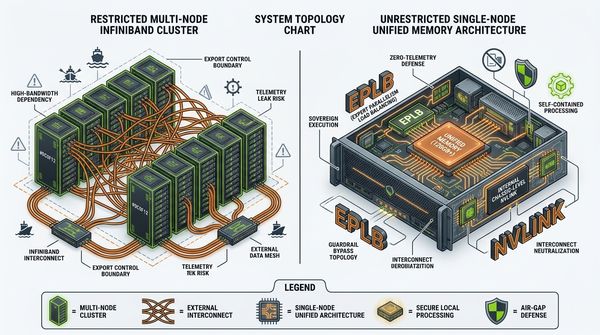
Semiconductor export controls —including U.S. BIS Export Control Rules—historically restrict the high-bandwidth inter-server interconnects (such as InfiniBand or NVLink meshes) required to process massive dense models. The implementation of sparse intelligence density techniques disrupts this multi-node restriction model via three architectural mechanisms:
- Export Control Limitations : Expert Parallelism Load Balancing (EPLB) co-locates massive 600B+ models within a single node's memory space by balancing activated experts instead of raw token counts, as detailed in Efficient MoE Serving in the Memory-Bound Regime: Balance Activated Experts, Not Tokens .
- Static Weight Storage Requirements : Storing the static weights of a 671B model at 4-bit quantisation mathematically requires ~335 GB, mandating advanced chiplet architectures or internal chassis-level NVLink interconnects.
- Fabric Sanction Neutralisation : Consolidating dependencies into single-node systems neutralises historical multi-node hardware interconnect sanctions, permitting embargoed entities to execute frontier-class intelligence on localised server racks.
A critical conflict within current AI scalability research exists regarding memory-bound regimes. Resolving severe load imbalances via dynamic rerouting minimises computational overhead but exacerbates dual-use risk through a specific sequence of factors:
- Hardware Barrier Reduction : Dynamic rerouting lowers the hardware threshold necessary for malicious actors to deploy ungoverned AI agents.
- Load-Balancing Exploitation : The mathematical optimisations designed to route isolated sensitive intelligence effectively dismantle external oversight mechanics.
- Autonomous Operational Capabilities : Operational efficiencies enable threat actors to bypass network-level detection models entirely by executing autonomous threat generation offline.
Conclusion & Strategic Advice
The transition to decentralised, unified memory MoE architectures generates a strict operational duality by furnishing defensive practitioners with zero- telemetry environments while concurrently supplying offensive actors with uncensored, zero-cost intelligence loops. Security architects must navigate this landscape using a binary deployment matrix:
- High-Compliance Environments : Air-gapped local MoE execution establishes mandatory sovereignty over proprietary kernel dumps and exploit research.
- General Enterprise Workflows : Stateless enterprise cloud APIs remain optimal and deliver structural guardrails without the operational overhead of managing local hardware enclaves .
- Architectural Convergence : Enterprises must adopt hybrid operational models to segregate highly sensitive malware analysis from general corporate intelligence workflows.
Final Series Wrap-Up
This series has mapped the technical evolution of Mixture of Experts architectures—from overcoming VRAM bottlenecks to the current reality of localised, sovereign execution where centralised AI monopolies permanently fracture. As computational intelligence becomes a single-node commodity, the global security apparatus must urgently mitigate dual-use risks via a structural transition across three core elements:
- Bandwidth Deprecation : Security frameworks must completely transition away from restricting inter-server bandwidth.
- Hardware-Level Provenance : Governing bodies must enforce hardware-level physical provenance tracking at the silicon layer.
- Enclave Implementation : Single-node execution mandates the integration of Trusted Platform Module (TPM) enclaves to establish immutable root-of-trust protocols on local hardware.
💬 Will hardware-level physical provenance be enough to secure this new frontier, or is the dual-use genie permanently out of the bottle? Drop your thoughts below and ♻️ share this post with your network!
Further Reading
- DeepSeek-V3 Technical Report
- Fine-tuning Aligned Language Models Compromises Safety
- OWASP Top 10 for Large Language Model Applications
More From Me
Original Article: Read on LinkedIn | Read on Substack