Microcontroller Threat: Conscripting the Consumer IoT Long Tail
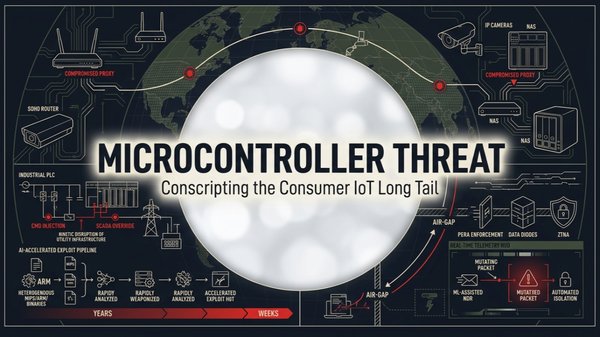
- Part 6 of 6 - SOHO Gateways, SCADA Sabotage, and AI-Accelerated Vulnerability Discovery
Introduction
Following the swarm dynamics detailed in Microcontroller Threat: Orchestrating Autonomous Swarms, offensive tradecraft has moved from hardened corporate perimeters to the consumer edge. The global base of active edge and Internet of Things (IoT) hardware now exceeds 21 billion units. These devices create an expansive attack surface defined by long-standing security debt, absent cryptographic controls, and zero endpoint telemetry.
Operational threat models split this compromised footprint into two core groups:
- The Weaponised Proxy: Consumer IoT hardware and residential gateways conscripted into resilient, multi-hop relay networks.
- The Kinetic Target: Mission-critical, unpatchable operational technology (OT) cores that adversaries reach through civilian infrastructure.
This article assesses edge conscription mechanisms, the collapse of vulnerability discovery timelines, and practical mitigation controls required at operational boundaries.
Prerequisites & Caveats: Incident data and telemetry metrics reflect open-source threat reporting and intelligence estimates; figures illustrate macro attack surface scale rather than an audited census. Analysis is framed strictly for defensive threat modelling and infrastructure resilience.
1. The Inevitability of Consuming the Long Tail
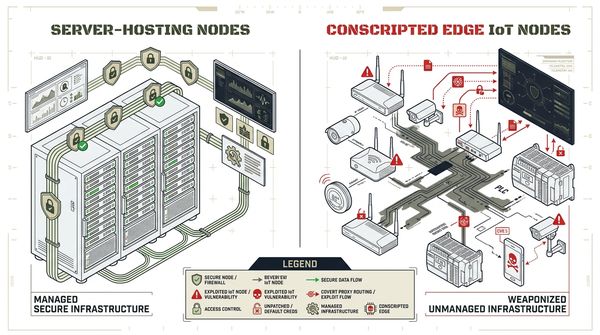
The structural asymmetry of the threat environment stems from edge economics. Enterprise cores maintain Endpoint Detection and Response (EDR), behavioural telemetry, and automated patching pipelines. In contrast, consumer edge devices operate on bare-metal firmware with multi-decade operational lifecycles, no host-level introspection, and negligible vendor patch support.
Empirical threat telemetry indicates persistent baseline exposure across edge assets:
- Unpatched Firmware Baseline: Approximately 70% of active edge devices run unpatched firmware throughout their operational lifecycles.
- Default Authentication Exposure: Approximately 35% of active units retain factory-default credentials.
- Distributed Attack Platforms: As shown in Turning Internet of Things (IoT) into Internet of Vulnerabilities (IoV): IoT Botnets, consumer architectures provide scalable infrastructure where sheer volume, geographic dispersion, and residential ISP placement offset low per-device compute power.
2. Category 1: Hijacking Consumer SOHO Routers & Cameras
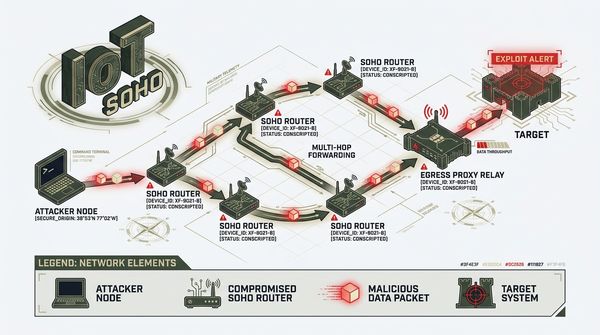
Small-office/home-office (SOHO) routers, digital video recorders (DVRs), and network-attached storage (NAS) units account for over 75% of recorded IoT intrusions. Threat actors repurpose these edge gateways into living-off-the-land proxy networks across four primary operational vectors:
- Mass-Scale Relay Clusters: The Aisuru and Kimwolf botnets co-opted over three million edge routing and surveillance systems to provide distributed egress relays. Concurrently, BadBox ecosystems compromised more than ten million Android-based devices via upstream supply-chain hardware injection.
- Volt Typhoon & KV Botnet: Operators leveraged end-of-life Cisco, Netgear, and DrayTek routers across North America, routing stealth operational traffic directly through residential subnets (CISA/FBI/NSA Advisory AA24-038A).
- Flax Typhoon & Raptor Train: Threat groups deployed the memory-resident "Nosedive" payload across 200,000 cameras and NAS units (CISA Advisory AA24-242A).
- Signature Neutralisation: Modern campaigns cycle benign residential IP addresses continuously. As demonstrated in The End of the Canonical IoT Botnet: A Measurement Study of Mirai's Descendants, dynamic rotation renders static IP reputation lists obsolete.
3. Category 2: Compromising Water-Facility PLCs
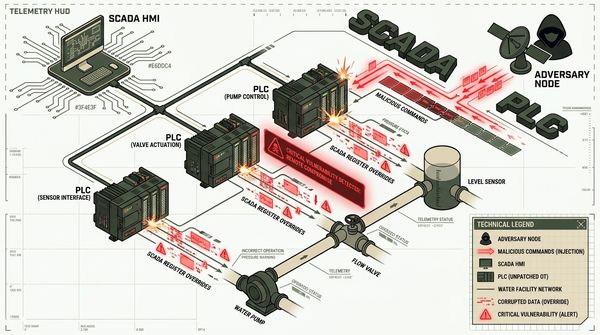
Adversary objectives have extended from passive traffic obfuscation to kinetic OT disruption. Threat groups, such as CyberAv3ngers, target municipal utilities across three operational dimensions:
- Target Hardware & Vector: Internet-exposed Rockwell/Allen-Bradley MicroLogix 1100/1400 and Unitronics Vision controllers exploited via CVE-2021-22681 (CVSS 9.8), an architectural protocol vulnerability in Logix communications lacking cryptographic authentication (CISA Advisory AA23-335A).
- Control Manipulation: Intruders modify administrative credentials, alter ladder logic to disable safety interlocks, and write false sensor values to Supervisory Control and Data Acquisition (SCADA) display registers to mask operational degradation.
- The Unpatchable Reality: Because legacy firmware and hardware architectures cannot accommodate retroactive cryptographic patches, complete logical and hardware-enforced network segmentation remains the primary viable countermeasure.
4. Category 3: Automated Target Scanning & AI Triage
The barrier to discovering and exploiting heterogeneous edge architectures has lowered significantly:
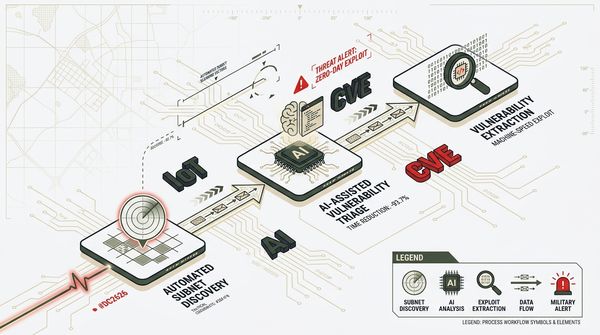
- Compressed Exploit Timelines: Mean time-to-exploit (MTTE) for published edge vulnerabilities dropped from over 700 days in 2020 to approximately 44 days by 2025.
- Automated Binary Triage: Specialised reasoning models and automated decompilation pipelines parse heterogeneous MIPS, ARM, and PowerPC binaries, isolating candidate zero-days in minutes.
- Dynamic Evasion: Research on Adversarial Explainability: Utilising Explainable Machine Learning to Bypass IoT Botnet Detection Systems demonstrates that automated agents alter packet headers and timing signatures dynamically to bypass legacy anomaly classifiers.
Defensive architectures must shift toward automated telemetry across three core areas:
- Autonomous Defence Pipelines: Real-time response tools operating at machine speed to intercept automated reconnaissance scripts.
- Behavioural Baselining: Continuous traffic profiling of edge communications and outbound telemetry flows.
- Dynamic Micro-Segmentation: Automated micro-segmentation protocols enforcing rapid isolation upon baseline divergence.
5. Strategic Takeaway for Infrastructure Mitigation
Regulatory mandates, including the EU Cyber Resilience Act (Regulation EU 2024/2847) and the US FCC Cyber Trust Mark (NIST IR 8425), establish baseline manufacturing standards. Defending operational systems against automated, AI-accelerated threats requires four core architectural adjustments:
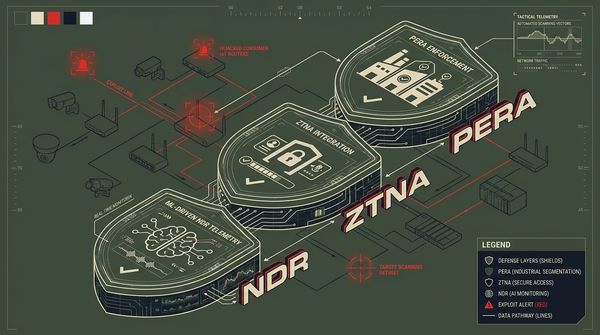
- Enforce PERA and ZTNA Boundaries: Complete OT air-gapping is rarely possible in facilities that rely on Industrial IoT (IIoT) for telemetry and maintenance. Implement the Purdue Enterprise Reference Architecture (PERA) using hardware-enforced unidirectional gateways (Data Diodes) and OT-specific Zero Trust Network Access (ZTNA) to enforce deterministic, cryptographically validated data flows.
- AI-Driven Network Detection & Response (NDR): Static egress filtering and legacy NetFlow analysis struggle against mutating packet headers. Deploy behavioural anomaly detection and ML-based classification to identify low-frequency command-and-control (C2) beacons routed through residential IP pools.
- Dynamic Micro-Segmentation: Confine SOHO, smart-office, and surveillance hardware to dedicated network segments that automatically quarantine nodes displaying abnormal traffic patterns.
- Credential Auditing & Decommissioning: Eliminate factory-default credentials and systematically retire legacy appliances that cannot support modern cryptographic ciphers.
Conclusion & Strategic Advice
Low-cost, unmanaged edge hardware represents persistent tactical infrastructure for adversaries. The consumer IoT footprint is routinely conscripted into deniable proxy fabrics to reach vulnerable OT targets.
Adversary campaigns exploit three recurring vulnerabilities:
- Silicon-Level Weaknesses: Exploitation of hardware-level memory corruption and unpatchable firmware.
- Autonomous Adversarial Tooling: Automated binary triage and rapid zero-day weaponisation.
- Residential Proxy Fabrics: Obfuscation through compromised consumer routers and surveillance devices.
Effective defense requires moving beyond static firewall rules and assumed air-gaps toward hardware-enforced PERA segmentation, deterministic data paths, and continuous behavioral telemetry capable of identifying dynamic evasion techniques.
💬 How is your security team mitigating proxy-routed threats crossing the boundary between consumer edge and operational infrastructure? Share your perspective below and ♻️ repost to alert your network!
Further Reading
- Protecting the Grid against IoT Botnets of High-Wattage Devices (Soltan et al., 2018)
- An Automated and Comprehensive Framework for IoT Botnet Detection and Analysis (Trajanovski & Zhang, 2021)
- CISA Joint Advisory: PRCs State-Sponsored Actors Compromise SOHO Routers (AA24-038A)
- CISA Joint Advisory: IRGC-Affiliated Actors Exploit PLCs in Critical Infrastructure (AA23-335A)
More From Me
Original Article: Read on LinkedIn | Read on Substack