Microcontroller Threat: Orchestrating Autonomous Swarms
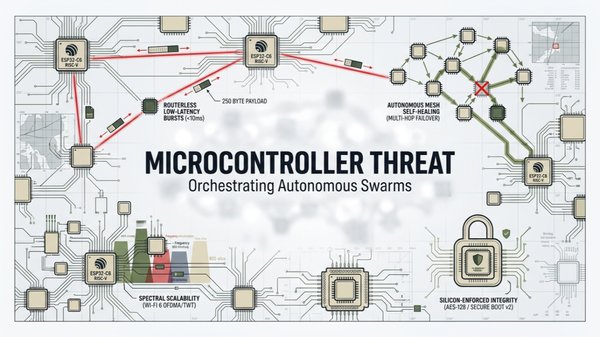
- Part 5 of 6 - Routerless Topologies, Multi-Hop Packet Forwarding, and Self-Healing RF Grids
Introduction
Building on the low-power sensing primitives established in Microcontroller Threat: Zero-Emission TinyML at the Edge , tactical edge deployments require resilient physical communication channels that withstand electronic warfare and kinetic attrition. Centralised wireless infrastructures remain inherently fragile because single gateway nodes emit persistent radio-frequency (RF) signatures and invite targeted interdiction.
Surviving in contested electromagnetic environments demands a departure from conventional hub-and-spoke topologies . Deploying Commercial off-the-shelf (COTS) silicon enables decentralised, self-healing mesh networks and routerless peer-to-peer telemetry grids through three foundational design pillars:
- Protocol Architecture : Combining connectionless ESP-NOW direct bursts with dynamic ESP-MESH routing structures provides deterministic, low-latency telemetry transport.
- Modern Silicon Foundation : Integrating RISC-V hardware with Wi-Fi 6 (IEEE 802.11ax) delivers hardware-enforced cryptographic boundaries and spectral efficiency.
- Spectral Scalability : Utilising advanced PHY enhancements, including BSS Colouring and OFDMA , enables dense swarms to scale without saturating the local RF spectrum.
Why Hub-and-Spoke RF Topologies Fail in Contested Zones
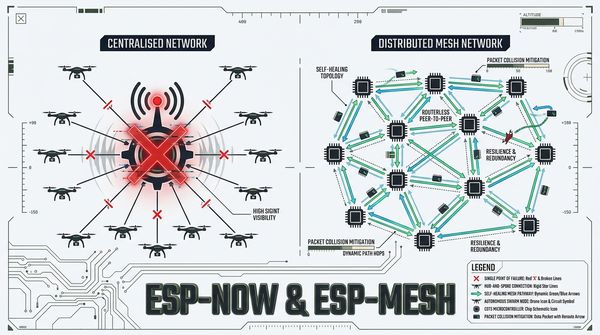
Centralised wireless topologies relying on fixed wireless access points or cellular base stations create high-value operational targets. Destroying or electronically jamming the coordinating node immediately severs all downstream communication.
Operating centralised networks in contested RF environments exposes three primary failure modes:
- SIGINT Vulnerability : Continuous high-power beacon broadcasts emit unambiguous signals-intelligence (SIGINT) signatures, allowing adversarial direction-finding systems to geolocate critical infrastructure.
- Channel Exploitation : As demonstrated in A Comparison of Link Layer Attacks on Wireless Sensor Networks , centralised shared channels present severe vulnerabilities to denial-of-service exploits and selective jamming.
- Distributed Routing Resilience : Distributing routing authority across peer nodes eliminates single points of failure, mitigates electronic risk, and ensures telemetry delivery survives kinetic node attrition.
ESP-NOW Peer-to-Peer Telemetry Routing
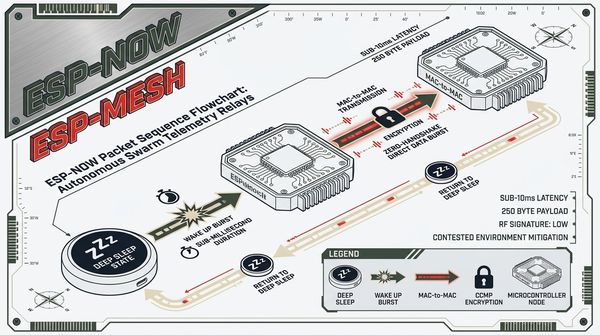
For direct node-to-node links, the Espressif ESP-IDF ESP-NOW API provides connectionless data delivery directly across the physical layer. Operating via IEEE 802.11 Vendor-Specific Action Frames (Category Code: 127, Element ID: 221, OUI: 0x18fe34), frames bypass association states and TCP handshakes entirely.
The link-layer protocol executes point-to-point communication through four operational parameters:
- Payload and Latency : Frames support a 250-byte maximum payload with transmission latencies typically below 10 ms.
- Low-Probability-of-Intercept (LPI) Bursts : Nodes wake from deep sleep, transmit telemetry to a target physical MAC address in a sub-millisecond burst, and return to sleep, minimising detectable RF emissions.
- Cryptographic Hardening : Unicast links enforce CCMP (CTR with CBC-MAC) encryption via AES-128 Local Master Keys (LMK), while a 4-byte monotonic header counter mitigates packet replay attacks.
- Dynamic Key Management : DevSecOps teams must account for the vulnerabilities of static LMK provisioning in compromised environments. Securely bootstrapping attritable, rapidly joining nodes without centralised PKI requires decentralised key distribution—such as Ephemeral Elliptic-Curve Diffie-Hellman (ECDH) executed via transient physical proximity or pre-shared out-of-band material—tightly bound to the silicon's permanent eFuse lockouts to prevent extraction from captured hardware.
ESP-MESH Self-Forming Protocol Topology
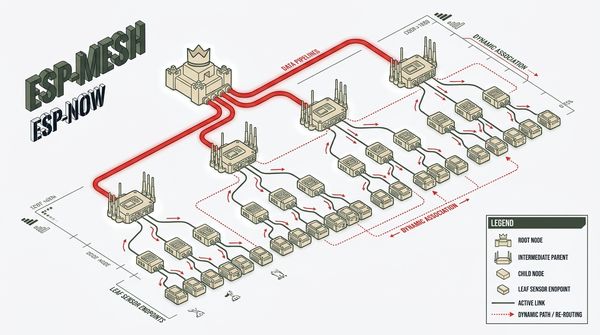
When dense sensor arrays require structured multi-hop telemetry aggregation, ESP-MESH establishes an autonomous tree topology over standard Wi-Fi station and soft-AP interfaces. Complete protocol parameters are detailed in the Espressif ESP-IDF ESP-WIFI-MESH Programming Guide and Espressif ESP-IDF ESP-WIFI-MESH Protocol Guide .
The autonomous mesh network operates across three core architectural principles:
- Hierarchical Node Roles : Devices dynamically assign roles as Root (sink gateway), Intermediate Parents (relays), Children, or Leaf endpoints.
- Topological Scale : The protocol supports up to 25 layers in tree mode (and up to 1,000 in chain mode), with routing tables resolving strictly at the MAC layer without IP overhead.
- Autonomous Root Election : Nodes broadcast beacon frames and elect a root based on RSSI , requiring a > 90% voting consensus across 15 election cycles to prevent split-brain formation.
Dynamic Route Healing and Anti-Jamming Redundancy
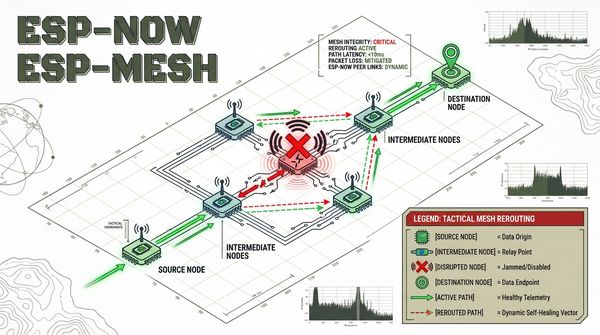
Under active electronic jamming or kinetic node loss, the mesh protocol autonomously isolates severed paths and reroutes telemetry around disrupted sectors. This defensive behaviour aligns directly with the defensive models in Stackelberg Game Approaches for Anti-jamming Defence in Wireless Networks .
Self-healing and route restoration proceed through four deterministic stages:
- Link-Loss Detection : Child nodes continuously track parent keep-alive beacons, triggering an automatic transition to a disconnected state when consecutive frames drop.
- Candidate Evaluation : Orphaned nodes initiate active channel scans, ranking potential parent nodes by RSSI, hop count, and historical packet transmission success rates.
- Rapid Convergence Timers : Child reconnection completes within 5 seconds, while full root-failover recovery resolves in under 10 seconds to maintain end-to-end data flow.
- High-Mobility Operational Constraints : In high-mobility kinetic environments (such as fast-moving UAV swarms), a 10-second failover creates a critical telemetry blackout. Severe Doppler shifts and rapid physical displacement degrade standard RSSI-based parent election algorithms, necessitating immediate fallback to direct ESP-NOW bursts during high-velocity manoeuvres.
Operational Takeaway for Resilient Distributed Sensing
Combining short-range ESP-NOW bursts with multi-hop ESP-MESH creates an attritable, self-healing communications grid, supported by performance evaluations in Comparative Study of MAC Protocols for Wireless Mesh Network .
System design requires balancing three critical architectural trade-offs:
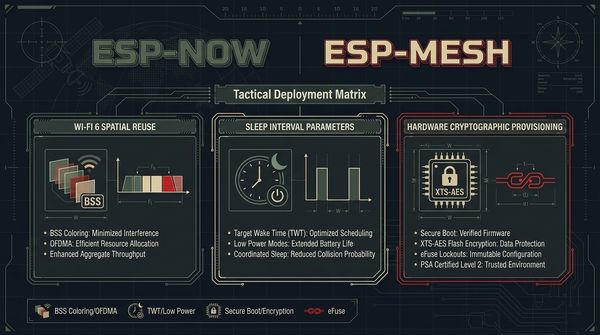
- RF Footprint vs Density : High node concentration increases aggregate packet collisions and SIGINT visibility. Deploying the ESP32-C6 brings native Wi-Fi 6 (802.11ax) capabilities, where BSS Colouring enables overlapping mesh nodes to ignore transmissions from neighbouring swarms. Integrating Orthogonal Frequency-Division Multiple Access (OFDMA) for simultaneous sub-carrier telemetry alongside Target Wake Time (TWT) resolves density bottlenecks far more effectively than legacy Wi-Fi 4 rate limiting.
- Hop Latency : Multi-hop tree traversals accumulate millisecond latency delays across relays, making direct ESP-NOW bursts preferable for time-critical target cues.
- Root Gateway Bottlenecks : The root node represents a residual concentration of risk, requiring pre-configured backup root-eligible nodes or heterogeneous LPWAN /satellite backhaul links.
Hardware-level security prevents physical capture from compromising swarm network credentials:
- Silicon Cryptographic Boundaries : As outlined in the Espressif ESP32-C6 Security Overview and Espressif ESP32-C6 Technical Reference Manual , modern RISC-V architectures enforce hardware security directly at the silicon layer.
- Hardware-Enforced Defences : Platforms integrate Secure Boot v2 (RSA-3072/ECDSA), XTS-AES -128 Flash Encryption, and permanent eFuse debug lockouts to protect cryptographic integrity in forward operational environments.
Conclusion & Strategic Advice
Resilient edge communications require decoupling operational routing from centralised infrastructure. Combining connectionless ESP-NOW direct bursts with self-forming ESP-MESH networks provides low-latency telemetry, automated route healing, and physical-layer survivability at commodity price points.
Deploying decentralised swarm meshes delivers three core strategic advantages:
- Decentralised Resilience : Peer-to-peer and mesh architectures eliminate single points of failure across contested operational environments.
- Spectral Efficiency : Integrating Wi-Fi 6 enhancements—specifically BSS Colouring and OFDMA—minimises spatial collision domains and shrinks adversarial SIGINT interception windows.
- Silicon-Enforced Integrity : RISC-V hardware primitives safeguard cryptographic keys against physical extraction and reverse engineering upon node capture.
In the final instalment of this series, Microcontroller Threat: Conscripting the Consumer IoT Long Tail , we will examine how legacy, unmanaged consumer IoT infrastructure across civilian networks can be co-opted to alter the broader contested electromagnetic landscape.
💬 How are you hardening edge telemetry against active RF jamming and single-point failures? Share your insights below and ♻️ share this post with your network!
Further Reading
- Espressif ESP-NOW User Guide — Technical implementation specifications for connectionless vendor-specific action frames.
- IEEE 802.11 Vendor-Specific Action Frame Mechanics — Official IEEE standard governing link-layer frame construction and MAC-to-MAC bursts.
- PSA Certified Level 2 Technical Overview — Industry standard benchmark for hardware-enforced cryptographic boundaries and silicon security assurance.
More From Me
- Agentic AI Swarms: Unleashing Collaborative Intelligence (Part 1)
- Agentic AI Swarms: Navigating Risks and Shaping the Future (Part 2)
- The Blueprint RISC-V: Unified Memory, Many-Core Scaling, and Geopolitical Sovereignty
- RISC-V and China: Road to Technology Independence
- The 2026 AI Threat Landscape: Machine-Speed Autonomous Agents
- Fail-Safe Lethal AI: A 5-Step Modular Framework
- Architecting Zero-Trust Systems: A Guide to Web Cybersecurity
- The Silicon Sword: AI and the New Global Arms Race
- Edge-Model Shift: Escaping the Token Tax
- When Will It Go Hot? Russia, China, and the Shadow War That's Already Here
Original Article: Read on LinkedIn | Read on Substack