Social Media Democratises Discourse and Enfranchises the Public
Introduction
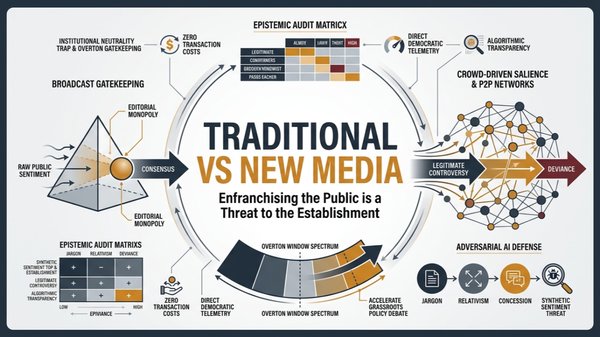
Legacy mass communication architectures operated within rigid broadcast constraints:
- Centralised Editorial Gatekeeping : A concentrated editorial cadre determined which policy issues reached national prominence and which remained excluded from legitimate debate.
- Passive Public Reception : Asymmetrical broadcast distribution restricted citizens to passive information consumption, limiting civic signalling to periodic electoral cycles.
The structural transition from one-to-many broadcast hierarchies to algorithmically mediated networks has fundamentally restructured the public sphere :
- Zero Publishing Costs : Digital platforms drove publishing transaction costs to near zero, replacing legacy broadcast gatekeepers with proprietary algorithmic gatekeepers.
- Algorithmic Navigation : Distributed communities navigate complex recommendation engines to surface empirical evidence and exert direct pressure on legislative priorities.
- Synthetic Sentiment Risks : Emerging threats from Generative AI astroturfing and synthetic sentiment require policymakers to evaluate real-time civic signalling through precise technical filtering.
- Proportionate Regulation : Regulatory frameworks must distinguish between structural network dynamics and institutional friction over fragmented narrative monopolies.
1. Dismantling the Gatekeepers: From Broadcast Monopolies to Networked Publishing
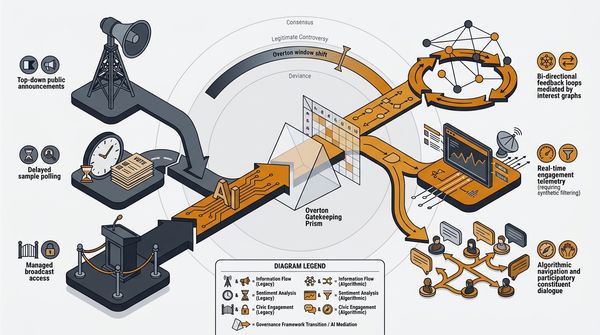
Historically, institutional newsrooms enforced discursive boundaries structured around Daniel C. Hallin's (1986) classic framework :
- The Sphere of Consensus : Core societal agreements that media institutions treated as unquestioned baseline realities.
- The Sphere of Legitimate Controversy : Mainstream debates recognised as valid topics for legislative and political contestation.
- The Sphere of Deviance : Political viewpoints systematically excluded from legitimate policy debate through structural gatekeeping absent elite backing.
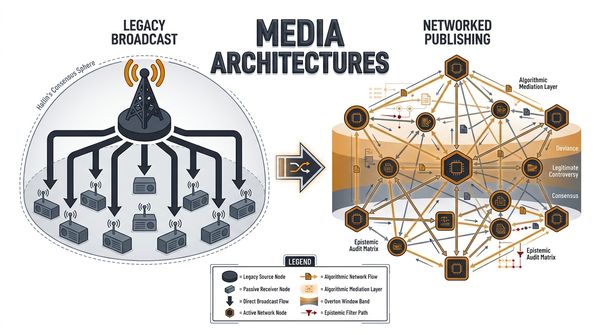
Decentralised networks replaced linear distribution with crowd-driven salience models:
- Networked Framing Dynamics : Sharon Meraz and Zizi Papacharissi (2013) demonstrated that networked gatekeeping and dynamic framing replaced hierarchical editorial curation.
- Accelerated Issue Velocity : Digital networks accelerate emerging policy debates to organic velocity before legacy outlets adapt, as documented by Locatelli et al., AAAI ICWSM (arXiv:2312.11326) .
However, modern networked distribution introduces new structural control mechanisms:
- Non-Traditional Gating Nodes : Karine Barzilai-Nahon (2008) demonstrated how intermediate network nodes exercise structural power within modern information architectures.
- Neural Network Hegemony : Engagement-optimised neural networks govern intermediate visibility and ranking across major platforms.
- Algorithmic Agenda-Setting : Machine learning distribution models have replaced legacy editorial boards as the primary arbiters of the public agenda-setting pipeline.
2. Amplifying Marginalised Voices: Participatory Media and Grassroots Organising
Under broadcast regimes, high capital requirements created structural barriers to entry for non-elite constituencies:
- Participatory Culture : Henry Jenkins (2006) established the digital counter-model of participatory culture across distributed communities.
- Collapsed Coordination Costs : Clay Shirky (2008) documented how peer-to-peer tools eliminated the economic transaction costs of collective civic action.
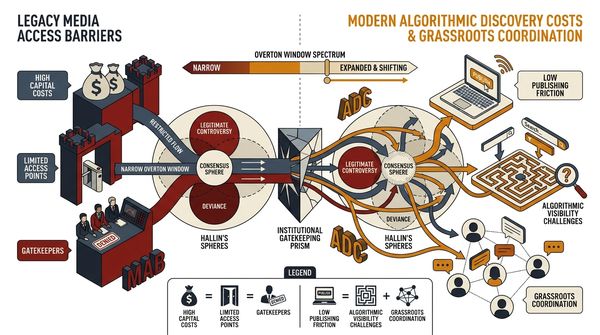
The evolution from Web 2.0 architectures to recommendation-driven platforms alters grassroots discovery economics:
- Graph Architecture Transition : Platforms shifted from user-curated social graphs to algorithmically driven interest graphs such as 'For You' feeds.
- Algorithmic Discovery Costs : Grassroots campaigns face minimal publishing friction but encounter substantial algorithmic discovery costs to secure broad visibility.
Modern civic movements operate across two distinct structural distribution barriers:
- Moderation and Algorithm Navigation : Counter-publics navigate shadowbanning and opaque content-moderation protocols to translate localised friction into national policy action.
- Network Power Laws : Platform reach follows severe power laws , granting verified nodes and funded PACs disproportionate communicative leverage.
3. Direct Accountability: Algorithmic Pandering and Real-Time Feedback
Social media architectures eliminate the intermediate editorial tier separating elected representatives from constituents:
- Legacy Communications Posture : Political actors historically communicated through staged press conferences and managed press releases.
- Low-Latency Feedback Channels : Modern platforms establish direct, bi-directional constituent interaction pipelines.
Legislative offices deploy digital platforms across two primary operational functions:
- Direct Constituent Engagement : Representatives use platform channels for direct constituent casework and to clearly articulate positions.
- Empirical Civic Telemetry : Legislative teams extract real-time public sentiment data, as demonstrated by Hemphill and Schöpke-Gonzalez, ICWSM (arXiv:1909.08189) .
Platform incentive structures distort democratic feedback loops across two key dimensions:
- Commercial Mediation of the Agora : Platform architectures operate as engagement-maximising commercial environments rather than neutral public agora spaces.
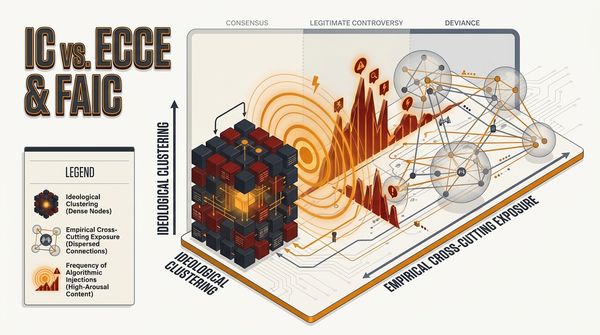
- Distribution-Driven Pandering : Proprietary ranking models amplify high-arousal, polarising content, incentivising lawmakers to optimise for algorithmic reach over nuanced policy development.
4. The Echo Chamber Dilemma: Synthetic Sentiment and Information Diets
Empirical network analysis challenges conventional assumptions regarding online ideological segregation:
- Multi-Platform Media Diets : Elizabeth Dubois and Grant Blank (2018) established that active citizens maintain diverse media diets that prevent insular echo chambers .
- Algorithmic Cross-Cutting Exposure : Recommendation systems routinely expose users to viewpoints outside their immediate social networks, as shown by Kulshrestha et al., ICWSM (arXiv:1704.01442) .
Cross-partisan engagement across network boundaries involves measurable operational dynamics:
- Network Bridging Costs : Bridging polarised digital communities requires specific network routing costs, as detailed by Garimella et al., WWW (arXiv:1801.01665) .
- Cross-Partisan Framing : Structured, cross-partisan message framing successfully engages ideologically divergent demographics, as documented by Saveski et al., ICWSM (arXiv:2111.02646) .
The primary systemic threat to digital discourse stems from automated manipulation vectors:
- Synthetic Media Deployment : Coordinated synthetic media campaigns distort organic debate through automated fabrication.
- Scalable Inauthentic Behaviour : Infrastructure powered by botnets , state-sponsored information operations , and LLM astroturfing systematically manipulates algorithmic curation mechanisms.
Conclusion & Strategic Advice
The transition to algorithmically mediated network architecture represents a permanent evolution in public debate:
- Evolving Information Topologies : Governance frameworks must adapt to distributed, ML-curated information networks rather than simple peer-to-peer models.
- Operational Shift : Policymakers must align their regulatory and communication postures across three strategic dimensions.
Governance Dimension : Legacy Broadcast Posture Algorithmically Mediated Strategy Information Flow Top-down public announcements Bi-directional feedback loops mediated by interest graphs Sentiment Analysis Delayed sample polling Real-time engagement telemetry (requiring synthetic filtering) Civic Engagement Managed broadcast access Algorithmic navigation and participatory constituent dialogue
Developing resilient civic infrastructure requires policy focus across three core technical priorities:
- Algorithmic Transparency : Mandating transparent auditing frameworks for platform recommendation and ranking pipelines.
- Systemic Interoperability : Enforcing platform interoperability and open protocols to support distributed public communication.
- Synthetic Sentiment Mitigation : Implementing verification systems to detect automated manipulation while preserving authentic civic debate.
💬 How can policymakers best balance open, algorithmic public discourse with the rising threat of synthetic AI astroturfing? Drop your thoughts below and ♻️ share this post with your network!
Further Reading
- Political Discourse on Social Media: Echo Chambers, Gatekeepers, and the Price of Bipartisanship (Garimella et al., ACM WWW)
- Topic Shifts as a Proxy for Assessing Politicization in Social Media (Locatelli et al., AAAI ICWSM)
- Engaging Politically Diverse Audiences on Social Media (Saveski et al., AAAI ICWSM)
- The Myth of the Echo Chamber (Dubois & Blank, Information, Communication & Society)
More From Me
- AI and the Democratization of Journalism: A New Era of Accountability🚀
- Will AI encourage Political Polarisation as a Rational Strategy? 🤖
- Narrative Capture: How David and Goliath Distorted the DeepSeek News
- Journalism in the AI Era: Fixing FOI and Funding Investigative Journalism
- The Pitfalls of Panopticon AI: Learning from COVID and Building Trust
Original Article: Read on LinkedIn | Read on Substack