Optimizely Cloud: Edge, Data, and Experimentation on AWS
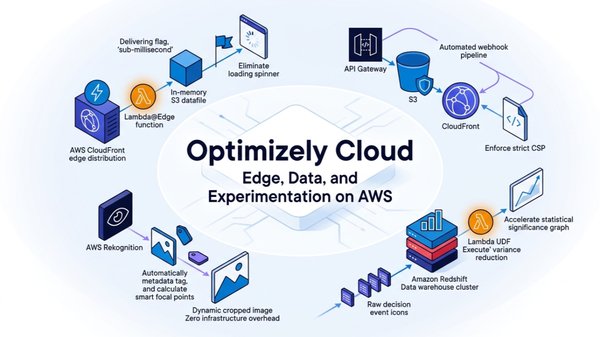
- Part 5 of 7 : Lambda@Edge Decisioning, Snippet Self-Hosting, and Redshift Streams
Introduction
Building on the hybrid media models analysed in Optimizely Cloud: Commerce on Azure and AWS Media AI , enterprise architectures frequently require a deliberate multi-cloud split. While Microsoft Azure serves as the native platform-as-a-service (PaaS) foundation for Optimizely Content Management System (CMS) and Commerce Connect runtimes, Amazon Web Services (AWS) provides specialised edge compute , low-latency delivery, and warehouse-native data processing layers.
From a systems-design perspective, AWS operates as a targeted execution environment across four primary technical vectors:
- Edge Decisioning : Zero-flicker feature flagging evaluated close to the client.
- Edge Delivery : Custom-domain snippet routing and asset distribution.
- Data Pipelines : Scalable customer data ingestion and warehouse streaming.
- Computer Vision : Embedded computer vision models for automated media intelligence.
Architects must navigate a nuanced Shared Responsibility Model across these integrations:
- Managed SaaS Capabilities : Services such as AWS Rekognition operate as fully licensed software-as-a-service (SaaS) features requiring zero infrastructure provisioning from the user.
- Customer-Managed Infrastructure : Edge decisioning pipelines and snippet self-hosting require DevOps teams to actively provision, monitor, and maintain AWS API Gateways, Lambda workers, IAM roles , and S3 buckets within the customer AWS estate.
This guide maps the five primary AWS touchpoints across the Optimizely portfolio, providing concrete infrastructure patterns to decouple edge decisioning from backend application lifecycles.
1. How AWS Actually Shows Up in the Optimizely Stack
AWS does not host the core DXP PaaS application layer. While legacy topologies once supported hosting on AWS Elastic Beanstalk and Amazon RDS , contemporary implementations operate on Azure Web Apps.
Instead, AWS supplies specialised primitives across five distinct functional domains:
- Edge Compute : Serverless execution via Lambda@Edge.
- Edge Delivery : Low-latency caching through CloudFront distributions.
- Object Storage : Scalable persistence using object storage in Amazon S3.
- Data Warehousing : Analytics and schema modelling inside Amazon Redshift data warehousing .
- Machine Learning : Media classification via embedded machine learning .
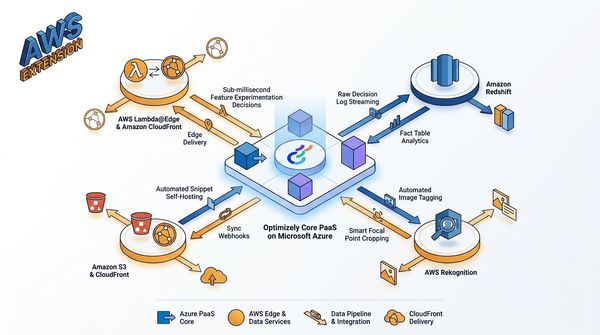
According to the official Amazon Web Services Integration catalogue, Amazon Simple Storage Service (Amazon S3) serves as the primary file-transport baseline for Optimizely Data Platform (ODP). Beyond raw data exchange, AWS primitives decouple edge performance from centralised origin servers.
Optimizely does not provide turnkey connectors for AWS messaging primitives, requiring explicit integration patterns:
- Webhook Bridging : Enterprise teams designing decoupled event-driven architectures must deploy custom Lambda middleware adapters or API Gateway receivers.
- Event Ingestion : These custom adapters forward Optimizely webhooks directly into Amazon SQS queues or SNS event streams.
2. Feature Experimentation: The Most AWS-Native Optimizely Product
Feature Experimentation offers native AWS runtime support across the product suite. Rather than executing flag evaluations on centralised origins or injecting client-side scripts, teams deploy decision logic directly to AWS Lambda@Edge behind Amazon CloudFront .
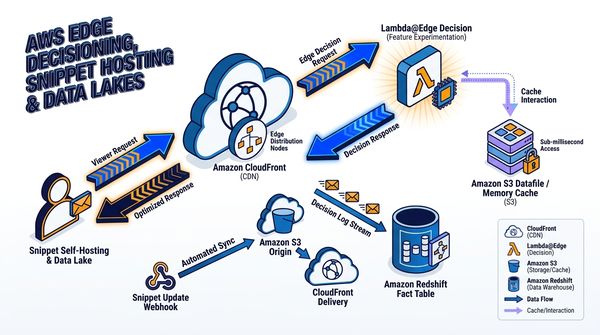
The JavaScript SDK runs directly inside edge compute workers to evaluate flags before generating the payload. This pattern eliminates layout shifts common in client-side experimentation, as detailed in Optimizely's Performance Edge documentation .
Mitigating cold-start latency spikes relies on a two-tier caching pattern:
- Initialisation Fetch : The Lambda worker retrieves the experiment datafile from a regional Amazon S3 bucket colocated with the Lambda@Edge execution region once during initialisation.
- In-Memory Evaluation : The datafile remains cached in execution memory, enabling subsequent viewer requests to evaluate the decision graph with sub-millisecond P95 response times without continuous network I/O penalties.
- Cold-Start Boundary : When cold starts occur, the colocated S3 fetch keeps initialisation latency in the low double-digit milliseconds.
For decoupled enterprise microservices , the centralised Optimizely Agent microservice scales horizontally behind AWS Application Load Balancers .
3. Web Experimentation: Snippet Self-Hosting via S3, CloudFront, and Lambda
To maintain strict Content Security Policies (CSP) and eliminate third-party DNS lookups , Optimizely provides a reference architecture to self-host the Web Experimentation snippet using CloudFront . This pattern falls under the customer-managed boundary of the Shared Responsibility Model, requiring DevOps teams to orchestrate and monitor the infrastructure.
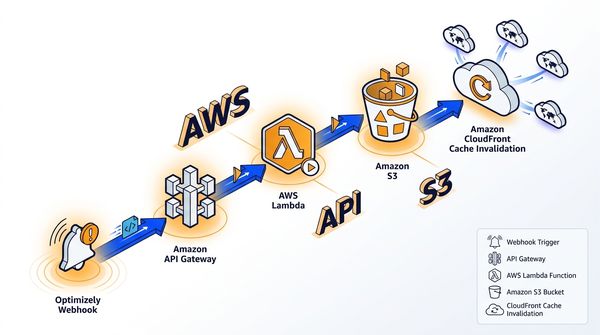
The automated snippet deployment pipeline executes through four sequential stages:
- Trigger : An Optimizely webhook fires when experiment changes are published in the management interface.
- Ingest : Amazon API Gateway routes the webhook payload to an AWS Lambda receiver function.
- Persist : The Lambda worker retrieves the latest production bundle and writes it directly to a dedicated Amazon S3 origin bucket.
- Distribute : Amazon CloudFront delivers the bundle from the organisation's primary apex domain with an automated cache invalidation cycle.
4. Data Platform and Analytics: S3, Redshift, and Warehouse-Native Analysis
Amazon S3 acts as the bidirectional exchange conduit for Optimizely Data Platform (ODP), processing scheduled data imports and exporting harmonised event schemas back into enterprise data lakes . Additionally, Optimizely CMS provides a first-party provider package enabling Amazon S3 as an alternative Blob storage layer alongside Azure Blob Storage.
For statistical reporting, raw decision logs stream directly into Amazon Redshift fact tables . Native connectors run AWS Lambda user-defined functions (UDFs) to execute CUPED variance reduction inside Amazon Redshift , enabling SQL-based conversion modelling directly against first-party transactional records.
Warehouse-native analytics provide two clear operational advantages:
- High-Throughput Processing : The architecture processes massive append-only fact tables with sub-second query latency.
- Accelerated Significance : Reducing metric variance via CUPED dramatically shrinks the sample timeline required to reach statistical significance in experiments.
5. The AWS AI Feature Inside Commerce DAM: Rekognition
Unlike the customer-managed CI/CD overhead required for edge compute and snippet hosting, AWS computer vision is embedded as an out-of-the-box, fully managed capability within Optimizely Digital Asset Management (DAM) . The platform natively licenses AWS Rekognition within Optimizely Software Services without requiring custom middleware.
Rekognition executes two primary asset operations without customer infrastructure overhead:
- Automated Metadata Extraction : Assigns descriptive hierarchical tags upon asset upload to eliminate manual catalogue classification.
- Smart-Focal-Point Detection : Locates the visual subject within multi-ratio assets, guiding automated dynamic cropping algorithms across responsive viewports .
Conclusion & Strategic Advice
AWS serves as a high-performance acceleration and data plane rather than a replacement for the Azure application layer:
- Edge Execution : Implement Lambda@Edge for zero-latency serverless experiment decisioning.
- Delivery Governance : Deploy CloudFront and S3 to self-host client-side scripts under first-party domains.
- Analytical Governance : Stream raw experiment events into Amazon Redshift to maintain warehouse-native truth.
For a deeper architectural comparison of compute trade-offs across serverless providers, continue to the next instalment: Optimizely Multi-Cloud: Serverless Trade-offs Across Clouds .
How are you decoupling edge experimentation and analytics from your core CMS origin? Drop your thoughts below💬 and share this architecture blueprint with your engineering network! ♻️
Further Reading
- AWS Lambda@Edge Developer Guide
- Amazon CloudFront Edge Delivery Best Practices
- Amazon Redshift User-Defined Functions (UDF) Architecture
More From Me
Original Article: Read on LinkedIn | Read on Substack