Optimizely Cloud: Commerce on Azure and AWS Media AI
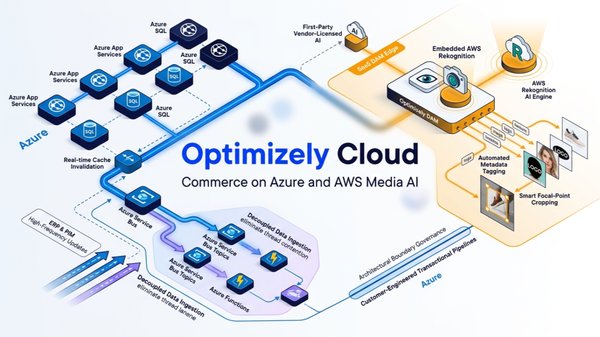
- Part 4 of 7 : Enterprise Microsoft Integrations and Embedded AWS Rekognition in DAM
Introduction
Building on the event-driven integration patterns we explored in Optimizely Cloud: Azure Functions for CMS Integration , modern digital commerce platforms demand an expanded operational topology. Beyond content presentation, a transactional commerce engine must coordinate high-frequency workloads across distributed infrastructure:
- SKU Mutations : Managing high-frequency catalogue state changes in real time.
- External ERP Feeds : Ingesting pricing, inventory, and account data streams asynchronously.
- Media Asset Pipelines : Processing and delivering heavy visual payloads across global endpoints.
Enterprise platform roadmaps frequently assume that choosing Azure for PaaS hosting enforces an exclusively Microsoft stack across all platform tiers. This assumption breaks down under architectural scrutiny.
While the core transactional engine executes within Azure, the platform incorporates licensed Amazon Web Services (AWS) capabilities directly into its media processing tier.
This guide dissects the multi-cloud topology of Optimizely Commerce across three core areas:
- Hosting Baselines : Evaluating the shared Azure infrastructure inherited from the content tier.
- Data Ingestion Pipelines : Architecting asynchronous ERP and PIM synchronisation surfaces.
- Embedded Computer Vision : Exposing licensed AWS Rekognition capabilities operating within Digital Asset Management (DAM) .
1. The Azure Hosting Model Commerce Inherits from CMS
Optimizely Commerce relies on the identical multi-instance runtime underpinning the content management tier. The infrastructure baseline comprises four primary components:
- Compute Tier : Scalable Azure App Services instances fronted by an Application Gateway .
- Data Persistence : Shared Azure SQL database instances alongside Azure Blob Storage accounts.
- Message Bus : Azure Service Bus broadcasting cache invalidation messages and distributed catalogue updates in real time, as detailed in Deploy CMS 12 sites to Azure Webapps .
- Identity Federation : Centralised platform administration via Opti ID or native OpenID Connect federation against Microsoft Entra ID .
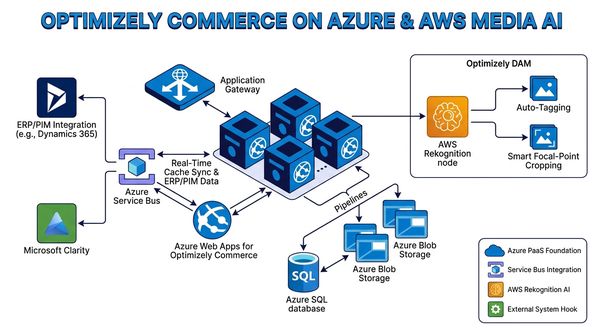
Binary assets follow a provider-agnostic abstraction layer. Engineering teams determine binary persistence at project initialisation by selecting either the Azure Blob Storage or AWS S3 NuGet packages, as outlined in BLOB storage and providers .
2. Commerce-Specific Azure Integration: PIM/ERP, Service Bus, and the Microsoft Ecosystem
Commerce architectures introduce high-throughput data ingestion channels absent in standard CMS deployments. Executing synchronous catalogue updates via internal scheduled jobs introduces thread contention and database timeout risks.
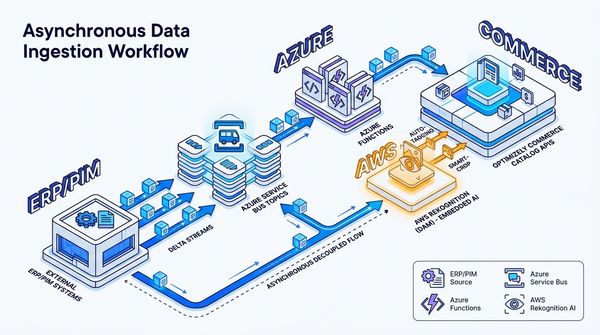
Production designs isolate external data ingestion through decoupled, event-driven pipelines:
- Asynchronous Ingestion : Azure Service Bus topics receive delta streams from external Product Information Management (PIM) and ERP systems.
- Serverless Processing : Azure Functions process queued payloads asynchronously into Commerce catalogue APIs, as documented in; Azure Service Bus Messaging for transferring data between external PIM/ERP to Optimizely .
At the enterprise integration layer, the Microsoft ecosystem provides two primary connector tiers documented on Optimizely Strategic Partners: Microsoft :
- Enterprise System Connectors : Dynamics 365 and SharePoint synchronise master records, pricing structures, and business customer data.
- Behavioural Telemetry : Microsoft Clarity captures real-time session heatmaps and clickstream telemetry to drive algorithmic merchandising and personalisation rules without impacting transactional order processing.
3. The AWS Hook No One Expects: Rekognition Inside the Commerce DAM
Despite an Azure-centric compute footprint, the media intelligence tier introduces a deliberate multi-cloud dependency. Optimizely Digital Asset Management (DAM) embeds AWS Rekognition as an officially licensed, first-party capability rather than relying on Azure Cognitive Services .
Technical Architects must recognise the architectural boundary governing this service:
- SaaS DAM Boundary : AWS Rekognition operates exclusively within the discrete Optimizely DAM SaaS module (CMP/Welcome layer).
- Core Commerce Boundary : It is not a feature of the standard IAsset or Azure Blob storage provider libraries in baseline Commerce Connect installations.
- Cross-Cloud Synchronisation : An API connector and specialised UI extensions bridge the environments, enabling Azure-hosted Commerce instances to resolve headless media representations from the AWS-hosted DAM.
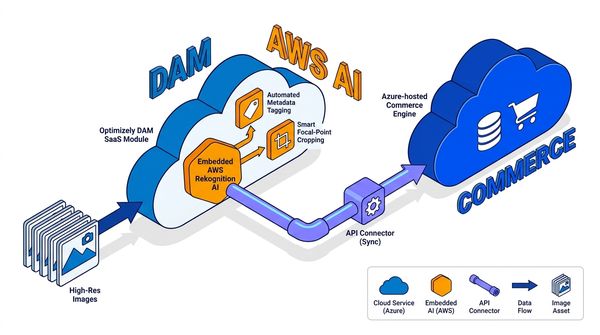
According to Service Descriptions: Optimizely Software Services, Nov 2025 , AWS Rekognition executes two automated tasks within the DAM:
- Automated Metadata Tagging : Analyses incoming product imagery and infers taxonomic labels, eliminating manual tagging during catalogue updates.
- Smart Focal-Point Cropping : Dynamically identifies the primary visual subject, ensuring automated crop variants centre accurately across responsive breakpoints.
4. First-Party vs. Build-It-Yourself: Reading the Commerce Integration Map
Accurate solution architecture requires categorising capabilities across four operational boundaries:
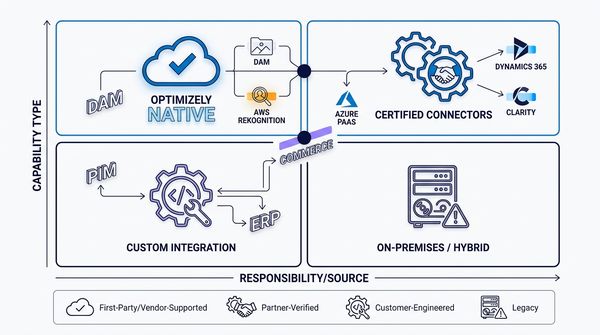
- First-Party Supported Capabilities : AWS Rekognition computer vision within the Optimizely DAM SaaS module, Azure Key Vault secret management, Application Insights telemetry, and official Azure or AWS Blob storage provider packages.
- Customer-Engineered Integration Patterns : Asynchronous Azure Service Bus and Azure Function ingestion pipelines, Azure AI Search indices fed via the Commerce ServiceAPI, and custom event webhooks .
- Partner Integration Verification : Enterprise systems like Dynamics 365, SharePoint, and Microsoft Clarity require engineering teams to validate underlying API contracts against technical documentation rather than relying on high-level partner marketing claims.
- Legacy Deployment Footprints : Hosting Commerce Connect on AWS Elastic Beanstalk with Amazon RDS remains documented in Deploy Amazon Web Services (AWS) in Commerce Connect , but serves legacy topologies rather than greenfield implementations.
Conclusion & Strategic Advice
Optimizely Commerce is not a mono-cloud runtime; it is a pragmatic multi-cloud architecture. It unites an Azure PaaS hosting spine with embedded AWS computer vision to balance operational scalability with specialised AI capabilities.
Strategic Selection Matrix
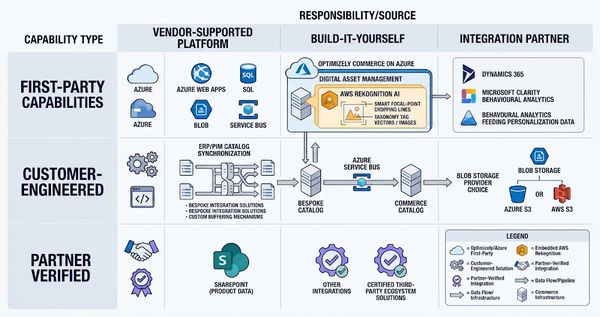
When planning enterprise commerce roadmaps, treat catalogue ingestion as a custom event-driven integration while leveraging embedded AWS media intelligence out of the box.
Continue to the next instalment in this series, Optimizely Cloud: Edge, Data, and Experimentation on AWS , to explore how Optimizely leverages AWS for high-velocity edge decisioning and experimentation.
How are you balancing asynchronous ERP feeds and media AI in your commerce topology? Drop your thoughts below💬 and share this breakdown with your architecture network! ♻️
Further Reading
- Microsoft Azure Service Bus Documentation: Enterprise Messaging
- AWS Rekognition Developer Guide: Image and Video Analysis
- Optimizely Commerce Connect Developer Documentation
More From Me
Original Article: Read on LinkedIn | Read on Substack