Optimizely Cloud: Serverless Trade-offs Across Clouds
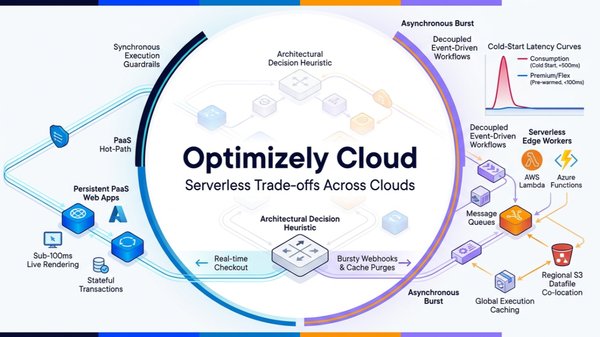
- Part 6 of 7 : Navigating Cold Starts, SDK Latency, and the PaaS Compute Boundary
Introduction
Building on our examination of Optimizely Cloud: Edge, Data, and Experimentation on AWS , modern enterprise architectures frequently augment persistent digital experience platforms with serverless compute tiers. Optimizely Content Management System (CMS) and Commerce operate within persistent Azure App Service runtimes, whereas integrating external systems demands isolated, elastic execution environments.
Serverless computing —via Azure Functions or AWS Lambda —offers elasticity and operational isolation for event-driven workflows. Introducing ephemeral execution models into a monolithic or decoupled PaaS topology creates two distinct operational challenges:
- Tail-Latency Vulnerabilities : Placing on-demand functions within critical, synchronous user paths introduces cold-start overhead .
- Resource Contention : Relying on CMS-hosted background tasks degrades primary web worker throughput.
This analysis evaluates the architectural trade-offs of deploying Azure Functions and AWS Lambda alongside Optimizely DXP. It establishes a placement framework across four core dimensions: platform-specific cold-start mechanics, compute infrastructure symmetry, SDK data synchronisation latency, and runtime boundaries.
1. Why Serverless Functions Appear in Optimizely Architectures
Optimizely CMS and Commerce execute as persistent Azure Web Apps within the Digital Experience Platform (DXP). As integration footprints expand to include third-party Product Information Management (PIM) , Enterprise Resource Planning (ERP) , and search indexing engines, running synchronisation jobs inside the core CMS process creates severe architectural risks.
Optimizely scheduled jobs execute on background threads directly within CMS web worker processes. Running background integration tasks inside this shared runtime introduces four primary failure modes:
- Process Recycling and Eviction : Tasks share application memory and remain vulnerable to IIS worker recycling and Azure App Service idle shutdowns.
- Horizontal Scale-Out Instability : Execution risks duplication or uncontrolled interruption during Web App autoscaling events.
- Absence of Durable Retries : Native CMS jobs lack durable retry mechanisms to handle downstream network partition faults.
- Limited Observability : Internal CMS background threads provide minimal telemetry and execution tracing compared to distributed tracing platforms.
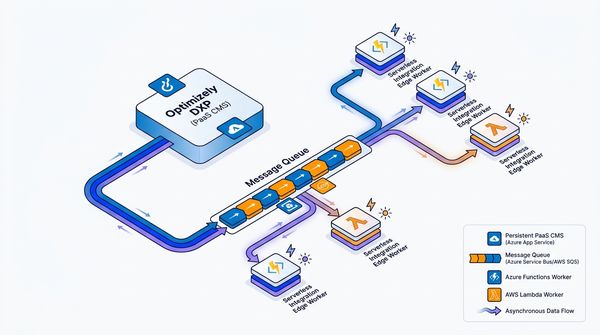
Offloading batch ingestions, search updates, and webhook fan-outs to external serverless microservices isolates compute resources and eliminates memory contention. Decoupling integration architecture relies on two standard implementation practices:
- Asynchronous Message Boundaries : Pairing message queues with serverless consumers provides durable, replayable integration boundaries, as documented on the Optimizely World Community Blog .
- Codified Infrastructure Automation : Implementing open-source orchestration frameworks standardises IAM permissions , event triggers, and deployment pipelines, as detailed on Engineers @ Optimizely .
2. Cold Starts on Azure: The Consumption Plan Problem and Its Mitigations
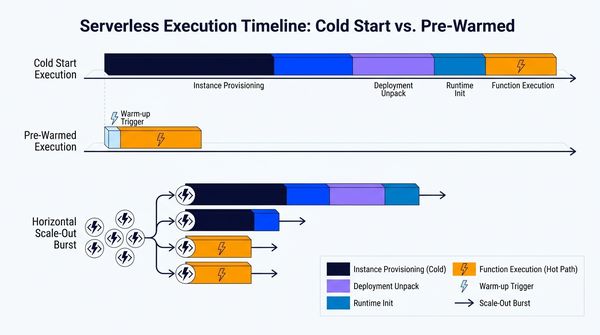
On the Azure Functions Consumption plan, underlying host instances de-allocate compute resources during periods of inactivity. Subsequent invocations incur an initialisation delay—ranging from one to several seconds—to allocate compute hosts, unpack the deployment artefact, and initialise runtime dependencies.
In production Optimizely environments, this latency penalty disrupts synchronous webhook endpoints. Production analysis on the Optimizely Dev-Blog evaluates two remediation strategies:
- Lightweight Warm-up Triggers : Deploying scheduled timer triggers every 5 to 10 minutes keeps a baseline worker process resident in memory. However, this approach fails during horizontal scale-out bursts because newly provisioned worker instances still encounter full cold-start latency.
- Dedicated Hosting Tiers : Migrating latency-sensitive endpoints to Azure Functions Flex, Premium, or dedicated App Service plans guarantees pre-warmed instances. This configuration eliminates container-provisioning overhead by trading consumption-only billing for a predictable operational baseline.
3. Cold Starts on AWS: Ephemeral Contexts, Provisioned Concurrency, and Datafile Latency
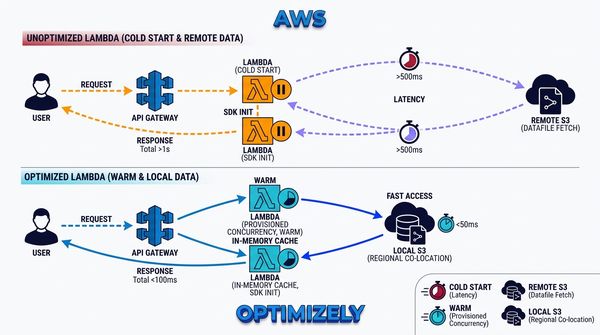
Deploying AWS Lambda within an Optimizely ecosystem presents a dual initialisation challenge: underlying container compute latency and application-level datafile retrieval latency when initialising the Optimizely Full Stack SDK. Multi-cloud architects resolve these latency profiles across three infrastructure layers:
- AWS Provisioned Concurrency : Acts as the direct infrastructural equivalent to Azure Functions Premium tiers by maintaining pre-initialised execution environments to eliminate runtime cold starts during traffic spikes.
- Regional Storage Co-location : Storing and synchronising experiment datafiles within an Amazon S3 bucket co-located in the identical AWS cloud region as the Lambda execution cluster, as demonstrated in the Optimizely Alexa Demo Repository .
- Global Context Caching : Instantiating and caching the parsed datafile instance in global execution memory outside the handler method to guarantee sub-millisecond feature flag evaluation across warm container invocations.
4. When Not to Go Serverless: The Failure Modes
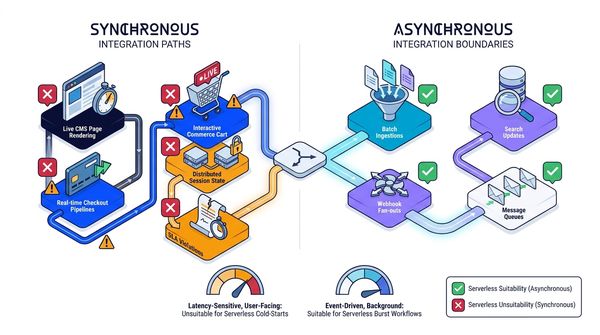
Serverless execution introduces structural latency risks when placed directly on synchronous, user-facing critical paths. Interactive rendering and checkout pipelines require guaranteed response budgets that cannot absorb ephemeral compute cold starts or remote network fetches:
- Synchronous Execution Paths : Live CMS page rendering, interactive Commerce cart calculations, and real-time checkout pipelines demand persistent compute runtimes to maintain sub-100ms response targets.
- Distributed Session State : Operating stateful microservices alongside Optimizely CMS requires external distributed cache providers such as Azure Cache for Redis , as detailed in the official Optimizely CMS Deployment Documentation .
- SLA Violations : Placing ephemeral functions in synchronous flows misaligns compute characteristics with user SLAs , resulting in client-side timeouts and degraded conversion rates.
5. A Decision Matrix: Placing Any Optimizely Integration Workload
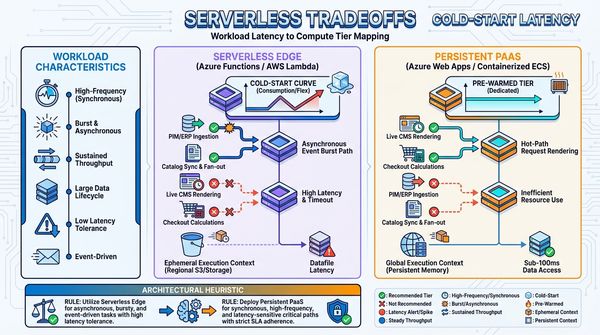
Workload placement across serverless and persistent tiers depends on invocation velocity, data lifecycle, and latency tolerance:
- Azure Functions / AWS Lambda (Serverless Edge) : Event-driven, asynchronous, bursty integration workloads. PIM and ERP catalogue ingestion, Optimizely Graph search re-indexing webhooks, CDN edge cache purge events, and experiment datafile pre-warming.
- Azure Web Apps / Containerised ECS (Persistent PaaS) : High-frequency, synchronous, sub-100ms critical execution paths. Live CMS page rendering, Commerce checkout state machines, real-time pricing rule engines, and interactive personalisation.
- Architectural Heuristic : Persistent compute infrastructure (or pre-warmed serverless tiers using Provisioned Concurrency and Flex/Premium models) is required when sustained throughput exceeds multiple requests per second or when cold-start delays breach system SLAs.
Conclusion & Strategic Advice
Aligning compute models with workload characteristics prevents production latency failures. Serverless functions deliver resilient, cost-effective scaling for asynchronous, decoupled integrations when protected against cold starts through enterprise patterns like AWS Provisioned Concurrency, Azure Premium plans, and regional caching. Persistent PaaS compute remains mandatory for the synchronous core.
In the final instalment of our series, Optimizely Cloud: Opal AI on Google Gemini , we examine how multi-cloud enterprise intelligence architectures integrate generative models with Optimizely Graph.
Technical architects should audit their current integration boundaries across three concrete steps:
- Decouple Webhook Receivers : Isolate bursty integration endpoints from the core CMS worker pool using message queues.
- Co-locate Configuration Data : Store and synchronise remote configuration datafiles within regional cloud storage adjacent to compute workers.
- Pre-warm Latency-Sensitive Tiers : Migrate critical serverless functions from consumption plans to pre-warmed hosting tiers.
How are you balancing serverless event workers against persistent compute in your multi-cloud architecture? Drop your thoughts below💬and share this with your engineering network! ♻️
Further Reading
- Microsoft Learn: Azure Functions Flex Consumption Plan Hosting
- AWS Documentation: Understanding the AWS Lambda Execution Environment
- Serverless Framework: Infrastructure Automation and Best Practices
More From Me
Original Article: Read on LinkedIn | Read on Substack