Industrial Revolution and AI: Panic, Sabotage, and What Actually Happened
Economic Lessons from Engels' Pause
Introduction
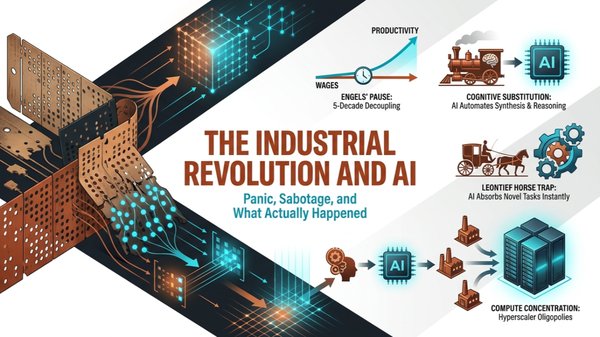
Technological transformations routinely trigger intense institutional friction, worker pushback, and structural reallocations of capital and labour. Silicon Valley narratives often invoke the British Industrial Revolution (1760–1840) to project frictionless long-run prosperity, dismissing structural labour displacement as temporary transition noise.
Historical data contradict this frictionless assumption across two macro indicators:
- Structural Decoupling : The historical record reveals a multi-decade divergence known as Engels' Pause , during which output per worker surged while real wages stagnated.
- Capital Consolidation : Profit captures doubled while societal stability deteriorated under the pressures of rapid industrial transition.
Understanding how mechanical automation disrupted 19th-century labour markets provides an indispensable framework for evaluating the modern deployment of foundation models. However, evaluating modern workforce impacts requires establishing a clear operational distinction between two technical paradigms:
- Tool-Based Generative AI : Systems that require human-in-the-loop operators and mirror historical patterns of worker resistance and task displacement.
- Agentic, Reasoning-Based AI : Autonomous systems capable of multi-step cognitive execution that vastly accelerate the macroeconomic threat of an Engels' Pause.
These frontier systems diverge across four foundational economic dimensions:
- Diffusion Speed : Near-instantaneous software deployment cycles.
- Cognitive Substitution : Direct automation of analytical and white-collar execution.
- Recursive Generality : Self-improving algorithmic architectures.
- Compute Concentration : Severe consolidation of hardware and capital assets.
To navigate this transition, we need to separate neo-classical compensation theories from capital-deepening realities to build resilient workforce architectures and capital allocation strategies.
1. Parallels in Resistance: Sabotage, Collective Bargaining, and Technological Unemployment
The popular portrayal of the 1811–1816 Luddite uprisings as irrational anti-technology sentiment distorts historical mechanics. Northern English stockingers and croppers engaged in asymmetric collective bargaining driven by three distinct economic grievances:
- Wage Suppression : Manufacturers deployed wide frames to drive down baseline wage rates.
- Standard Degradation : Employers systematically bypassed established apprenticeship standards to cut production costs.
- Market Flooding : Unregulated mechanical output flooded regional markets with inferior goods.
Machine-breaking emerged only after Parliament rejected legislative wage protections, which prompted the Frame Breaking Act of 1812 and domestic military deployment.
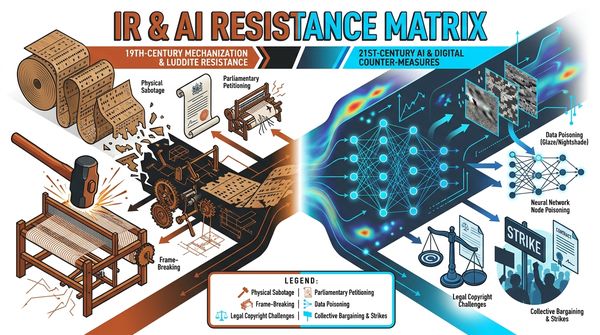
Modern white-collar resistance directly mirrors this defensive dynamic across two primary fronts:
- Adversarial Perturbation : Visual artists and authors deploy mathematical perturbation tools such as Glaze and Nightshade to poison latent feature representations in web-scraped model training pipelines.
- Contractual Safeguards : Collective labour unions execute industry-wide strikes to establish enforceable contractual firewalls against unauthorised synthetic replicas.
Between 1800 and 1830, over 250,000 British handloom weavers saw wages collapse by 70% following Edmund Cartwright's power loom. This collapse exemplifies classic Keynesian technological unemployment , where the rate of labour displacement dramatically outpaces the rate of new task discovery.
2. The Standard of Living Debate: Rural Escape versus Engels' Pause
Evaluating living standards requires reconciling individual microeconomic incentives with macroeconomic aggregates. Millions migrated from agrarian poverty because pre-industrial rural life was defined by Malthusian vulnerability, seasonal malnutrition, and universal agricultural child labour.
Early urban factory environments offered tangible short-term financial differentials:
- Cash Premiums : Factory shifts provided steady cash earnings 30% to 50% higher than agrarian day rates.
- Material Access : Concentrated wage payments gave workers reliable purchasing power for essential manufactured goods.
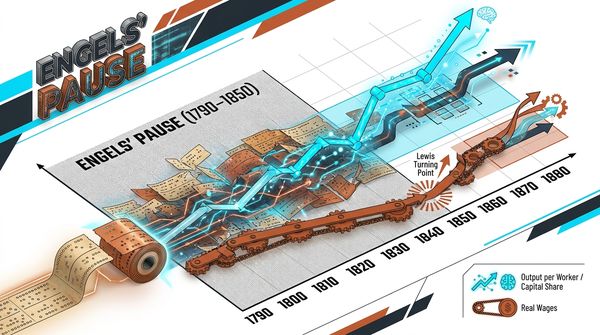
However, as demonstrated by Robert Allen (2009) , the macroeconomy exhibited a fifty-year decoupling:
- Surging Productivity : Output per worker grew by nearly 50% , driven by steam power and centralised mills.
- Wage Stagnation : Real wages remained flat , as an elastic labour supply of rural migrants suppressed competitive wage pressure.
- Capital Deepening : The profit share of national income doubled , channelling industrial productivity surpluses straight into capital accumulation.
Broad-based wage growth emerged only after 1850, once the agricultural surplus labour pool reached the Lewis Turning Point . This realignment required four structural counterbalances:
- Regulatory Guardrails : Passage of the Factory Acts to cap exploitation.
- Labour Formalisation : Legalising and expanding industrial trade unions.
- Human Capital Investment : Implementation of universal compulsory education.
- Labour Supply Depletion : Natural exhaustion of rural migration inflows.
3. Structural Divergences: Five Vectors Separating AI from Mechanisation
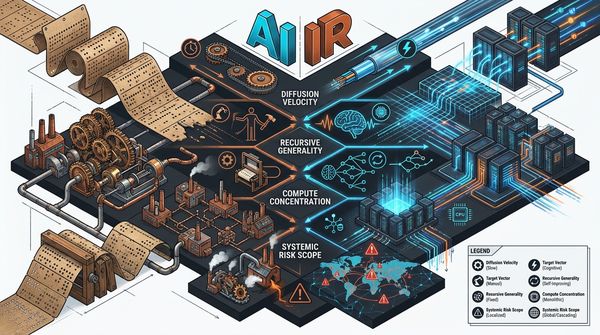
Agentic and generative models break historical industrial paradigms across five structural vectors:
- Diffusion Velocity : Industrialisation required decades of physical infrastructure buildout; cloud-hosted intelligence scales globally overnight at near-zero marginal distribution cost.
- Target Vector : 19th-century mechanisation replaced physical muscle while leaving human cognition sovereign; frontier AI automates synthesis, multi-step analysis, logical reasoning, and software generation.
- Recursive Generality : Steam engines remained domain-specific; autonomous agents represent universally applicable, compounding systems that automate the exact analytical tasks displaced workers are historically advised to adopt.
- Compute Concentration : Industrial mills were distributed across regional enterprises; frontier model weights and gigawatt compute clusters remain concentrated within hyperscaler oligopolies.
- Systemic Risk Scope : AI introduces epistemic degradation, autonomous cybernetic exploitation, and algorithmic monoculture. Economically, algorithmic monoculture is an acute contagion risk: a flawed foundation model or synchronised hallucination loop creates a single point of failure capable of collapsing global financial networks or critical engineering pipelines simultaneously—a systemic risk profile absent from the Industrial Revolution.
Early workforce analyses projected a "Senior Cliff" by 2035, predicting that automated entry-level workflows would hollow out human apprenticeship pipelines. However, this perspective remains anthropocentric and obsolete:
- Autonomous Reasoning : Modern frontier models execute autonomous reasoning, self-evaluation, and synthetic data generation without human oversight.
- Full-Hierarchy Displacement : Enterprise capabilities drive structural redundancy across the entire vertical biological hierarchy rather than merely compressing junior tiers.
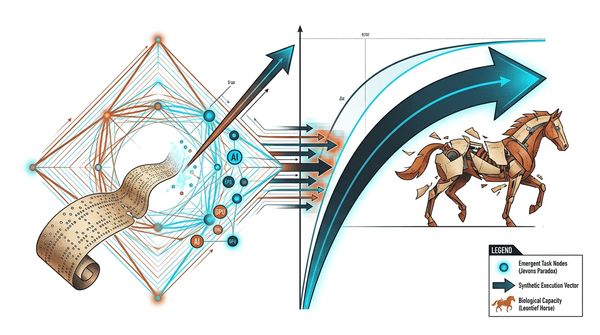
4. Macroeconomic Models: Jevons Paradox versus the Leontief Horse Analogy
Economic forecasts diverge across two opposing theoretical frameworks:
- Dynamic Compensation & Task Creation : Under the Jevons paradox , cheaper unit costs expand aggregate market demand. Empirical research by Autor et al. (2024) shows that over 60% of modern employment stems from job titles created after 1940. However, recursive generality breaks this historical dynamic: when autonomous agentic AI masters and executes novel tasks instantaneously, it absorbs newly created demand before biological workers can acquire relevant competencies.
- Structural Obsolescence (The Horse Fallacy) : Wassily Leontief observed that equine labour expanded during early mechanisation before the internal combustion engine rendered biological muscle obsolete post-1915. Equine labour could not retrain for emerging industrial workflows; horses experienced permanent economic retirement. When synthetic systems achieve structural cost and capability superiority across cognitive tasks, comparative advantage cannot rely on retraining an organic workforce.
Conclusion & Strategic Advice
Long-run macroeconomic optimism cannot justify complacency about the transition. The historical lesson of the Industrial Revolution demonstrates that technological abundance does not automatically translate into broad-based prosperity without aggressive structural intervention.
Relying on historical precedent to advocate for junior pipeline restructuring or human-in-the-loop oversight represents a fundamental analytical failure:
- Capital Inefficiency : If compounding, self-improving synthetic intelligence validates the Leontief Horse scenario for human cognition, investing capital into biological apprenticeship pipelines is as economically irrational as breeding junior workhorses in 1925.
- Strategic Polarisation : Enterprise leadership must move beyond comfortable consensus and choose between two operating paths: transition biological staff into hyper-specialised orchestrators of agentic swarms, or restructure enterprise architectures around fully autonomous synthetic agents.
- Macroeconomic Restructuring : Mitigating the destabilising fallout of an accelerated Engels' Pause requires radical capital-labour realignment through aggressive capital taxation frameworks, sovereign wealth fund orchestration, and the definitive decoupling of human economic security from cognitive labour output.
Further Reading
- The Origins and Content of New Work, 1940–2018 (NBER)
- Engels' Pause: Technical Change, Capital Accumulation, and Inequality (Allen, 2009)
- Restoring Creative Agency with Nightshade and Glaze (University of Chicago)
- Automation and New Tasks: How Technology Displaces and Reinstates Labour (Acemoglu & Restrepo, 2019)
More From Me
Original Article: Read on LinkedIn | Read on Substack