Integrating Jev: Decision Models with Optimizely Opal
Introduction
Modern digital experience platforms increasingly rely on multi-agent automation to orchestrate content authoring, search optimisation, and omnichannel personalisation. Chaining generative foundation models across every operational node introduces three systemic failure modes:
- Latency Bottlenecks : Chained foundation models stall synchronous workflows.
- Escalating Token Expenditure : Metered consumption compounds across high-frequency intermediate tasks.
- Structural Fragility : Deploying a 70-billion-parameter autoregressive model to execute binary routing decisions or evaluate brand compliance introduces unnecessary architectural failure points.
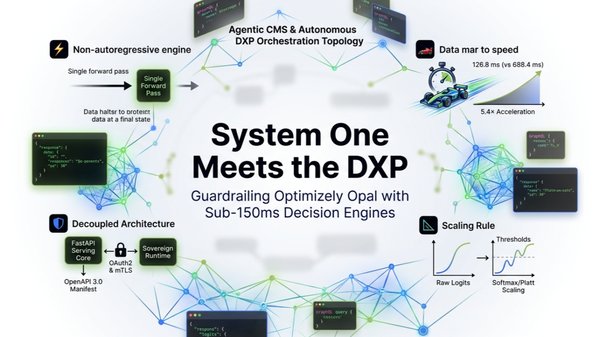
This guide outlines a production-grade blueprint for integrating non-autoregressive "System One" decision models—specifically TypeSafe Jev, SemIf, and Supersonic Labs Julia-1—into Optimizely Opal. Offloading classification, triage, and validation to dedicated, single-pass decision engines delivers three primary operational gains:
- Elimination of Decoding Loops : Workflows bypass sequential token decoding overhead entirely.
- Deterministic Latency Reductions : Pipeline round trips drop below 250 milliseconds.
- Cost Optimisation : Operational inference costs fall by more than 90%.
This hybrid topology pairs multi-tenant cloud agility at the customer experience tier with sovereign, deterministic control across the core operational infrastructure.
1. The Autoregressive Tax in Multi-Agent DXP Workflows
Multi-agent pipelines inside Optimizely One link discrete computational stages: inbound triggers, triage routing, creative generation, and compliance checks. When foundation models such as Google Gemini 2.0 Flash or Anthropic Claude 3.5 Sonnet govern every node, workflows incur an autoregressive tax.
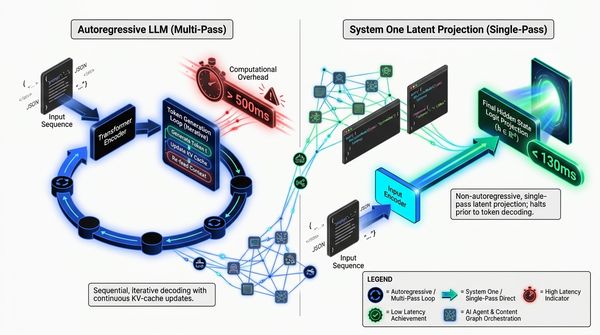
Every generated token requires a full forward pass through transformer layers, updating key-value (KV) caches sequentially. This computational pattern creates two compounding liabilities:
- Wasted Syntax Compute : Intermediate agents expend compute generating structural JSON syntax ({"route": "seo_agent"}) to classify inbound tasks or validate regulatory constraints.
- Compounded Latency Chains : Chaining three to four sequential LLM nodes inflates end-to-end response times to 3–5 seconds while compounding metered operational costs.
2. System One Models: Technical Specifications and Benchmarks
System One decision models eliminate the token decoding phase entirely. Inputs map through an encoder in a single forward pass (h∈Rd h ∈R d ), halting execution at the final hidden state where class logits are extracted directly.
Raw logits (h∈Rd h ∈R d ) are not inherently bounded as calibrated probabilities. To establish the deterministic confidence score required by Optimizely workflows, engineering teams map these raw logits via two primary calibration techniques:
- Softmax with Temperature Scaling : Adjusts the logit distribution variance to provide calibrated confidence values.
- Platt Scaling : Applies a logistic transformation over the model outputs to ensure accurate, operational thresholding.
Production implementations rely on three primary non-autoregressive architectures:
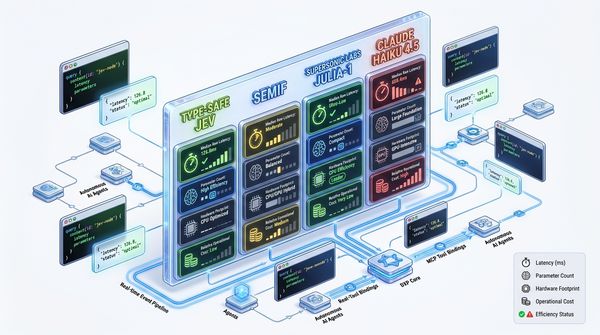
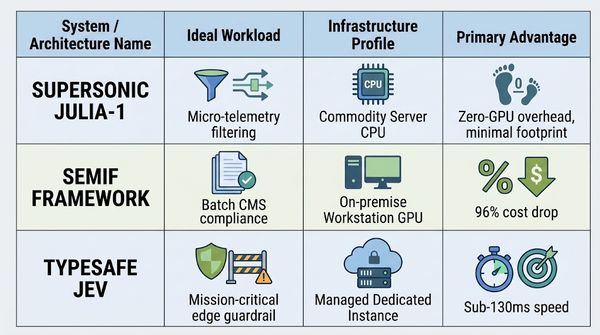
- TypeSafe Jev : A specialised dense transformer delivering strongly typed categorical classifications with a median raw inference latency of 126.8 ms (LiteLLM benchmarks), outpacing Claude Haiku 4.5 (688.4 ms) by 5.4× while eliminating output token metering.
- SemIf : An open-source framework detailed in the TheoLeeCJ SemIf Repository that freezes open weights (such as Qwen 2.5 4B) to evaluate class probabilities directly, sustaining >20 decisions per second on an NVIDIA RTX 3090.
- Julia-1 : A 144.3M parameter mmBERT architecture hosted on the Supersonic Labs Julia-1 Model Card , optimised to evaluate categorical options on commodity server CPUs without GPU acceleration.
Trade-off Caveat : Benchmark data reveals that while open models like SemIf match Jev on standard evaluations (95.2% vs. 94.5%), purpose-trained architectures maintain higher precision under ambiguous edge cases (74.1% vs. 59.5%).
3. The Two-Tier Sovereign Harness for Optimizely Opal
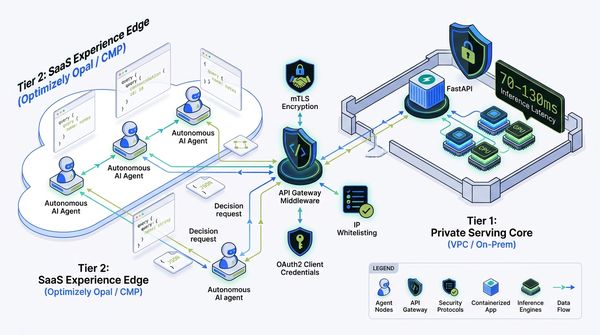
Optimizely Opal operates as a managed cloud service across CMP, CMS, and Experimentation, as documented in the Optimizely Opal Tools Documentation . Because Opal restricts custom CUDA runtimes and local PyTorch execution within its SaaS sandbox, integrating private decision models requires a decoupled two-tier harness:
- Tier 1 (Private Serving Core) : A containerised FastAPI service hosted in private infrastructure executing single-pass logit extraction in 70–130 ms.
- Tier 2 (SaaS Experience Edge) : An API Gateway exposing an OpenAPI 3.0 custom tool manifest registered inside Optimizely CMP. To meet enterprise security standards, this gateway enforces strict IP whitelisting, mTLS (Mutual TLS) , or an OAuth2 Client Credentials flow , securing all communication between cloud agents and the private core.
4. Implementation Contracts: Serving Code and OpenAPI Schemas
The private serving core exposes a typed REST contract secured via enterprise-grade OAuth2:
from fastapi import FastAPI, Depends, HTTPException, Security
from fastapi.security import OAuth2PasswordBearer
from pydantic import BaseModel
from typing import List

app = FastAPI(title="System One Decision Core")
oauth2_scheme = OAuth2PasswordBearer(tokenUrl="token")

class DecisionRequest(BaseModel):
    text: str
    target_task: str
    candidate_labels: List[str]

class DecisionResponse(BaseModel):
    selected_label: str
    confidence: float
    passed: bool
    model_execution_ms: float

@app.post("/v1/decision", response_model=DecisionResponse)
async def evaluate(req: DecisionRequest, token: str = Security(oauth2_scheme)):
    # Single-pass logit projection halts before token generation.
    # Note: Softmax temperature calibration is applied to raw logits to yield reliable confidence.
    return DecisionResponse(
        selected_label=req.candidate_labels[0],
        confidence=0.974,
        passed=True,
        model_execution_ms=126.8 # Raw inference time (SaaS-to-VPC transport adds ~50-100ms overhead)
    )
Inside the Optimizely CMP Developer Console, register the corresponding OpenAPI 3.0 manifest mapped to the secure client credentials flow:
openapi: 3.0.0
info:
  title: System One Decision Engine
  version: 1.0.0
paths:
  /v1/decision:
    post:
      operationId: evaluateSystemOneDecision
      security:
        - OAuth2ClientCredentials:
            - decision:execute
      requestBody:
        required: true
        content:
          application/json:
            schema:
              type: object
              required: [text, target_task, candidate_labels]
              properties:
                text: { type: string }
                target_task: { type: string, enum: [guardrail, route, compliance] }
                candidate_labels: { type: array, items: { type: string } }
      responses:
        '200':
          content:
            application/json:
              schema:
                type: object
                properties:
                  selected_label: { type: string }
                  confidence: { type: number }
                  passed: { type: boolean }
components:
  securitySchemes:
    OAuth2ClientCredentials:
      type: oauth2
      flows:
        clientCredentials:
          tokenUrl: https://api.enterprise.com/oauth/token
          scopes:
            decision:execute: Execute System One decision models
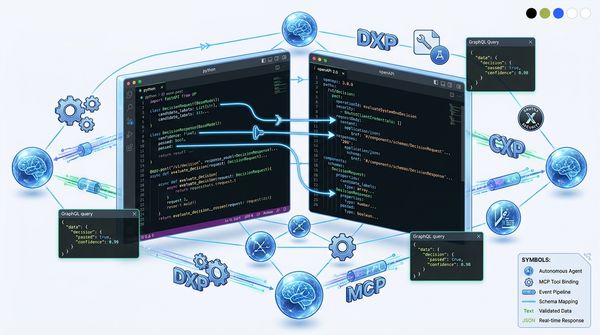
The diagram below highlights the direct 1:1 mapping between these two components. Notice how the FastAPI Pydantic schema (DecisionRequest / DecisionResponse) mirrors the OpenAPI contracts registered in Opal CMP:
- Endpoint & Method : @app.post("/v1/decision") binds directly to /v1/decision under paths.
- Payload Alignment : Properties defined in DecisionRequest (text, target_task, candidate_labels) reflect the exact parameters expected by the YAML requestBody schema.
- Security & Execution : The oauth2_scheme dependency enforces the OAuth 2.0 Client Credentials flow defined in components.securitySchemes. Opal uses this specification to automatically validate requests, negotiate credentials, and translate model output straight into downstream agent state.
5. Production Deployment Scenarios: Guardrails, Routing, and Compliance Auditing
Deploying this harness enables three core enterprise operational patterns, fully accounting for physical transport latency across the SaaS-to-VPC boundary:
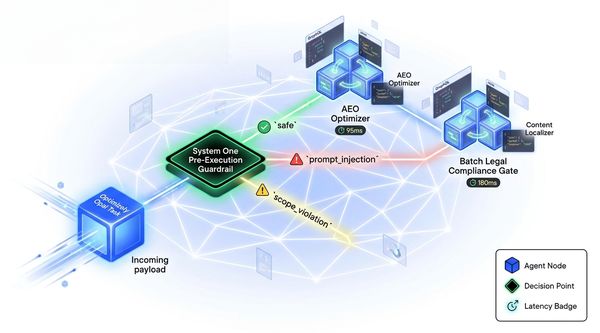
- Sub-250ms Pre-Execution Guardrails : Inbound user prompts entering Opal CMP Chat evaluate against candidate labels ([safe, prompt_injection, scope_violation]). Malicious payloads halt within a sub-250 ms round-trip (combining ~126 ms raw inference with ~80 ms transport overhead), preventing adversarial context poisoning and eliminating upstream token calls.
- Deterministic Multi-Agent Routing : Campaign intake payloads route across specialised agents (AEO Optimizer, Localizer, Legal Gate) via a 95 ms forward pass (resolving in ~180 ms over the SaaS boundary), eliminating JSON deserialisation exceptions.
- High-Density Batch Compliance Auditing : Evaluating 250 localised CMS page variants for mandatory legal disclaimers completes in ~12 seconds using SemIf on private hardware, bypassing external LLM rate limits and slashing audit costs by 96%.
Architectural Advisory: Probability Calibration Discrepancies Raw logits must never serve directly as routing thresholds. Open-weight decision models output probabilities conditional on user-supplied options.
Conclusion & Strategic Advice
Architecting modern AI infrastructure requires matching task complexity to execution dynamics. Generative foundation models excel at synthesis and narrative framing, but fail as fast reflex engines.
Audit automated agent pipelines to identify intermediate nodes expending generative tokens on binary triage. Decouple reflexive logic into a sovereign System One tier, reserving cloud foundation models for genuine creative synthesis.
Are you burning expensive generative tokens on binary triage and compliance checks in your multi-agent pipelines? Drop your architectural take below, 💬 and share this blueprint with your engineering network! ♻️
Further Reading
- Hugging Face Transformers Model Outputs Documentation
- OpenAI Function Calling Guide and Strict Schemas
- OpenAPI Specification v3.1.0
- ModernBERT: Bringing BERT into the Modern Era
More From Me
- Optimizely Opal: Connecting Enterprise AI to Your Toolchain
- Edge-Model Shift: Escaping the Token Tax
- The God Prompt Trap: Single-Prompt Reasoning Amplifies AI Failures
- Model Context Protocol: Universal Adapter for Agentic AI🌐
#EnterpriseAI #AgenticAI #Optimizely #SystemArchitecture #MachineLearning #Jev #Julia-1 #SemIfFramework #TypesafeJev
Original Article: Read on LinkedIn | Read on Substack