Edge-Model Shift: Escaping the Token Tax
Introduction
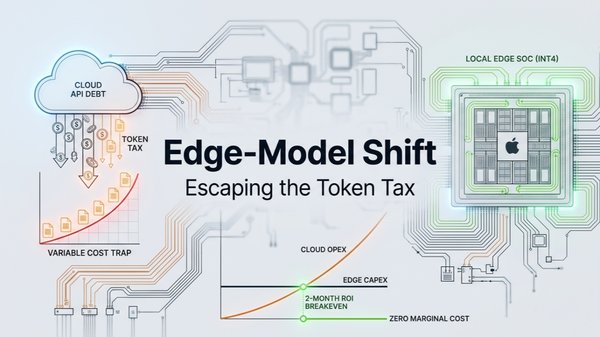
When evaluating infrastructure strategies for continuous, multi-turn agentic workflows , cloud dependency exposes three critical vulnerabilities:
- Operational Volatility : Centralised cloud APIs mandate variable cost models that penalise complex automation.
- Token Serialisation Tax : Charging per token serves as a transactional fee levied on every executed loop.
- Margin Erosion : Compounding consumption costs directly degrade underlying software product margins.
Reclaiming these product margins requires shifting execution to local environments via two primary mechanisms:
- Hardware Locality : Executing high-parameter intelligence at the edge using unified-memory system-on-chips (SoCs) and local inference .
- Cost Restructuring : Converting AI operations from variable operational expenditure (OpEx) into fixed capital expenditure (CapEx) .
Establishing the exact volume threshold for profitable workload migration relies on building a deterministic 3-year Total Cost of Ownership (TCO) framework.
1. The Variable Cost Trap: The Token Serialisation Tax
Centralised LLM platforms mandate consumption-based billing that compounds across three execution phases:
- Workflow Expansion : Agentic loops execute recursive file reading, code compilation, and system-correction cycles that aggressively inflate the token footprint.
- Orchestration Bloat : Multi-agent architectures lacking hard graph constraints lead to massive redundancy in recursive calls.
- System Profiling : Managing this redundancy requires strict structural controls, detailed in AgentSlimming: Towards Efficient and Cost-Aware Multi-Agent Systems .
This "token serialisation tax" introduces immediate margin degradation through four financial mechanisms:
- Transactional Compounding : Every incremental system action incurs a variable fee that compounds exponentially under load.
- Margin Compression : High-margin SaaS features become heavy operational burdens over time.
- Resource Prioritisation : Engineering teams must restrict token usage as a constrained system resource, as validated in Cost-Aware Speculative Execution for LLM-Agent Workflows: An Integrated Five-Dimension Method .
- Deployment Bottlenecks : High-frequency AI features remain permanently low-margin without alternative local infrastructures.
2. Developing the 3-Year TCO Framework
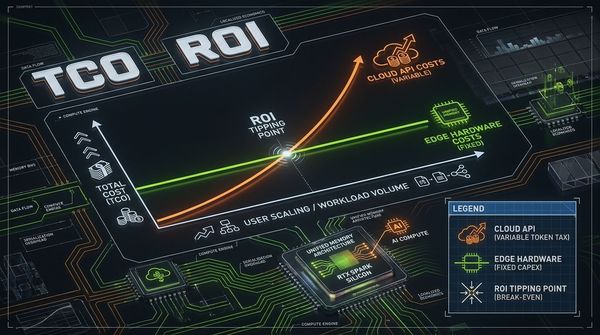
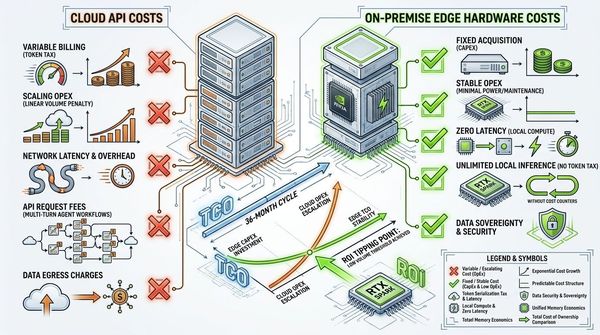
Rationalising a pivot to edge infrastructure requires a comprehensive 3-year TCO baseline contrasting two distinct architectural pathways:
Centralised Cloud Path
Evaluating remote infrastructure exposes three recurring expenditure vectors:
- Variable Billing : API consumption scales linearly with input/output token volume.
- Transfer Overheads : Persistent data routing incurs ongoing network bandwidth egress fees .
- Integration Drag : Third-party integrations demand continuous monitoring and maintenance cycles.
On-Premise Edge Hardware Path
Localised deployments transition financial models towards three fixed-cost categories:
- Capital Expenditure (CapEx) : Upfront acquisition of unified memory workstations (e.g., Apple M-Series Ultra desktop arrays) or discrete Nvidia Ada Lovelace GPU configurations.
- Operational Expenditure (OpEx) : Predictable baseline costs encompassing physical security, local IT management, and hardware depreciation across 36 months.
- Power Utility : A 500W node operating 24/7 under peak 350W-500W load adds less than $50 to monthly utility overhead under standard corporate electricity pricing.
3. The Local Compute ROI Tipping Point
Establishing the financial tipping point for local compute requires analysing a standard engineering division of 50 developers across two deployment scenarios:
Cloud API Scenario
Executing continuous local agent testing on remote infrastructure yields three strict financial liabilities:
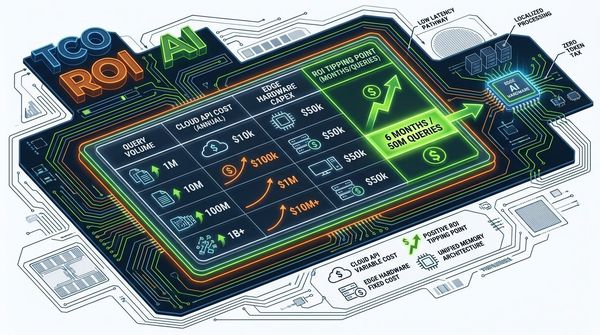
- Token Volume : 50 users executing 500 daily tasks at 50,000 tokens per task generates a daily volume of 1.25 billion tokens.
- Daily Expenditure : Applying a blended rate of $5.00 per million tokens results in a daily operational cost of $6,250.
- Annual Burn : Over a standard 20-day working month, monthly API expenditure reaches $125,000, totalling $1.5 million annually.
Edge Hardware Scenario
Provisioning the same 50-developer team with 128GB unified memory workstations introduces three strategic financial advantages:
- Fixed Acquisition : Procuring local units requires an upfront CapEx of $200,000 (approximately $4,000 per workstation).
- Accelerated Amortisation : The capital investment amortises completely in under 2 months, supplemented by immediate tax deductions via depreciation schedules like MACRS 5-year or Section 179 .
- Zero Marginal Cost : Post-amortisation, query execution incurs zero transaction fees, driving immediate expansion of software margins.
4. Unified Memory and the Local Edge Advantage
Executing this economic pivot requires replacing legacy datacenter-dependent clusters with three specific silicon and algorithmic advancements:
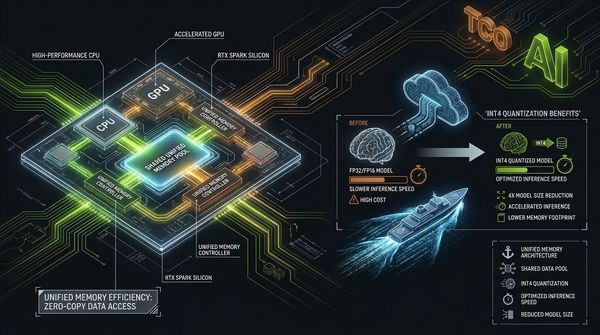
- Memory Locality : Client SoCs (such as Apple's M-Series Ultra) integrate CPUs and GPUs directly with up to 192GB of high-bandwidth unified memory, completely bypassing historical PCIe bus latency bottlenecks.
- Algorithmic Compression : Executing massive parameters on $4,000 hardware mandates rigorous model quantisation ( GGUF , INT4 ) alongside localised inference frameworks like MLX or Llama.cpp .
- Low-Latency Orchestration : Binding quantised weights directly on-device forces local agents to execute rapid, recursive loops entirely isolated from external network latency.
Combining these three technologies allows heavily compressed models to rival remote datacenter output at a fraction of the hardware footprint and energy cost, as demonstrated in Co-training and Co-distillation for Quality Improvement and Compression of Language Models .
Conclusion & Strategic Advice
The transition to edge intelligence helps reclaim software margins across high-frequency operations. Multi-turn AI loops dictate a shift toward unified memory hardware to secure fixed-cost predictability.
Deploying this architecture introduces three distinct operational caveats:
- Capital Requirements : Local compute mandates substantial upfront financial allocation and introduces direct hardware deprecation risk over a 3-year cycle.
- Utilisation Modelling : Seasonal workloads risk leaving expensive cores idling, requiring rigorous throughput baselining to justify acquisition.
- Infrastructure Overhead : Localised deployments dictate active IT management and strict physical security protocols.
To advance the integration of high-capacity hardware with optimised local intelligence, explore the subsequent architectural strategies in The Distillation Path: Shrinking Models for the Local Edge. Audit your existing token burn to identify systems paying a variable tax on operations that function more profitably as fixed hardware assets.
Transitioning to edge intelligence is no longer just a privacy play—it is a mandatory financial mechanism to secure fixed-cost predictability. 💬 At what query volume does your cloud AI infrastructure become unsustainable? Drop your insights below and ♻️ share this post to help your network audit their token burn!
Further Reading
- Understanding the Performance and Power of LLM Inferencing on Edge Accelerators
- Agent Memory Below the Prompt: Persistent Q4 KV Cache for Multi-Agent LLM Inference on Edge Devices
- Dynamic Pricing for On-Demand DNN Inference in the Edge-AI Market
More From Me
Original Article: Read on LinkedIn | Read on Substack