Optimizely Opal: Connecting Enterprise AI to Your Toolchain
Introduction
Standalone generative language models produce fluent text, but isolated systems create operational friction. Copying and pasting prompts between separate dashboards adds latency, breaks audit trails , and limits artificial intelligence to basic copywriting.
Building on the principles in Optimizely Opal: The Hub-and-Spoke Architecture , enterprise deployments require connecting autonomous agents directly to internal toolchains and databases.
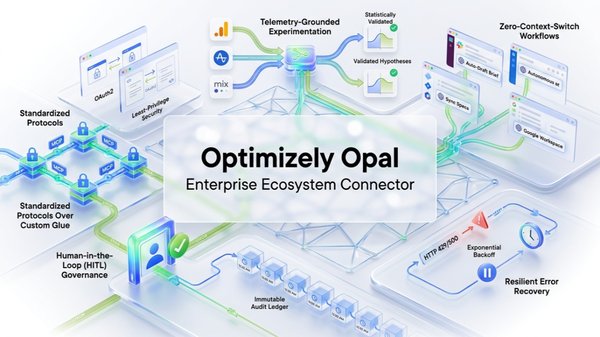
Optimizely Opal is an asynchronous orchestration layer designed to handle API schema drift and rate limits . It converts conversational requests into structured, reliable API calls. This guide outlines how to connect Opal across workplace suites, real-time analytics platforms , customer data systems, and content repositories.
The Shift from Isolated Chatbots to Integrated Ecosystems
Isolated chatbots produce static text bounded by their training data. By contrast, connected agentic systems read application state, work within operational schemas, and trigger deterministic downstream actions.
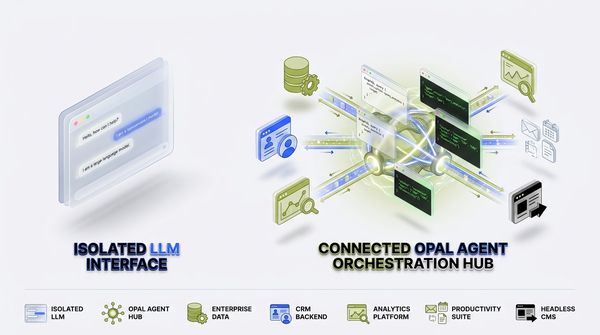
Using structured API calls and standard protocols like the Model Context Protocol (MCP) , Opal agents operate across four primary boundaries:
- Delegated Authority : Opal connectors rely entirely on delegated OAuth2 user credentials or enterprise service principals .
- Administrative Boundaries : Agent execution capabilities remain strictly bounded by permissions configured within external identity providers and third-party administrative consoles.
- Context Drift Control : As highlighted in martingale analyses of agent fidelity such as Information Fidelity in Tool-Using LLM Agents (arXiv:2602.13320) , recurring semantic re-grounding is essential to mitigate multi-step tool distortion.
- Fault Tolerance & Error Recovery : Long-horizon autonomous tasks mandate standard operational procedures for API failure recovery. When MCP orchestrations encounter HTTP 429 (Too Many Requests) or HTTP 500 (Internal Server Error) responses, agents deploy empirical protocols like exponential backoff and state-preserving pauses rather than hallucinating successful state mutations.
Productivity & Collaboration Connectors: Google, Microsoft & Slack
Embedding agents directly into daily collaboration environments eliminates manual context switching across three core workplace ecosystems:
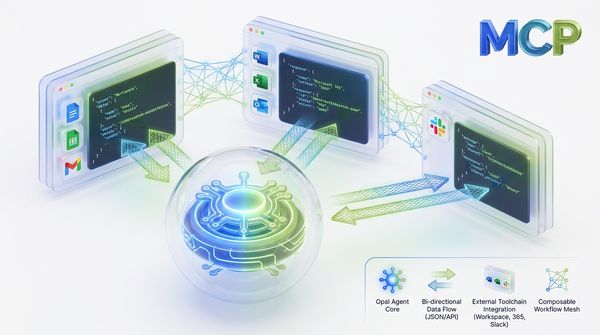
- Google Workspace & Microsoft 365 : Opal agents read product specifications in Google Sheets and Excel, write structured drafts in Google Docs and Word, and prepare follow-up emails in Outlook and Gmail.
- Slack & Microsoft Teams : Teams call specific agents in channels (such as @opal-brief-bot ) to share sprint updates, summarise incident logs, or convert content formats.
- Atlassian Jira & Confluence : Agents analyse customer feedback, create Jira tickets with clear reproduction steps, and ground details against indexed Confluence pages.
Analytics and Behavioural Grounding: GA4, Amplitude, and Looker
Integrated agents base their reasoning on live telemetry rather than assumptions:
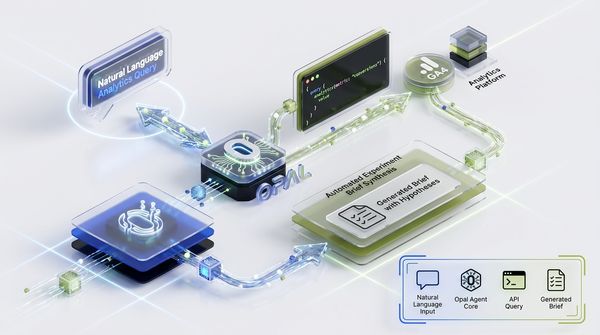
- Google Analytics 4 & Adobe Analytics : Agents convert natural-language diagnostic requests into reporting API queries, identifying drop-offs and bounce anomalies without manual report builds.
- Amplitude & Mixpanel : Funnel drop-off telemetry feeds into testing pipelines to produce data-backed variant hypotheses inside Optimizely Web Experimentation.
- Looker & Tableau : Agents compile dashboards into weekly executive summaries that pinpoint actionable pipeline variances.
CRM, Marketing Automation & Commerce Pipelines
Sharing customer data allows agents to coordinate workflows across business systems:
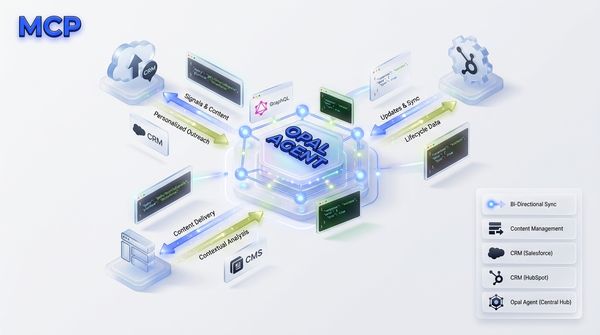
- Salesforce & HubSpot : Agents review deal history, summarise CRM logs, and write account-specific outreach based on past interactions.
- 6sense & ZoomInfo : Agents mechanically read live firmographic intent signals to surface account-based insights. The subsequent writing or publishing of dynamic web audience segments to adapt content delivery mandates passage through explicit human-in-the-loop (HITL) gates to prevent runaway personalisation loops and enforce strict state governance.
- Content Repositories : Approved copy, media assets, and structured taxonomy schemas synchronise bi-directionally across the Optimizely Content Marketing Platform (CMP) and headless CMS endpoints.
Governance, Security, and Failure Modes
Connecting enterprise systems to autonomous execution requires strict containment, as detailed in Queen-Bee Agents: A BeeSpec-Centered Architecture for Governed Enterprise MCP Orchestration (arXiv:2606.06545) :
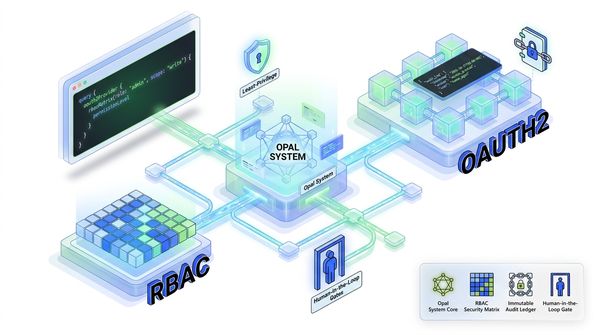
- Least-Privilege RBAC : Connectors enforce minimal OAuth2 scopes, keeping telemetry endpoints read-only and separating destructive write actions.
- Human-in-the-Loop (HITL) Gates : Publishing content, altering database records, and launching campaigns require explicit human approval before execution.
- Immutable Audit Ledgers : Every external payload dispatch, credential handshake, and agent decision is recorded for SOC 2 , ISO 27001 , and GDPR compliance standards.
- Operational Fallback : Systems must handle changing third-party schemas and rate limits. Agents use webhooks for asynchronous callbacks and apply backoff strategies when APIs slow down. If automated recovery fails, the agent pauses, saves state, and alerts an operator.
Conclusion & Strategic Advice
The value of enterprise AI comes from closed-loop execution. Connecting Optimizely Opal to everyday software, analytics platforms, and core CRMs moves teams past manual prompt typing into governed, reliable pipelines.
Focus deployment across three areas:
- Analytics & Experimentation : Connect GA4 and Amplitude first so variant ideas come from real user behaviour.
- Editorial & Go-to-Market : Link CMP, Slack, and Microsoft 365 to eliminate manual copying across tools.
- Platform Architecture : Put strict OAuth2 scopes and MCP rules in place before opening up write permissions.
To configure production-grade API contracts, webhook routing recipes, and phased integration rollouts, explore the next instalment in our series: Optimizely Opal: Implementation Blueprint and Strategic Integration Roadmap .
💬 How is your team bridging the execution gap between generative LLMs and production databases? Drop your insights below and ♻️ repost to help your network build governed agentic workflows!
Further Reading
- Optimizely Opal Platform Overview & Architecture
- Model Context Protocol (MCP) Open Specification
- Optimizely Web Experimentation Developer Documentation
More From Me
- Optimizely Opal: Implementation Blueprint and Strategic Integration Roadmap
- Optimizely Opal: Connecting to Core Enterprise Infrastructure
- Optimizely Opal: Why Isolated Intelligence Encounters the Enterprise Wall
- Optimizely Opal: Architecting Hybrid Intelligence
- Understanding Optimizely: Content Marketing Platform (CMP)
Original Article: Read on LinkedIn | Read on Substack