HTMX 4.0: The Fetch Rewrite Changes Everything
Introduction
Building on the hypermedia fundamentals established in HTMX Hypermedia Returns: The Old/New Architecture of the Web , declarative HTML-over-the-wire has crossed an architectural threshold. For years, hypermedia workflows delivered server-driven simplicity while carrying the legacy weight of XMLHttpRequest (XHR) transport mechanics, destructive DOM swaps, and implicit attribute cascading.
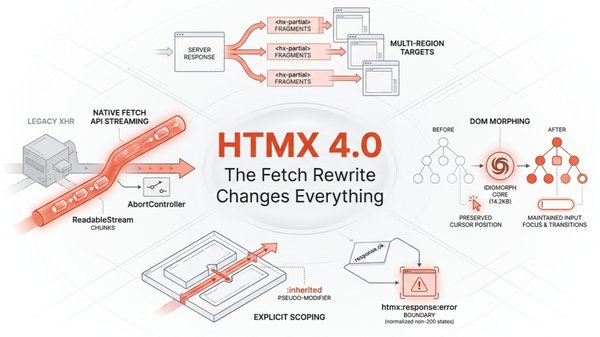
The arrival of HTMX 4.0 resolves these structural compromises by re-architecting the core transport layer around browser-native primitives and integrating surgical DOM diffing.
Modernising server-rendered web architectures with HTMX 4.0 addresses three core operational vectors:
- Enterprise Error Boundaries : The 4.0 engine natively intercepts Fetch default behaviour, where HTTP error statuses do not reject the Promise, by evaluating response.ok internally and automatically normalising non-200 responses to trigger the new htmx:response:error event without custom intercept scripts.
- Native Primitives : Upgraded transport mechanics eliminate XHR constraints in favour of modern streaming, precise abort signals, and unified security policies.
- Deterministic Upgrades : This guide breaks down the core breaking changes, operational caveats, and practical migration steps required to modernise your server-rendered web architectures.
1. The Watch Item That Shipped
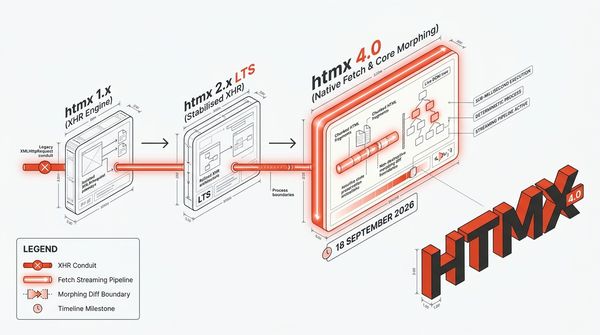
The release of HTMX 4.0 on 18 September 2026 (detailed in the InfoQ Announcement ) marks the definitive end of the legacy XHR engine. While version 2.x stabilised hypermedia controls under long-term support, 4.0 rebuilds the underlying network transport and reconciliation layers without compromising declarative simplicity.
2. The fetch() Rewrite: What Actually Changes
Under the hood, HTMX 4.0 replaces XMLHttpRequest with the browser-native MDN Fetch API .
This modernisation unlocks four core architectural advantages:
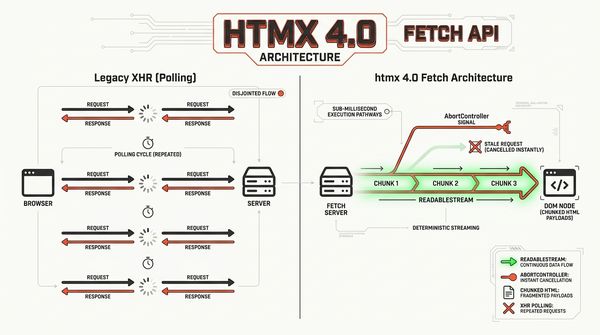
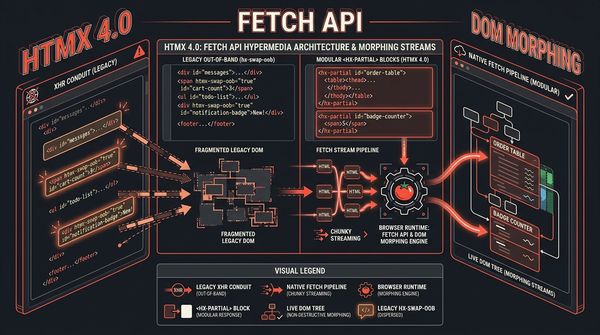
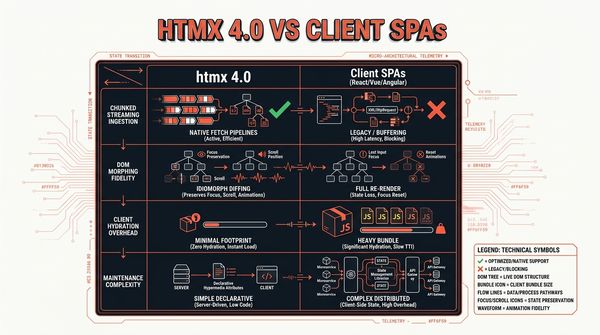
- Chunked Streaming Ingestion : Native ReadableStream integration enables progressive HTML processing. Server backends can stream partial table rows, telemetry counters, or dynamic fragments directly into the DOM as chunks arrive, eliminating legacy polling.
- Deterministic Request Cancellation : First-class AbortController signals replace erratic .abort() methods, ensuring instant socket termination upon debounced inputs or fast route transitions.
- Native Error Boundary Normalisation : Unlike XHR, window.fetch() does not reject its Promise on HTTP error statuses (e.g., 400, 404, 500); it only rejects on network failure. HTMX 4.0 reconciles this behavioural delta internally by evaluating response.ok and automatically triggering the htmx:response:error lifecycle event, maintaining reliable HTTP status code boundaries for enterprise error handling.
- Transport Security & CSP : Fetch evaluates directly against Content Security Policy (CSP) connect-src directives.
3. Built-In Morphing Swaps: Goodbye Idiomorph Extension
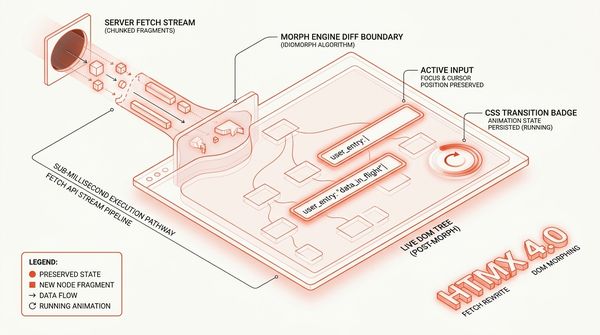
Prior releases defaulted to destructive element replacement, discarding text cursor positions, active input focus, and running CSS transitions unless augmented with the external Idiomorph DOM-Merging Algorithm .
<div hx-get="/telemetry/live" hx-trigger="every 3s" hx-swap="morph">
  <!--Live telemetry updates without dropping focus or scroll position -->
</div>
HTMX 4.0 incorporates morphing directly into the ~14.2 KB core bundle ( hx-swap="morph" ). The engine parses incoming HTML into a virtual fragment, computes the minimum structural diff, and updates only changed nodes and attributes.
Caveat & WAF Trigger : The browser no longer dispatches X-Requested-With: XMLHttpRequest by default. Web Application Firewalls (WAF) , rate limiters, or Cloudflare rules keyed on this header require updating or explicit restoration during the migration cutover phase.
4. hx-partial: Cleaner Fragment Updates
Targeting multi-region DOM mutations previously required scattered out-of-band ( hx-swap-oob="true" ) elements. HTMX 4.0 formalises multi-region targets using declarative <hx-partial> blocks:
<!-- Multi-target server response -->
<hx-partial id="order-table">
  <table><!-- Updated order rows --></table>
</hx-partial>

<hx-partial id="badge-counter">
  <span class="badge">12 Active</span>
</hx-partial>
The browser ignores <hx-partial> rendering entirely; htmx intercepts the stream and routes each fragment directly to its corresponding DOM target.
5. Explicit Attribute Inheritance: The Footgun Fixed
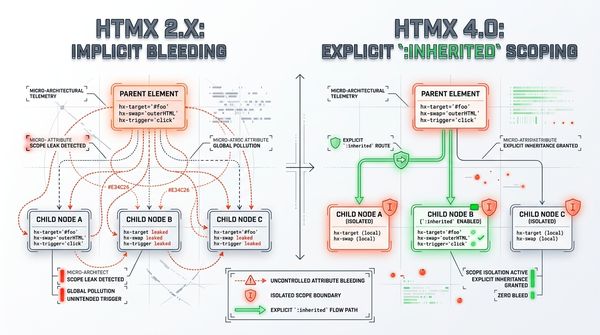
In 2.x, container attributes ( hx-target , hx-confirm ) cascaded implicitly down entire DOM subtrees, causing unexpected network triggers on nested elements. HTMX 4.0 makes attribute inheritance explicit via the :inherited pseudo-modifier:
<!-- Explicit scoping in server templates -->
<nav hx-target:inherited="#main-panel" hx-boost="true">
  <a href="/metrics">Metrics</a> <!-- Inherits target -->
  <button hx-target="#modal-root" hx-get="/action">Action</button> <!-- Isolated scope -->
</nav>
Any child element without :inherited maintains strict lexical isolation.
6. Event Name Standardisation
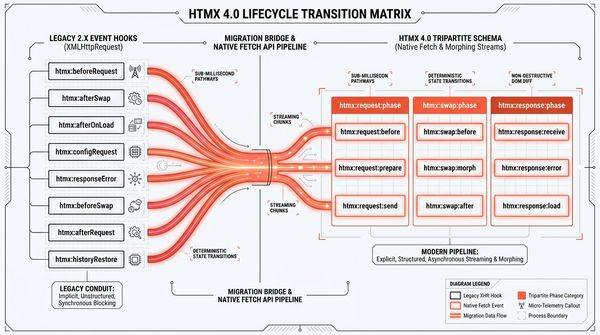
HTMX 4.0 replaces ad-hoc event descriptors with a structured tripartite lifecycle taxonomy ( htmx:phase:action ):
7. Migration Guide: 2.x → 4.x
Execute migration systematically across production codebases:
# Run automated CLI template scan
npx htmx.org@4.0.0 upgrade-check
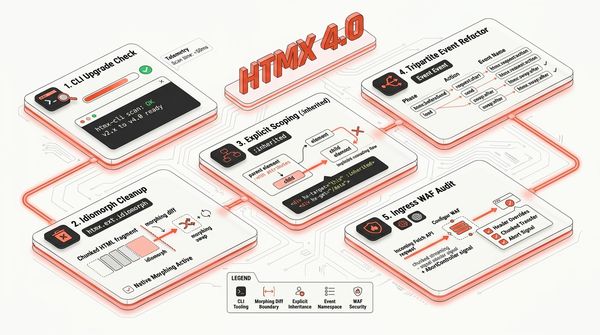
The upgrade procedure follows five sequential operational stages:
- Scan Layouts & Views : Execute npx htmx.org@4.0.0 upgrade-check across templates to flag legacy event bindings and un-scoped cascades.
- Remove Idiomorph Scripts : Strip separate Idiomorph bundle imports from base templates.
- Explicitly Opt-In Cascades : Convert cascading container tags to use :inherited .
- Refactor Event Listeners : Update client-side telemetry and custom JavaScript hooks to the tripartite event syntax.
- Audit Ingress Firewalls : Update WAF policies to accommodate standard Fetch requests and restore headers if necessary.
8. Server-Rendered Frameworks: The Enterprise Integration Layer
Across enterprise environments utilising Django, Go, Laravel, or Spring Boot, HTMX 4.0 serves as a universal integration layer, delivering sub-50ms server-rendered interactions without the hydration overhead of client-heavy SPAs.
ASP.NET Core provides a prime empirical case study for typed backend integration within enterprise CMS pipelines:
- Typed Middleware Integration : Pairing HTMX 4.0 with the HTMX.NET Package provides high-velocity server-rendered components.
- Persistent Header Handling : Because backend middleware like Request.IsHtmx() natively reads the persistent HX-Request header, server controller actions returning PartialView() remain intact while seamlessly benefiting from the new non-destructive client-side morphing engine.
9. What's Next: HTMX + Agentic Frontends
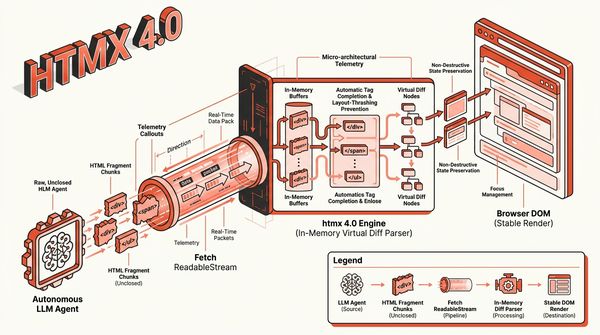
By combining fetch() streaming with zero-loss DOM morphing, HTMX 4.0 establishes a pristine edge interface for autonomous AI agents. Real-time language models can stream raw semantic hypermedia fragments directly into target containers—bypassing JSON serialisation pipelines and client-side reconciliation entirely.
Crucially, the new hx-swap="morph" algorithm natively resolves the severe bottleneck of processing fragmented, unclosed HTML nodes delivered via a chunked ReadableStream.
The engine manages incomplete streaming payloads across three mechanical phases:
- In-Memory Buffering : As an LLM yields incomplete HTML tags line-by-line (e.g., <div class="card" ), the HTMX 4.0 engine buffers the active stream through a virtualised DOM template parser.
- Automated Tag Completion : The parser auto-completes unclosed tags in memory and computes a safe structural diff.
- Layout Thrashing Prevention : Painting only valid, fully-formed nodes directly prevents active layout thrashing and stops malformed markup from bleeding into the user interface while the stream completes.
Conclusion & Strategic Advice
HTMX 4.0 eliminates the core technical compromises of hypermedia architectures. The modernisation to native Fetch transport, integrated morphing, robust native error boundaries, and strict lexical attribute scoping turns server-rendered interfaces into resilient, low-latency, and maintainable systems.
For teams building dynamic enterprise applications, HTMX 4.0 removes the architectural rationale for frontend SPA bloat. Audit your event pipelines, test your streaming endpoints, and migrate to explicit attribute scoping to take full advantage of the modern hypermedia web.
Are you planning to modernise your server-rendered templates with native Fetch and morphing, or staying on 2.x LTS? Drop your thoughts below 💬 and share this breakdown with your dev network! ♻️
Further Reading
- InfoQ: HTMX 4.0 Official Release Announcement
- MDN Web Docs: Fetch API and ReadableStreams
- Idiomorph: DOM Diffing and Reconciliation Specification
- HTMX.NET: Razor TagHelpers and Server-Side Middleware
More From Me
Original Article: Read on LinkedIn | Read on Substack