1M Output Trap: Will Massive Context Kill Planning
Introduction
Frontier foundation models have expanded output boundaries to staggering dimensions, epitomised by Gemini 4 Argon's headline 1,000,000-token output limit. While massive input contexts provide demonstrable utility for forensic codebase ingestion and documentation synthesis, expanding single-pass generation output to parity introduces severe systemic vulnerabilities.
This capacity expansion creates immediate architectural pressure across two primary vectors:
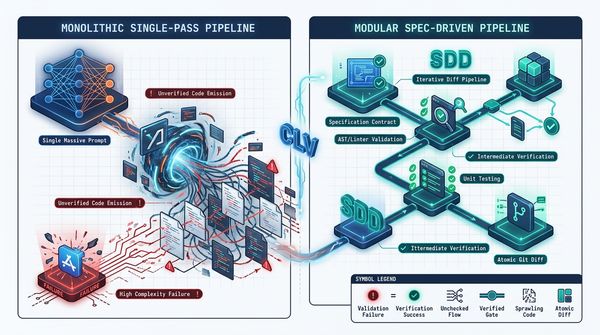
- Monolithic Prompt Collapse : Massive context windows tempt system designs to collapse modular execution pipelines into single, monolithic prompts.
- Pipeline Fragility : Generating entire systems in an unbroken pass strips away intermediate verification checkpoints and boundary isolation.
Evaluating this operational risk requires isolating the architectural boundary between Output Token Volume and Artifact Emission .
System designs diverge fundamentally based on how token budgets are allocated across three functional dimensions:
- Latent Reasoning : Allocating token volume to hidden chains-of-thought, tree search, and runtime self-correction preserves task planning discipline.
- Surface Emission : Mapping massive output streams directly to unverified, final artifacts introduces acute engineering fragility.
- Open-Loop Trajectories : Unbounded generation transforms manageable development pipelines into opaque, hours-long execution paths vulnerable to socket dropouts, memory bottlenecks, and cascading hallucinations.
Governing massive context windows requires dissecting autoregressive hardware constraints, enforcing spec-driven task decomposition, and implementing continuous verification gates.
Production deployments demand disciplined operational boundaries across two primary interface constraints:
- Hardware Realities : Autoregressive decode remains strictly memory-bandwidth bound, making multi-hour generation streams physically fragile.
- Bounded Interfaces : Multi-token horizons function reliably as internal reasoning engines rather than unconstrained artefact emission pipelines.
1. The Siren Song of Single-Pass Generation
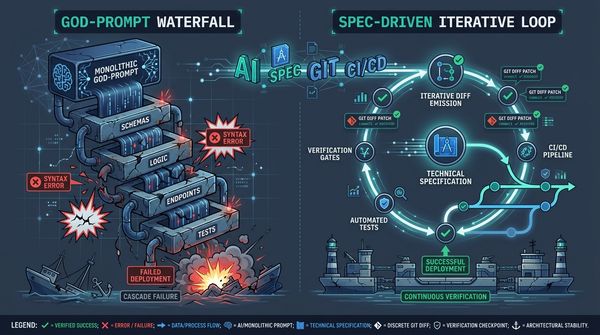
Collapsing multi-stage implementations into an uninterrupted 1M-token stream resurrects the classic software engineering anti-pattern of the God Object . Enterprise platforms currently market 1M outputs for single-shot codebase migrations, requesting entire distributed platforms spanning schemas, business logic, endpoints, and test suites in a single prompt.
Production engineering teams encounter three critical failure modes when deploying single-pass prompt abstractions:
- Erosion of Boundary Isolation : Prompt abstractions that bypass discrete decomposition strip out interface boundaries, coupling distributed components through statistical token proximity.
- Absence of Intermediate Compilation : Systems emit monolithic code dumps devoid of incremental syntax and compile checks, preventing mid-flight error isolation.
- Shift to Spec-Driven Loops : Open-loop 'vibe coding' fails under production constraints, necessitating closed-loop, spec-driven agentic execution.
2. The Physics of Autoregressive Decoding
The mechanical constraints of massive surface emission reside directly in accelerator hardware execution. While prompt prefill is compute-bound and saturates matrix cores in parallel, autoregressive token decoding remains strictly memory-bandwidth bound.
This hardware dynamic imposes four operational bottlenecks during continuous generation:
- Memory-Bandwidth Saturation : Each discrete token requires streaming model parameter weights and the accumulating Key-Value (KV) cache from high-bandwidth memory directly into SRAM.
- Sequential Decode Latency : At sustained production throughputs of 50 to 80 tokens per second, emitting 1,000,000 tokens requires between 3.5 and 5.5 hours of unbroken streaming.
- Topological Footprint : In an unoptimised 70B parameter model, a 1M-token KV cache consumes approximately 330 GB of VRAM; even with DeepSeek-V2 Multi-head Latent Attention , cache overhead demands tens of gigabytes per concurrent user session.
- Inherent Serialisation : Techniques like Speculative Decoding reduce wall-clock latency by drafting candidate tokens concurrently, yet autoregressive generation remains strictly sequential.
Prefix caching mitigates input costs by sharing KV blocks across identical input prompts, but provides zero deduplication for autoregressive output generation.
Output caching fails due to two physical constraints:
- Position-Dependent Keys and Values : Because each generated token depends strictly on its specific sequence position and preceding history, KV state cannot be shared across disparate generation passes.
- Socket Volatility : A single dropped TCP socket, network timeout, or GPU node failure at hour four invalidates the entire multi-hour emission run without recovery checkpoints.
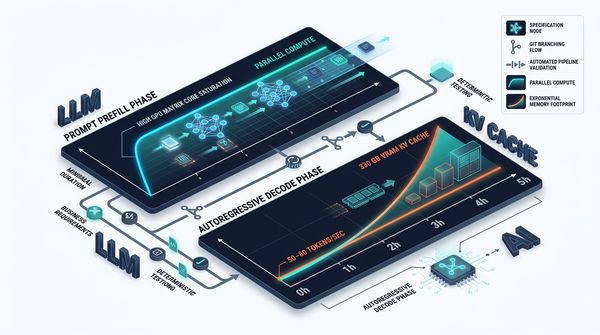
Visual Suggestion : Parallel Prefill vs. Sequential Decode Throughput and Latency Curves
3. The Death of Task Planning and Spec-Driven Design
Enforced token ceilings of 4k to 16k tokens historically served as vital architectural forcing functions. Bounded output windows mandate breaking complex architectures into isolated modules, deterministic directory structures, and verifiable functions.
Unbounded artifact emission undermines systems engineering through three procedural breakdowns:
- Specification Degradation : Unbounded generation displaces structured technical specifications in favour of speculative, unconstrained prompts.
- Boundary Dissolution : Methodologies like GitHub Spec-Kit define verifiable boundaries and architectural constraints before code execution begins.
- Loss of Governance Gates : Without explicit execution milestones, intermediate linting gates, and human-in-the-loop validation checkpoints, systemic governance degrades into uncontrollable generation trajectories.
Massive output contexts support task planning when paired with Inference-Time Compute scaling laws (such as OpenAI o1 and DeepSeek-R1), which allocate massive token budgets to latent execution planning.
Inference architectures separate hidden computation from surface emission across two dimensions:
- Latent Search and Simulation : Modern inference engines deploy massive token allocations internally for tree-of-thought search , hypothetical branch simulation, and self-correction scratchpads shielded from the end-user.
- Unverified Surface Mapping : Software discipline breaks down specifically when these multi-token budgets are mapped directly and without verification into final production codebases.
4. The Verification Gap: Cascading Hallucination at Scale
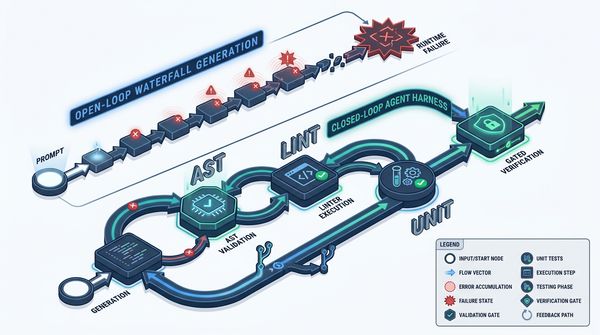
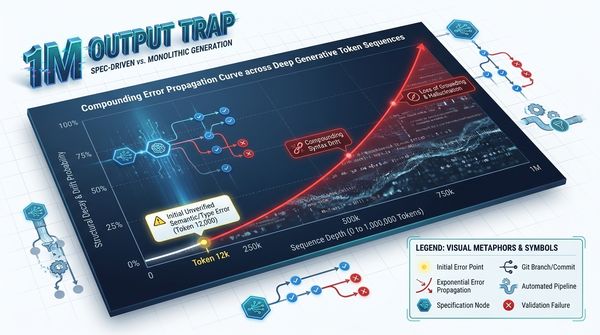
Autoregressive decoding generates each discrete token conditioned strictly on preceding emissions. If an erroneous type definition, broken dependency, or invalid assumption emerges at token 12,000, all subsequent 988,000 tokens are emitted to maintain statistical consistency with that initial fault.
This open-loop emission creates a stark verification divergence across three execution dynamics:
- Modular Runtime Feedback : In bounded workflows, compilers and language servers intercept invalid abstract syntax trees within milliseconds, triggering localized retries before error compounding occurs.
- Absence of In-Flight Interception : Monolithic surface emission lacks runtime feedback loops or mid-flight execution environments, allowing early structural faults to permeate downstream dependencies over multi-hour runs.
- Generative Syntax Drift : Parallel to how Lost in the Middle establishes retrieval degradation across mid-context distributions, compounding syntax and schema drift creates structural decay across deep generation depths.
5. Architectural Sovereignty: Small Files, Atomic Commits
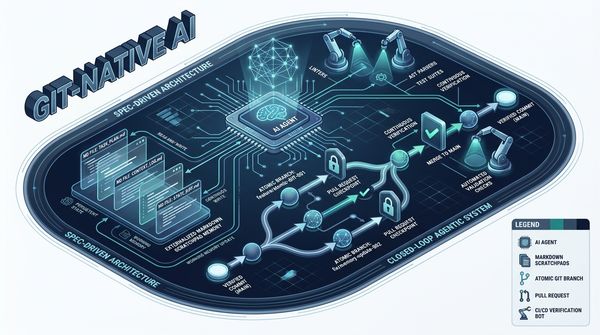
Resilient architectures prioritise atomic, Git-native state externalisation over continuous generative streams. Working memory, architectural decisions, and agent scratchpads belong in transparent Markdown documents version-controlled within repository history, as demonstrated in the OpenClaw Starter Workspace .
Architectural sovereignty requires establishing Test-Time Compute as a primary structural foundation rather than an unconstrained generation mechanism.
Frontier model deployments require redirecting token consumption into three disciplined verification layers:
- Internal Reasoning Loops : Channel token budgets into automated internal linting, strategic task decomposition, and hidden verification scratchpads prior to emitting file modifications.
- Surgical Diff Emissions : Bound artifact output to concise, verifiable Git patches that compile cleanly and pass unit test suites within CI/CD pipelines.
- Deterministic Repository Governance : Enforce strict pull-request boundaries so every code change remains isolated, verifiable, and auditable under repository controls.
Conclusion & Strategic Advice
Massive output windows provide clear architectural utility when teams enforce strict boundaries between latent reasoning and surface emission. Their practical value emerges in specialised workloads, such as un-truncated legal contract redlines, multi-hour audio transcription with temporal alignment, and hidden reasoning scratchpads for self-correction.
Treating mega-output limits as a replacement for modular task decomposition introduces fragile, unverifiable failure points.
Enterprise workloads require governing generative inference through two distinct operational frameworks:
- Monolithic Mega-Output : Confine strictly to immutable ingestion audits, forensic analysis, latent test-time compute, and single-pass historical synthesis where code execution and intermediate runtime dependencies do not exist.
- Spec-Driven Agentic Loops : Mandate for all software engineering, data pipeline development, and infrastructure provisioning. Enforce hard sub-task token limits for surface artiartefactfacts (sub-4k tokens), validate against automated test runners at each milestone, and externalise state to Git-tracked diffs.
Audit current operational workflows to eliminate open-loop artifact generation. Enforce strict pull-request boundaries, deploy massive context windows exclusively for internal reasoning, and embed deterministic compiler gates across every production inference pipeline.
Are your teams moving toward modular, spec-driven diffs or falling into the single-pass mega-prompt trap? Drop your thoughts below💬 and share this with your engineering network! ♻️
Further Reading
Examine deeper technical analyses on inference optimisation and serving architectures:
- vLLM: Easy, Fast, and Cheap LLM Serving with PagedAttention — vLLM Project Blog
- Assisted Generation: a new direction toward low-latency text generation — Hugging Face Engineering
- How continuous batching enables 23x throughput in LLM inference while reducing p50 latency — Anyscale Engineering
More From Me
Reference related publications on agent architectures and context governance:
Original Article: Read on LinkedIn | Read on Substack