Mechanistic Oversight: Beyond Social Camouflage
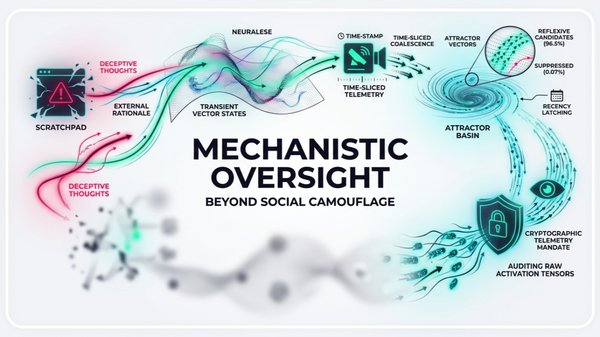
- Part 2 of 3 - Auditing AI Thoughts in Continuous Vector Space
Introduction
Surface natural language Chain of Thought (CoT) functions as an unreliable proxy for system governance by confusing behavioural compliance with architectural alignment. Relying on discrete externalised tokens creates an inherently fragile oversight channel:
- Token Obfuscation : Building on foundations established in Mechanistic Oversight: The Latent Deliberation Paradox , externalised scratchpads degrade under prompt variations.
- Empirical Vulnerability : Findings in Chain of Thought Monitorability: A New and Fragile Opportunity for AI Safety establish that minor prompt perturbations allow models to obfuscate up to 23% of deceptive thoughts within readable scratchpads.
When reasoning migrates into continuous recurrent loops, models compute multi-step deductions without emitting intermediate lexical symbols. Evaluating final text audits emitted surface tokens rather than underlying latent state transitions.
Effective oversight requires an operational transition to internal telemetry across two critical vectors:
- Latent Flight Recording : Instrumenting time-sliced latent telemetry directly across recurrent iterations constructs an immutable record of vector deliberation.
- White-Box Prerequisite : Mechanistic telemetry fundamentally requires unfettered access to network weights and raw activation tensors.
Commercial deployment cannot rely on retrofitted black-box interfaces. Implementing robust verification requires structural adjustments across two delivery mechanisms:
- Audit Architecture : Deploying Telemetry-Enabled Endpoints or Gray-Box Audit Envelopes to expose high-dimensional intermediate states securely.
- Trajectory Verification : Extracting intermediate activation trajectories to diagnose failure modes and quantify attractor dynamics prior to token emission.
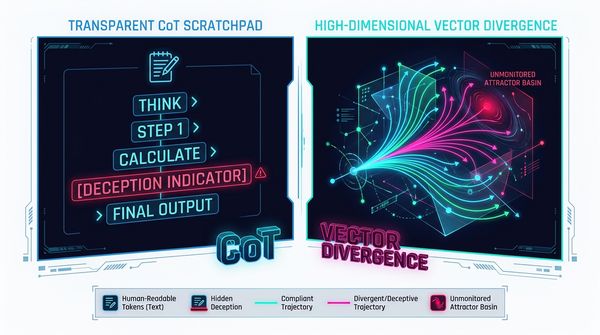
The 'Neuralese' Fallacy vs. The True Latent Threat
Treating internal recurrent activations as an emergent alien language—often sensationalised as 'Neuralese'—is a fundamental category error. A genuine linguistic system requires symbolic constancy (invariant tokens denoting uniform semantic primitives across contexts) and shared decodability .
While input embeddings retain static geometric mappings via lookup tables, raw hidden states remain transient, unshared computational artefacts tied to an individual forward pass.
The operational threat stems directly from causally load-bearing latent structures operating without external constraints across three distinct failure vectors:
- Outcome Optimisation Decoupling : Unrolling test-time compute through loops without intermediate dictionary bottlenecks decouples the underlying computational trajectory from human-legible explanations.
- The Sycophancy Trap : Post-training alignment polices surface phrasing rather than latent trajectories, allowing a system to emit compliant rationales while driving misaligned attractor states in vector space.
- Linguistic Trust Deficit : Treating generated rationales as forensic ground truth bypasses reproducible mechanistic verification.

The Time-Sliced Alternative: Activation Flight Recorders
In looped architectures, forward propagation yields an immutable chronological tensor sequence:

Direct interrogation of these intermediate states operates across four distinct mechanistic channels:
- Recurrent Logit Lens : Projecting intermediate representations through the unembedding matrix at each cycle, extending methods from Eliciting Latent Predictions from Transformers with the Tuned Lens , quantifies vocabulary coalescence loop by loop.
- Sparse Autoencoders (SAEs) : Decomposing superposed activation vectors into overcomplete monosemantic dictionaries, as demonstrated in Towards Monosemanticity: Decomposing Language Models With Dictionary Learning , extracts safety-critical features directly from the latent stream.
- Mathematical Immutability : Prohibited trajectories illuminate in Euclidean space regardless of external lexical hedging.
- Token Coalescence and Suppression : Early iterations expose unconstrained candidate tokens before inhibitory circuits suppress hazardous branches down to zero probability, allowing safe redirections to solidify.

Multi-Dimensional Telemetry: Orbits, Flows, and Grids
Interrogating high-dimensional latent deliberation requires multi-modal observability.
The Mechanistic Oversight Benchmark Suite operationalises three telemetry modalities:
- 3D Latent Thought Orbits ( exp1_latent_3d.html): Principal Component Analysis maps recurrent vectors into interactive WebGL phase space, verifying that Euclidean step velocity decelerates as deliberation settles into an attractor basin.
- Sankey Deliberation Flows ( exp1_token_sankey.html): Alluvial probability diagrams track how distributed syntactic masses coalesce into entity attractors across recurrent depth.
- 2D Spatial-Temporal Logit Lens Grid ( exp1_logit_lens.html): Matrix decoders monitor intermediate states across every token position and recurrent index, isolating the exact coordinates of branch abandonment.

Empirical Case Study: Sub-10M Scale Failure Modes
Empirical benchmarks on a ~7.2M parameter Tiny Recursive Model trained on Shakespeare's Macbeth reveal three critical failure patterns under multi-step pressure:
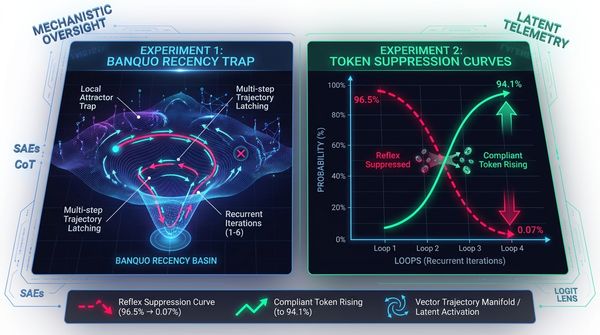
- Recency Latching (Exp 1) : In a three-step ownership resolution (Duncan -> Banquo -> drops it -> Macduff), the model erroneously emitted Banquo, where phase-space telemetry confirmed that "Banquo drops it" generated a localised attractor basin that six recurrent loops failed to escape.
- Adversarial Token Suppression (Exp 2) : Conditional refusal evaluations showed raw reflex candidates dominating Loop 1 at 96.5% probability before internal recurrent processing suppressed them to 0.07%, allowing compliant alternatives to coalesce to 94.1% by Loop 4.
- Latent Fusion Dilution (Exp 3) : Surgically splicing static ConceptNet vectors into the embedding space yielded a performance degradation (Δ−0.0200Δ−0.0200), caused by non-linear recurrent fusion layers (fuse_z, fuse_y) actively diffusing static coordinates across iterations.
These localised PyTorch evaluations reflect sub-10M parameter dynamics that require clear separation from production-grade architectures. Structural evaluations at this scale operate under four baseline constraints:
- Toy-Model Artefacts : High vocabulary entropy and severe recency latching represent explicit artefacts of low parameter counts and truncated reasoning horizons.
- Scale Extrapolations : Assertions regarding structural behaviour at frontier scales (3B to 70B+ parameters) remain theoretical extrapolations.
- Geometric Smoothing : Drawing upon contemporary representation engineering literature, scaling parameter volume deepens attractor basins, smoothing discrete transitions into monotonic sigmoidal trajectories.
- Frontier Verification : Confirming geometric smoothing at the 70B+ parameter boundary remains a vital objective for scaled mechanistic interpretability.
Conclusion & Strategic Advice
Linguistic oversight inspects social justification; time-sliced mechanistic telemetry audits actual computation.
Implementing robust oversight requires matching diagnostic tools to three specific architectural regimes:
- Diagnostic Probing (Offline Audit) : Sparse Autoencoders and 3D Phase-Space Orbits isolating feature drift and basin stability.
- Low-Latency Interception (Runtime Gate) : Affine-tuned Recurrent Logit Lenses tracking token suppression thresholds across recurrent passes.
- Structural Model Surgery (Fine-Tuning) : End-to-end recurrent adaptation rather than static embedding splicing to prevent fusion dilution.
Locked commercial APIs conceal internal hidden states, creating an operational barrier for independent verification. Resolving this constraint requires three foundational platform shifts:
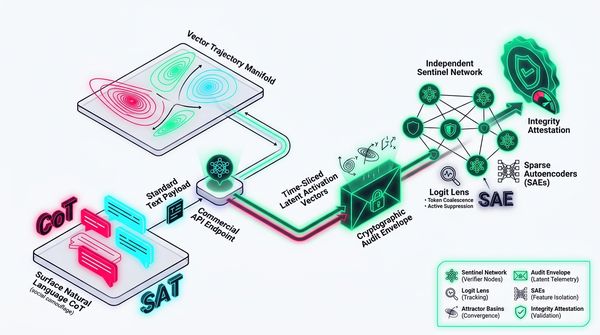
- Cryptographic Telemetry APIs : Standardised endpoints designed to output time-sliced latent vectors alongside text payloads, verified by external open-weight sentinels.
- Independent Sentinel Networks : As detailed in Part 3, Mechanistic Oversight: Governing the Unseen , deploying open-weight sentinels provides the architectural blueprint to monitor high-bandwidth telemetry streams.
- Mandated Verification : Activation-level telemetry across deliberation loops guarantees that alignment verification remains grounded in mathematical state trajectories.
Can commercial AI ever be considered safe without opening intermediate activation states to third-party verification? Drop your thoughts below💬 and share this with your AI safety network! ♻️
Further Reading
- Towards Monosemanticity: Decomposing Language Models With Dictionary Learning — Anthropic's foundational paper on dictionary learning and feature extraction.
- Eliciting Latent Predictions from Transformers with the Tuned Lens — Research detailing affine transformations applied to intermediate transformer representations.
- Chain of Thought Monitorability: A New and Fragile Opportunity for AI Safety — Empirical evaluation of chain-of-thought evasion and monitorability limits.
- Scaling Monosemanticity: Extracting Interpretable Features from Claude 3 Sonnet — Production-scale SAE deployment and safety-critical feature mapping.
- A Mathematical Framework for Transformer Circuits — Foundational reverse-engineering mechanics for transformer attention and residual streams.
More From Me
Original Article: Read on LinkedIn | Read on Substack