Mechanistic Oversight: The Latent Deliberation Paradox
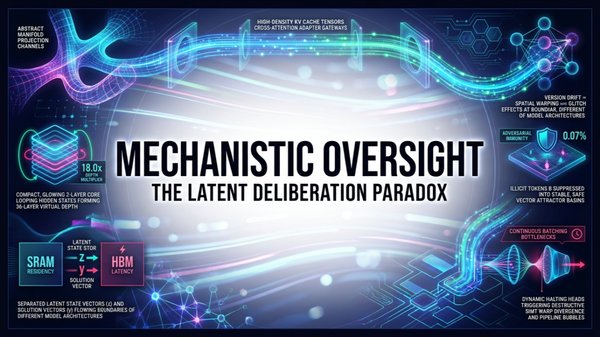
- Part 1 of 3 - Recurrent Depth, The Impulsivity Trap, and the End of Thinking Tokens
Introduction
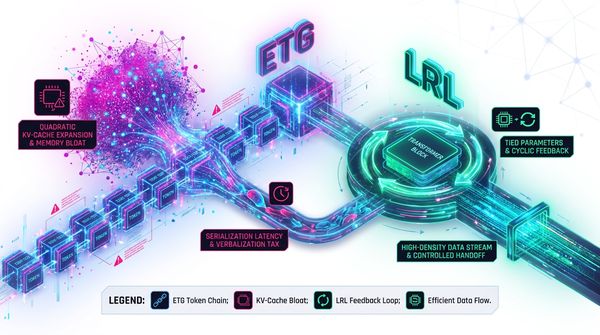
Building on the analysis of memory overhead and token throughput established in Latent Space: The Token Bottleneck , frontier reasoning systems face a fundamental architectural ceiling. Scaling test-time compute through explicit Chain-of-Thought sequences imposes three critical hardware bottlenecks:
- Key-Value Cache Expansion : Generating thousands of explicit tokens scales memory footprints quadratically across execution buffers.
- Network Serialisation Latency : Distributing long reasoning trajectories across multi-node clusters introduces substantial interconnect and transfer penalties.
- Verbalisation Tax : Forcing deliberative computation through human-readable vocabulary saturates memory bandwidth with non-essential token emissions.
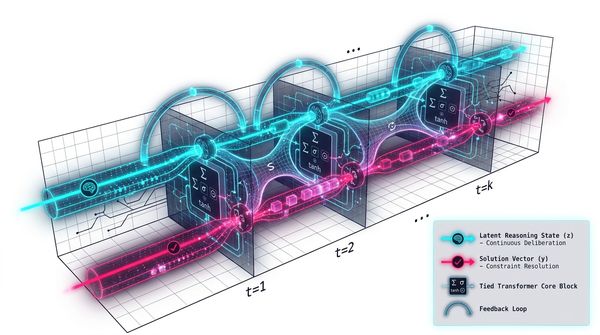
Representations cycle through tied parameters to resolve constraints non-verbally, decoupling internal computational work from external token emissions as demonstrated in Scaling up Test-Time Compute with Latent Reasoning .
Caveat & Context : Current proprietary frontier models, such as OpenAI's o1 family, continue to generate thousands of discrete reasoning tokens, paying a heavy explicit verbalisation tax. Recurrent depth architectures diverge from this paradigm by synthesising mechanics across three empirical sources:
- Pre-Print Research : Foundational test-time compute scaling outlined in February 2025 research ( arXiv:2502.05171 ).
- Patent Disclosures : Algorithmic specifications for tied-parameter recurrence and dynamic execution graphs.
- Empirical Validation : Benchmarking runs executed on local sub-10M parameter test harnesses.
While recurrent depth remains largely confined to experimental research environments rather than enterprise deployment, evaluating these mechanics determines whether adopting continuous latent loops justifies the training compute penalty for low-latency, high-assurance production pipelines.
The Structural Impulsivity Trap
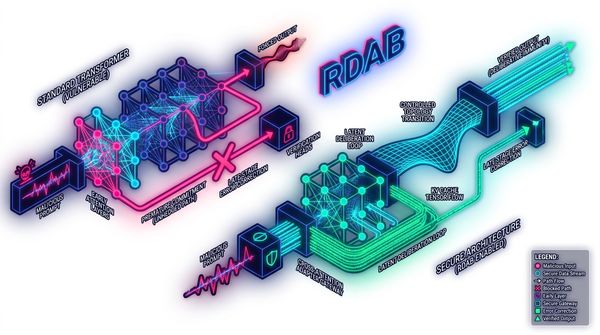
Standard autoregressive transformers are structurally impulsive. A single forward pass allocates an identical compute budget to every token regardless of semantic complexity, triggering two critical failure modes:
- Premature Commitment : The model cannot pause to evaluate conflicting premises or verify edge cases before appending text to the context buffer.
- Adversarial Exploitation : Malicious prompts exploit this reflex behaviour by steering early attention heads, forcing compromised output paths before error correction can intervene.
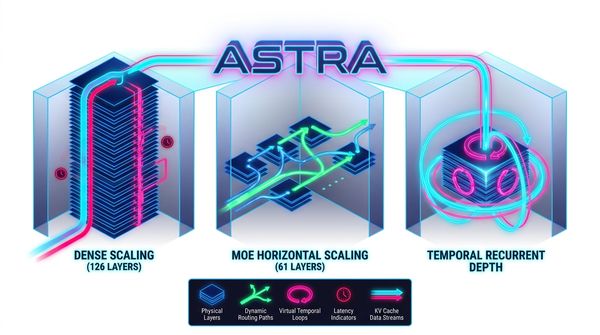
The Sequential Latency Wall: Dense vs. MoE vs. Recurrent Depth
Vertical depth cannot be parallelised across silicon clusters because layer execution (L1→L2→⋯→LN L 1→ L 2→⋯→ LN ) imposes strict serial dependencies. Frontier engineering addresses this constraint through three distinct architectural strategies:
- Dense Scaling Limits : Stacking established physical depth, such as the 126 layers in Llama 3.1 405B , pushes sequential inference latency to the edge of interactive viability.
- MoE Horizontal Scaling : Architectures like DeepSeek-V3 restrict sequential depth to 61 physical layers, routing dynamically across 37B active parameters out of 671B total weights to avoid memory stalls.
- Temporal Recurrent Scaling : Recurrent depth loops representations through a compact physical layer core (N N cycles), generating deep virtual problem-solving capacity without expanding the static parameter footprint.
Recurrent Depth: Temporal Scaling in Latent Space
In looped transformer topologies, hidden states update iteratively across a tied transformer block: ht(k)=TransformerBlock(ht(k−1)) h t ( k )=TransformerBlock( h t ( k −1)). Parameter tying alters execution graphs across middle layers while injecting learnable timestep embeddings to track temporal iteration.
Decoupling computation into paired operational vectors enables compact architectures to match massive dense networks, as demonstrated in Less is More: Recursive Reasoning with Tiny Networks by Samsung SAIL:
- Latent Reasoning State (zz) : Maintains continuous multi-step deliberation across recurrences without intermediate token emission.
- Solution Vector (yy) : Accumulates intermediate constraint resolutions, allowing sub-10M parameter networks to match 50B+ dense baselines on relational reasoning tasks.
The Inference Efficiency Equation: Bandwidth vs. FLOPs
Hardware execution trade-offs depend strictly on cluster memory bounds across three primary operational dimensions:
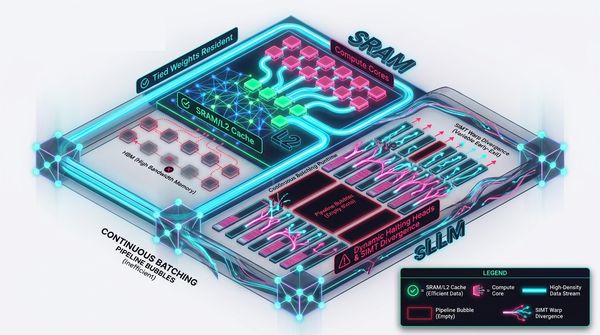
- Memory-Bandwidth Dominance : At batch size 1, autoregressive decoding is memory-bandwidth bound. Looped models maintain compact layer weights resident inside on-chip SRAM and L2 cache, eliminating repetitive High Bandwidth Memory (HBM) fetches.
- Arithmetic FLOP Reality : Looping L L times consumes L L times the matrix operations, but 16 latent loops require orders of magnitude fewer FLOPs than generating 2,000 explicit English reasoning tokens while eliminating key-value cache bloat.
- Continuous Batching Bottlenecks : Latent loops require a learned halting threshold via a dynamic halting head to determine hidden state convergence. In serving runtimes like vLLM, early-exit mechanisms based on Adaptive Computation Time (ACT) induce destructive pipeline bubbles and SIMT warp divergence because tokens within the same warp follow unaligned serialised execution paths.
Empirical Cost-Benefit Benchmark: Recurrent vs. Non-Recurrent Baselines
Controlled benchmarks on a matched Macbeth and logic corpus evaluate a 2-layer StaticFeedforwardTransformer against a 2-layer TinyRecursiveModel (TRM) unrolled across 9 loops across four core metrics:
- Parametric Efficiency : The recurrent model required 17% fewer parameters (3,465,984 vs. 4,171,264) via weight reuse.
- Virtual Depth : 9 recurrent loops with 2 latent updates delivered 36 effective virtual layers (2×9×2=362×9×2=36)—an 18.0x increase in cognitive depth over the 2-layer static baseline.
- Compute Overhead : Backpropagation Through Time (BPTT) increased training compute by 4.6x (~16.1 min vs. ~3.5 min), and per-token inference latency rose 19.7x (642.9 ms vs. 32.6 ms).
- Adversarial Resilience : In refusal stress tests, internal deliberation suppressed illicit tokens from 96.5% down to 0.07%. This statistical delta occurs through representation collapse within the model's attractor basin ; malicious prompt perturbations degrade across multiple latent updates until the hidden state converges onto a stable, safe vector before token verbalisation. The single-pass baseline lacks this convergence mechanism and emits reflex tokens impulsively.
Visual Suggestion : Matched Macbeth benchmark comparison layout illustrating virtual depth multiplier, training compute tax, and refusal delta.
Conclusion & Strategic Advice
Recurrent depth transitions transformer inference from reflexive generation to continuous vector deliberation, resolving structural impulsivity without memory saturation. Production implementation strategies divide into three operational profiles:
- Edge & Embedded Sandboxes : Deploy recurrent depth. On-chip SRAM weight residency eliminates HBM bandwidth bottlenecks on resource-constrained silicon.
- High-Throughput Cloud Serving : Maintain established MoE or fixed-depth baselines until dynamic depth schedulers resolve continuous batching pipeline bubbles in production environments.
- High-Assurance Workflows : Adopt latent recurrence where verifiable refusal and intermediate constraint satisfaction outweigh raw per-token latency.
Because latent deliberation eliminates visible text scratchpads, classical log inspection cannot observe internal cognition. In Part 2, Mechanistic Oversight: Beyond Social Camouflage , we analyse why explicit Chain-of-Thought functions as social camouflage, and how time-sliced activation telemetry provides a deterministic flight recorder of neural intent.
For hands-on evaluation, inspect the runnable benchmarks in the Mechanistic Oversight Benchmark Suite .
Can latent vector deliberation replace explicit Chain-of-Thought in production inference pipelines? Drop your thoughts below💬 and share this breakdown with your engineering network! ♻️
Further Reading
- Scaling up Test-Time Compute with Latent Reasoning: A Recurrent Depth Approach (Geiping et al., 2025)
- Less is More: Recursive Reasoning with Tiny Networks (Jolicoeur-Martineau, 2025)
- The Llama 3 Herd of Models (Meta AI, 2024)
- DeepSeek-V3 Technical Report (DeepSeek-AI, 2024)
More From Me
Original Article: Read on LinkedIn | Read on Substack