The Multiplicative Frontier: AI Scaling Isn't Hitting a Wall, It's Changing Coordinates
The Multiplicative Frontier: AI Scaling Isn't Hitting a Wall, It's Changing Coordinates
Introduction
The prevailing narrative across technology commentary asserts that machine learning has encountered an immutable ceiling. Market observers cite three primary constraints as evidence of an impending performance plateau:
- Corpus Depletion : The near-total exhaustion of high-quality human-authored public web corpora for baseline ingestion.
- Thermal Ceilings : Escalating data-centre power consumption and infrastructure cooling constraints.
- Pre-Training Saturation : Tapering benchmark differentials derived from raw pre-training scaling runs.
If artificial intelligence systems relied strictly on ingesting expanding static corpora into monolithic transformer architectures, progress would decelerate. Emerging architectural fundamental changes demonstrate the exact inverse.
Frontier laboratory telemetry, highlighted by researchers including Adam Majmudar, reveals an operational gap between external perception and modern inference trajectories. Rather than evaluating static next-token completion engines, frontier research deploys reinforcement learning search and test-time compute across two verified benchmark domains:
- Formal Mathematics : Autonomous solutions to Olympiad-tier problems, exemplified by OpenAI o1 and DeepMind's AlphaProof .
- Complex Systems Synthesis : Multi-step code generation and rigorous logical verification loops.
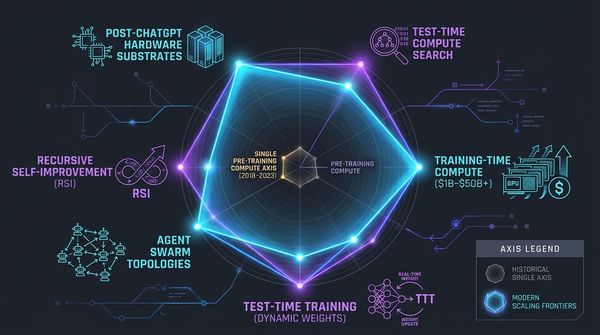
Pre-training compute serves as the initialisation of the coordinate space rather than the terminal boundary. System capability advances across six deterministic operational vectors:
- Post-ChatGPT Compute Substrates : Specialised silicon architectures tailored for high-throughput inference workloads.
- Test-Time Compute : Algorithmic heuristic exploration and deliberate search at runtime.
- Training-Time Compute Scaling : Multi-gigawatt facility investments scaling capital commitments from $1B to $50B+.
- Test-Time Training (TTT) : Dynamic in-context gradient updates applied directly to weights during runtime.
- Agent Swarm Topologies : Micro-agent distribution multiplying pipeline execution efficiency.
- Recursive Self-Improvement (RSI) : Automated synthetic data curation, kernel compilation, and hyperparameter tuning.
Evaluating these compounding axes allows enterprise architects to transition infrastructure pipelines from static prompt-response interfaces to dynamic, compound execution environments.
1. The Multiplicative Formulation: Beyond Additive Gains
Between 2018 and 2023, capability progression followed an essentially singular law: increasing compute budgets and dataset token counts during pretraining. Modern systems advance instead along a compounding lattice, where inference-time search multiplies baseline performance rather than providing incremental additive gains.
Inference search executes directly across the latent probability distribution established during pretraining. Systems model capability progression using a multiplicative power-law formulation rather than linear expansion:

This formulation represents a heuristic model that conceptualises post-training nonlinear dynamics rather than a formally proven mathematical theorem. Its operational implications dictate two primary architectural realities:
- Multiplicative Expansion : A 10x refinement in base semantic representation (Q_{\text{base}}), combined with a 100x expansion in test-time search depth (T_{\text{search}}), increases the reachable solution space by orders of magnitude.
- Bottleneck Inversion : The structural bottleneck moves away from raw training data ingestion toward runtime search efficiency over structured latent representations.
2. Empirical Verification: Search Depth, Hardware, and Dynamic Adaptation
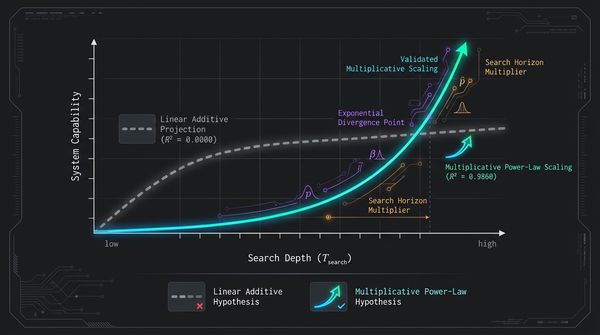
Workstation-level empirical verification using the Multiplicative Scaling Verification Suite and executed via run.ps1 confirms compounding behaviour against formal logic benchmarks in data/reasoning_benchmark.json . Statistical evaluation isolates the predictive power between two competing hypotheses:
- Linear Additive Hypothesis : Collapsed with an R^2 of 0.0000.
- Multiplicative Power-Law Hypothesis : Validated with an R^2 of 0.9860.
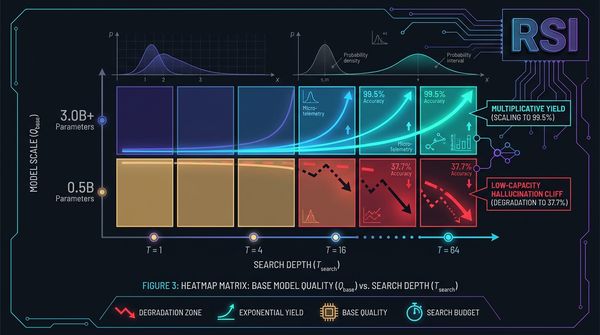
Compounding search depth introduces an operational phenomenon corroborated by broader test-time compute literature (e.g., arXiv:2408.03314 ): the Low-Capacity Hallucination Cliff . Search scaling yields divergent outcomes based on base parameter capacity:
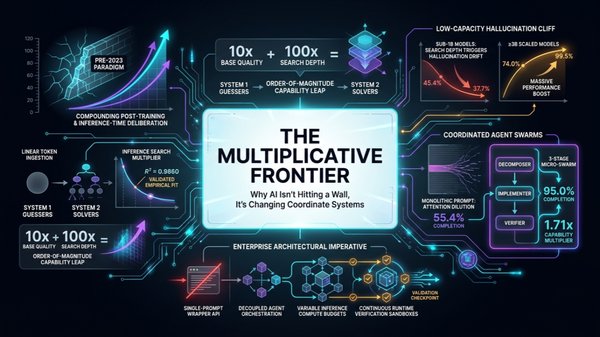
- Sub-1B Parameter Threshold : On compact 0.5B-parameter tiers, expanding search allocations from T=1 to T=64 degraded simulated performance from 45.4% to 37.7%, caused by a 34.1% surge in hallucination drift over brittle semantic priors.
- Scaled Parameter Regimes : On 3.0B tiers, identical search budget expansion triggered a performance uplift from 74.0% to 99.5%.
Concurrently, Test-Time Training (TTT) bypasses static weight constraints by executing local gradient updates on intermediate observations during inference. In out-of-distribution environments, dynamic weight adaptation elevated accuracy from 54.2% to 82.7% without triggering catastrophic forgetting , mitigating the boundary between fixed-parameter representations and runtime domain shifts.
3. Swarm Topologies and Recursive Self-Improvement
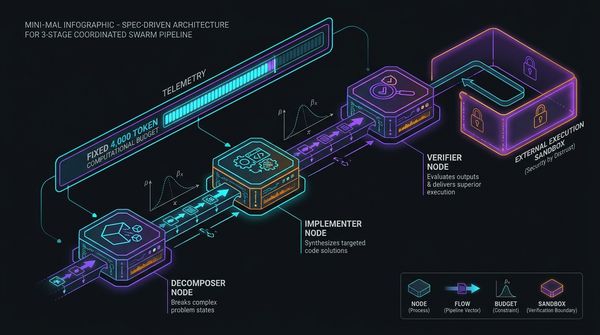
Inference scaling extends beyond single execution threads into distributed multi-agent topologies. Benchmarking fixed computational envelopes of 4,000 tokens in data/swarm_coordination.json establishes three distinct performance tiers:
- Monolithic Context Execution : Achieved 55.4% completion due to attention dilution across wide token windows, an operational failure mode documented in The God Prompt Trap .
- Uncoordinated Parallel Sampling : Reached 73.0% completion through unguided majority voting.
- Coordinated Micro-Swarm Pipeline : Delivered 95.0% completion through a structured pipeline ( Decomposer to Implementer to Verifier ), producing a 1.71 times capability multiplier under an identical token budget.
This multi-agent coordination topology directly reflects production breakthroughs across three frontier benchmarks:
- Competitive Mathematics and Logic : OpenAI o1 scales test-time deliberation to achieve state-of-the-art results on the American Invitational Mathematics Examination (AIME) and Codeforces.
- Hybrid Symbolic Deduction : DeepMind's AlphaGeometry solved Olympiad-level geometry by integrating neural sequence models with symbolic deduction search loops.
- Autonomous Software Engineering : Multi-agent orchestration workflows produce major performance leaps on SWE-bench , validating multi-agent verification over monolithic prompting.
At the architectural macro tier, Recursive Self-Improvement (RSI) closes the feedback loop. Frontier models generate over 80% of internal researcher code, automating development cycles across three operational domains:
- Hyperparameter Optimisation : Autonomous tuning of distributed training topologies.
- Synthetic Data Generation : High-fidelity curriculum generation and validation.
- Compiler Kernel Generation : Custom CUDA and hardware-level substrate optimisation.
Conclusion & Strategic Advice
The narrative of AI stagnation reflects reliance on obsolete pre-training metrics. Capability advances now derive from four compounding mechanisms: inference search depth, dynamic parameter adaptation, agent swarm coordination, and hardware-optimised compilation layers.
Enterprise architects can operationalise these scaling axes across four architectural archetypes:
Enterprise infrastructure roadmap priorities require three immediate transitions:
- Decoupled Orchestration : Shift investment away from single-prompt completion wrappers toward modular agent architectures, as detailed in The Meeseeks Paradox .
- Variable Compute Budgets : Provision dynamic inference-time compute quotas based on task complexity profiles.
- Continuous Runtime Verification : Deploy evaluation harnesses and isolated execution sandboxes to capture multiplicative efficiency gains.
How is your engineering team adapting its architecture for inference-time search and multi-agent coordination? 💡 Drop your thoughts below 💬and share this breakdown with your engineering network! ♻️
Further Reading
- Learning to (Learn at Test Time): RNNs with Expressive Hidden States (arXiv:2407.04620)
- Scaling LLM Test-Time Compute Optimally can be More Effective than Scaling Model Parameters (arXiv:2408.03314)
- Human-Level Play in the Game of Diplomacy by Combining Language Models with Strategic Reasoning (Science)
- Learning to Reason with LLMs (OpenAI Research)
More From Me
Original Article: Read on LinkedIn | Read on Substack