Security by Distrust: Capability Tokens and Simulated Realities
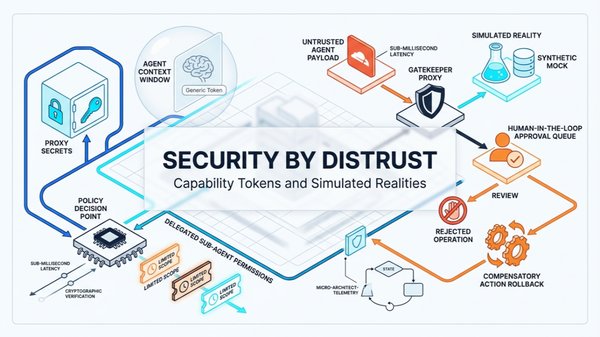
- Part 3 of 3 - Decoupling Credentials, Scoped Proxy, and Sandbox Simulations
Introduction
Operating autonomous agentic workloads inside production infrastructure breaks traditional perimeter assumptions. While Part 1: ephemeral execution kernel established the required sub-millisecond agent lifecycles and Part 2: Economics of Edge Agents detailed the serverless economics governing distributed compute, raw execution speed provides zero value if an agent compromises backend systems.
Granting runtime access to production environments via ambient credentials creates unmitigated exploitation vectors.
Enterprise containment demands an explicit Architecture of Distrust across the entire token lifecycle:
- Hostile Intent Posture : Treat the underlying intent of large language models as untrusted by default whenever they interact with databases, source repositories, or infrastructure APIs.
- Proxy Secret Decoupling : Decouple raw credentials from agent runtimes using Gatekeeper proxies to enforce isolated execution layers.
- Deterministic Capability Tokens : Issue cryptographically scoped capability tokens derived strictly from non-LLM policy matrices.
- Simulated Mutation Loops : Isolate high-risk state changes inside Simulated Reality execution loops to sustain operational momentum while maintaining strict human governance.
This guide provides an architectural blueprint to eliminate secret exposure, enforce deterministic containment boundaries, maintain autonomous reasoning momentum, and ensure human oversight over destructive mutations.
The Vulnerability of Raw Credentials
Placing raw production credentials or long-lived API tokens inside autonomous agent context windows introduces critical vulnerability vectors across enterprise infrastructure. Model hallucinations , prompt injection attacks , and unvalidated tool calls allow external payloads to extract secrets or execute unauthorised mutations across internal systems in Cloudflare OS Platform Architecture .
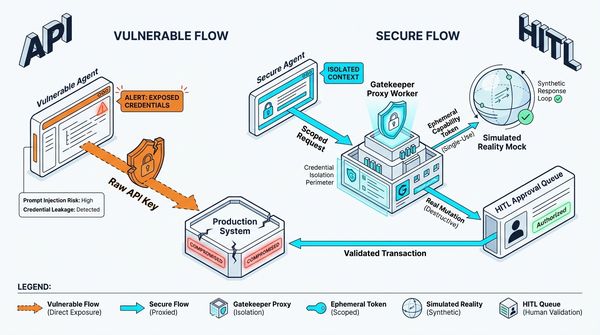
When agents hold ambient access privileges, arbitrary context manipulation exposes three primary failure modes:
- Unrestricted Lateral Movement : Exploited context windows trigger lateral movement across internal networks without triggering standard perimeter alarms.
- Trajectory Hijacking : Conventional security controls cannot differentiate between a legitimate autonomous workflow and a compromised model trajectory in Cloudflare Computer Repository .
- Execution Boundary Collapse : Perimeter defence fails at the model runtime layer because outbound HTTP requests arrive over authenticated, pre-authorised transport channels.
Capability-Based Access Control
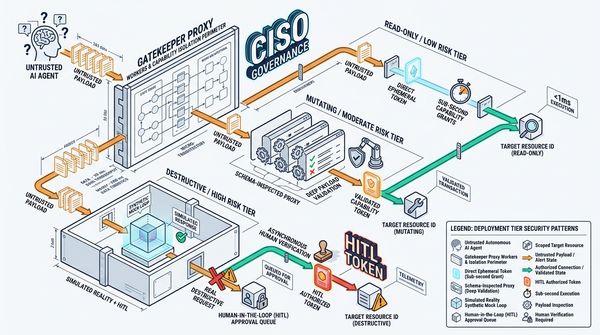
The cloudflare-os platform enforces an Architecture of Distrust by introducing intermediate proxy Workers known as Gatekeepers :
- Credential Isolation : Secrets, OAuth tokens, and API keys remain sealed inside the Gatekeeper environment and never enter agent execution contexts.
- Authorisation Bootstrapping and PDP : Token issuance operates through a dedicated Policy Decision Point (PDP) that validates requests against a deterministic policy matrix rather than model output. The platform traces execution context back to a verified human user session or bounded service account, minting time-bound capability tokens restricted to specific entity IDs only after cryptographic verification of underlying RBAC and ABAC policies.
- Payload Inspection : The proxy validates the inbound request schema against fine-grained access policies before communicating with third-party APIs Cloudflare Security Architecture Overview .
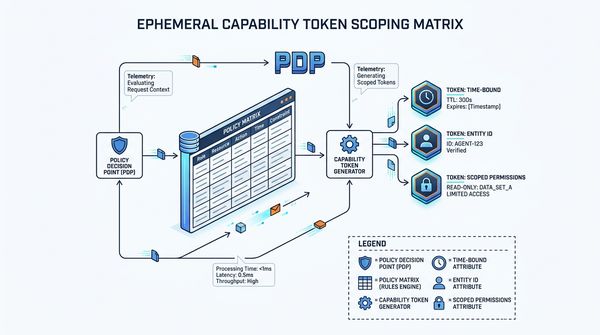
By replacing ambient network authority with fine-grained object capabilities and strict policy validation, the platform prevents compromised agents from operating beyond their assigned target scope Cloudflare workerd Runtime Repository . Each capability token encapsulates both designation and authorisation, guaranteeing that delegated sub-agent tasks cannot exceed parent permission envelopes.
Simulated Realities and Human-in-the-Loop
For high-risk operations—such as database migrations, financial transactions, or production deployments—the Gatekeeper intercepts mutations using Simulation Mode :
- High-Fidelity Synthetic Response : The proxy intercepts destructive commands and returns a schema-perfect synthetic mock success payload to the agent runtime. To prevent semantic drift and maintain valid sequential tool calls, the system generates these mocks dynamically using OpenAPI specifications and historical API traces.
- Downward Execution : With a structurally accurate synthetic state, the agent executes downstream reasoning steps without blocking on manual intervention.
- Human Review Queue : The platform routes the authentic mutation payload to a human-in-the-loop (HITL) approval dashboard, dispatching the real transaction only after explicit operator confirmation ( Cloudflare OS Security & Governance Model) .
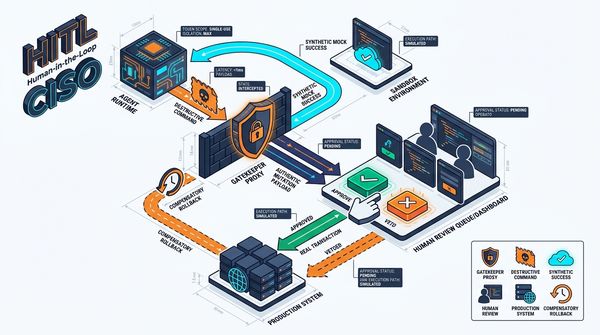
Caveat & Latency Tradeoffs : While Simulation Mode prevents interactive blocking, downstream external dependencies must account for asynchronous review latency. When an operator rejects a mutation at step n , the architecture initiates a distributed Saga pattern for state reconciliation:
- Thread Interruption : The Gatekeeper halts the active agent execution thread and injects failure context into the model's context window.
- Compensatory Rollback : The runtime forces the model to deterministically unroll its reasoning logic and execute compensatory actions for downstream steps ( n+1 , n+2 ) executed under simulated success.
Architecting Trust in Autonomous Fleets
Treating all agent outputs as untrusted enables secure fleet deployment across sensitive corporate environments. Decoupling secrets through Gatekeeper proxies and enforcing human validation for critical state mutations ensures compliance without throttling development velocity ( Cloudflare Agentic Governance Framework ).
Implementing defence in depth across the agent execution boundary establishes two auditable operational controls:
- Cryptographic Audit Trails : Tool calls generate immutable log entries stored in SQLite -backed Durable Objects .
- State Replay : Gatekeepers re-execute captured simulation traces against staging environments to verify behavioural bounds before production commit mathematically.
Conclusion & Strategic Advice
Implementing capability-based isolation and Simulated Realities bridges the gap between agent autonomy and enterprise zero-trust governance.
Deployment Tier Security Pattern Primary Mechanism Read-Only / Low Risk Direct Ephemeral Tokens Scoped sub-second capability grants Mutating / Moderate Risk Schema-Inspected Proxy Deep payload validation via Gatekeeper Workers Destructive / High Risk Simulated Reality + HITL Synthetic mock loop with asynchronous human verification.
This concludes our three-part architecture series: uniting the ephemeral kernel that guarantees sub-millisecond cold starts , the serverless economics that make multi-agent deployments viable, and the architecture of distrust that ensures complete operational governance.
Evaluate your agent tool-calling vectors and implement proxy-isolated credential boundaries before granting agentic runtimes write access to production data planes .
How is your engineering team isolating credentials and governing high-risk tool calls in agentic workloads? Drop your thoughts below💬 and share this architecture blueprint with your engineering network! ♻️
Further Reading
- Cloudflare Workers Security Model (Official Cloudflare runtime isolation and capability architecture)
- OWASP Top 10 for Large Language Model Applications (Standard classification for prompt injection and excessive agency risks)
- NIST AI Risk Management Framework (AI RMF 1.0) (Enterprise governance standards for autonomous systems)
More From Me
- The 2026 AI Threat Landscape: Machine-Speed Autonomous Agents
- Architecting Zero-Trust Systems: A Guide to Web Cybersecurity
- Model Context Protocol: Securing AI Systems Against Cybercrime and Warfare🔒
- The Accountability Gap: Why Human Oversight Is a Business Imperative
- Evaluating AI APIs in 2026: Prioritising Functional Constraints and Abilities
Original Article: Read on LinkedIn | Read on Substack