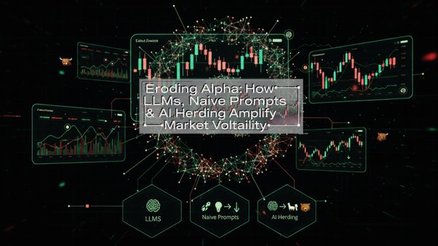
Eroding Alpha: How LLMs, Naive Prompts & AI Herding Amplify Market Volatility
Introduction
So, what's the big deal? It feels like Large Language Models (LLMs) are everywhere these days, right? Tools like ChatGPT have shown up in just about every industry, and finance is no exception. They're being talked up as this amazing new tool that gives sophisticated analysis to anyone with a keyboard. The idea is that they level the playing field, giving everyday investors the kind of analytical power that used to be just for the big Wall Street firms.
But here's a thought: what if giving everyone the same powerful tool is actually making them all think—and act—the same? What if it's creating a new, hidden risk for the entire market?
Trying to find "alpha"—that special edge that lets you beat the market—is already incredibly tough. Now, imagine millions of people uncritically using LLMs by asking them simple questions. This is creating a new kind of "digital herding." The scary part is, this trend doesn't just make it harder to find that alpha; it also cranks up market volatility, creating a shaky consensus that could fall apart in an instant.
The 'Naive Prompt' Trap
How AI Builds an Echo Chamber: You can see why LLMs are so popular for investing. They can read a dense earnings report in seconds, figure out market sentiment on the fly, and even spit out trading algorithms. The problem is how most people use this power: through "naive prompts."
These are super simple, generic questions like, "What are the best tech stocks to buy now?" or "Is it a good time to sell NVDA?"
This is a classic example of an LLM anti-pattern I've talked about before, the 'One Prompt to Rule Them All,' where you expect a deep, personalized answer from a question that has no nuance. These prompts don't know anything about you—your financial goals, how much risk you're comfortable with, or your unique way of looking at the market.
Even worse, since the major LLMs are all trained on pretty much the same giant pile of public internet data, they tend to give very similar, consensus-driven answers. They're great at spotting what used to work and extending those trends forward. This can push everyone into the same crowded trades, a risk that firms like Robeco have pointed out. This creates an AI echo chamber where popular opinions get amplified and served up as if they're fresh, unique insights (Gartner).
From Digital Groupthink to Market Tremors
Welcome to 'Herding 2.0': Now, picture this: thousands, or even millions, of investors are all typing similar naive prompts into their AI. Naturally, they're all getting back similarly biased answers.
This isn't just a theory. A University of Chicago study showed that sentiment analysis from ChatGPT on news headlines could actually predict stock returns for the next day (SSRN). This shows a direct line from AI to coordinated trading signals on a massive scale. It's basically the classic "herd mentality" but supercharged by technology. The CFA Institute even has a name for it: "Herding 2.0" (CFA Institute).
And the fallout from this is very real; financial authorities around the world are starting to sound the alarm.
-
Strategists at JPMorgan have warned that this "AI herding" could lead to sharp, coordinated market sell-offs and even future "flash crashes" (Bloomberg).
-
The U.S. Treasury's Office of Financial Research agrees, identifying that everyone relying on just a few popular models creates a "monoculture" that threatens financial stability (U.S. Department of the Treasury - Office of Financial Research).
-
The European Central Bank cautions that the widespread use of similar AI can lead to companies taking on the same risks without even realizing it, which makes market stress much worse (European Central Bank).
-
And the Bank for International Settlements highlights the risk of having just a few third-party AI providers that everyone depends on (Bank for International Settlements).
This all creates a dangerous feedback loop. Research shows that herding is strongest for stocks that are already getting a lot of media coverage (Finance Research Letters). As AI-driven trades move a stock, it gets more media attention. The LLMs then gobble up this new information, which just reinforces their original consensus and validates the herd's behavior.
The result? It kills your alpha—since you can't beat the market if you're doing the same thing as everyone else—and it makes the market way more jumpy by getting a massive group of people to act in lockstep.
Conclusion
The naive application of LLMs in finance is a double-edged sword. While it democratizes access to information, it simultaneously homogenizes thought and action, eroding the very alpha it promises to uncover while amplifying market volatility. The widespread reliance on generic models for direct investment advice creates a fragile, consensus-driven market prone to digital stampedes.
💬What are your thoughts? Have you seen this kind of AI-driven groupthink impacting your industry or investment strategy? Share your thoughts below and ♻️ this post with your network.
Further Reading
-
Implications of Artificial Intelligence for Financial Stability - U.S. Department of the Treasury, Office of Financial Research
-
AI and Investing: Herding 2.0? - CFA Institute
-
JPMorgan Says AI Trading "˜Herds' Could Cause Market Flash Crash - Bloomberg
-
Can ChatGPT Predict Stock Market Returns? - University of Chicago (via SSRN)
More from Me
Original Article: Read on LinkedIn | Read on Substack