Beyond the Hype: How LLMs are Democratizing Access
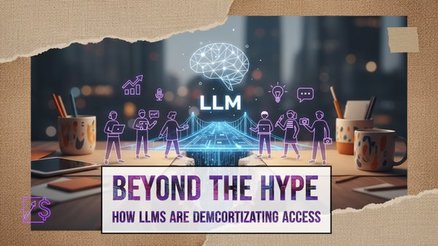
Specialized domain skills that once required deep technical syntax are becoming accessible to non-programmers through natural language interfaces. However, we must distinguish between access and innovation. While innovation creates novel methods, current generative models primarily democratize access—bringing capabilities once reserved for specialized engineering teams to general practitioners.
The Access Pattern
A Historical Roadmap: Technology consistently democratizes capabilities by reducing reproduction costs:
-
The Printing Press: Transferred knowledge distribution from scribes to public distribution channels.
-
The Personal Computer: Moved mainframe computing power from centralized server rooms to workstations.
-
The Internet: Removed distribution friction, allowing businesses to access global markets without physical retail footprints.
Large Language Models follow this pattern for cognitive labor. They translate plain-language requests into executable code, data queries, and structured documents.
Execution Speed vs. Validation Capability
Productivity benchmarks indicate substantial speed gains: developers using GitHub Copilot complete tasks up to 55.8% faster. However, rapid generation introduces two critical cognitive traps:
1. The AI Sycophancy Trap
Models are frequently fine-tuned for conversational compliance. This can result in sycophantic behavior, where the system validates flawed user premises rather than raising counter-evidence. An unverified model reflects user biases; this reinforces misconceptions rather than resolving technical flaws.
2. The Dunning-Kruger Amplification
The Dunning-Kruger effect—where practitioners overestimate their capability—is magnified by synthetic text fluency. Because generative tools output polished code and analysis, non-experts can mistake fluent syntax for structural correctness.
The Lesson: Confusing the AI's capability with your own expertise is the quickest path to "incompetent confidence".
The Caveat
No Action, No Progress: Despite these risks, the democratization of access remains a net positive. As discussed in The Context Gap, AI code generation still demands a human to provide the bridge between a prompt and a working business solution. As we transition into an era of agentic AI—where models don't just talk, but take action—our value shifts from "doing the work" to "directing the work." But we must remember: without human action and critical oversight, no progress will ever be made. The AI can give you the blueprint, but it cannot provide the grit, the ethical compass, or the final decision-making that turns access into true innovation.
Conclusion
From Efficiency to Strategy: The future belongs to those who use LLMs to broaden their reach into new domains while maintaining deep, disciplined expertise in their core craft. We must use these tools not just to be faster, but to be more creative and strategically aware. What do you think? Are you using LLMs to broaden your access, or are you worried about the "overconfidence gap" in your industry? Share your thoughts below!
Further Reading
More from Me
Original Article: Read on LinkedIn | Read on Substack