Sovereign Vision: Strategic Guide to Digitising Your Auteur's Taste
Introduction
A Prompt is Not a Strategy: Building on the foundational philosophy established in Part 1, Sovereign Vision: Mastering Taste and Synthetic Orchestration in AI, we must confront a harsh reality: a prompt is not a strategy, but merely a suggestion. Relying on rented text-to-image interfaces means surrendering your artistic baseline to average probabilistic aesthetics.
To execute a structural paradigm shift, operators must acknowledge that massive open-weight foundation models are rented realities constrained by external licensing:
- Technical Sovereignty: The operational core functions as Technical Sovereignty = Proprietary Weight Deltas (LoRA/Task Vectors) over Open-Foundation Baselines.
- Defensible Independence: Substituting API dependency for base-model dependency ensures localised delta weights form your actual operational moat.
- Role Transition: By taking absolute ownership of specialised model weights, the shift from external consumer to internal architect of the system is complete.
Taste is no longer an internal compass; it is a measurable, mathematical gradient. This guide provides the definitive framework for mapping your aesthetic identity into a defensible operational structure:
- Systemic Output Control: Navigating latent dimensions and implementing granular controls via training-free semantic manipulation forcefully dictates precise visual outcomes.
- Creative Provenance: Securing reference assets with cryptographic protection helps prevent attribution loss across production lifecycles.
- Immutable Standards: Forging a versioned digital standard guarantees absolute aesthetic consistency across all future deployments.
The Architecture of Digital Taste
From a systems-design perspective, generative models map complex creative data into a mathematical representation known as a latent space. This mechanism transforms subjective visual choices into measurable geometric gradients.
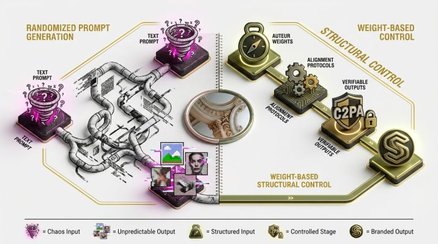
Relinquishing control to randomized text prompts restricts true creative output, requiring custom architectures to avoid defaulting to generic foundation weights:
- Structural Inputs: Architecting custom "Auteur weights" defines your distinct visual identity.
- Alignment Protocols: Implementing strict rules corrals stochastic probability into predictable, managed systems.
- Verifiable Outputs: Establishing mathematical controls guarantees exact execution of your aesthetic intent.
Navigating the Latent Space
Within this foundational architecture, aesthetics compress into lower-dimensional frameworks where visual attributes correspond to distinct directional vectors. Traversing these dimensions using vector arithmetic allows operators to isolate and alter specific structures.
Navigating standard diffusion models often introduces the severe friction of concept entanglement, which requires active mitigation:
- Concept Entanglement: Adjusting a single vector frequently destructively modifies unrelated elements within the overarching image.
- Prerequisite Resolution: Resolving this entanglement serves as the absolute requirement for highly targeted mathematical steering.
- Targeted Steering: Eliminating interference enables operators to adjust precise variables without degrading foundational image integrity.
Concept Sliders for Granular Control
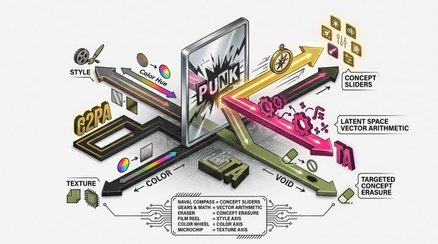
To eliminate entangled attributes, researchers deploy concept sliders, which are lightweight Low-Rank Adaptation (LoRA) adaptors. These adaptors grant continuous scalar control over aesthetics without the computationally expensive need to retrain massive base models.
Empirically quantifying the limitations of latent navigation reveals that achieving true vector orthogonality in high-dimensional systems is exceptionally difficult:
- Dimensional Optimization: Modern pipelines look beyond compute-heavy diffusion LoRA training, utilizing text-encoder latent manipulation (such as Text Sliders and Sparse Autoencoders) to isolate semantic directions directly within token embeddings before inference begins.
- Concept Bleed Tolerance: Architects must establish acceptable thresholds for interference, as concept sliders minimize—but do not achieve—absolute zero-interference.
- Operational Dials: Ultimately, subjective taste translates into highly precise, quantitative operational dials that require careful calibration.

Targeted Concept Erasure
Structural precision requires defending the aesthetic baseline by actively removing off-brand styles or heavily copyrighted references. Rather than filtering vast datasets for computationally prohibitive retraining, operators compute localized parameter updates to neutralize specific neural activation pathways.
Effective defense against this vector requires a multi-layered approach to prevent permanent degradation of the system:
- Catastrophic Forgetting Risk: Aggressive parameter penalization introduces the severe risk of catastrophic forgetting, degrading baseline visual coherence.
- Surgical Limitations: Erasing concepts operates as an imprecise tool that permanently damages the foundational model if pushed beyond safe tolerances.
- Balanced Defensibility: Establishing a robust moat against stylistic drift demands a delicate balance between defensive erasure and foundation stability.

Versioning and Model Consistency
Authentic structural proof of a distinct vision demands rigorous versioning protocols to combat inevitable stylistic drift. By treating specific weight directions as fully modular "task vectors," architects selectively apply or subtract them from baseline weights to freeze an aesthetic standard.
Managing this architecture in a live production environment involves addressing severe computational friction to ensure the system scales effectively:
- Pipeline Archival: Locking model seeds, archiving inference pipelines, and deploying deterministic adapters (like ControlNet) alongside specialized LoRAs keeps outputs in absolute alignment.
- VRAM Latency Bottlenecks: Stacking specialised task vectors introduces heavy VRAM friction, requiring operators to deploy multi-tenant inference architectures like S-LoRA or Punica to batch low-rank deltas dynamically without context-switching penalties.
- Inference Optimisation: Prioritising rigorous inference optimisation alongside aesthetic freezing maintains operational stability in high-fidelity workflows.

Securing Creative Provenance with C2PA
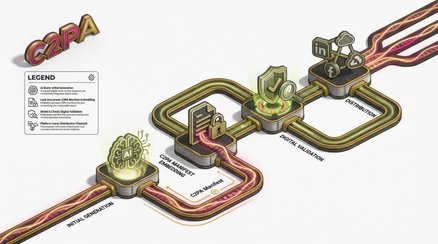
Establishing creative provenance requires embedding cryptographic standards directly into generated outputs. The Coalition for Content Provenance and Authenticity (C2PA) framework physically binds verifiable metadata to media files utilising Public-Key Infrastructure and cryptographic hashes, a framework that has transitioned from an elite design preference to a strict regulatory requirement under Article 50 of the EU AI Act.
Operators must navigate a fundamental friction between provenance tracking and social distribution, as platforms typically strip embedded metadata automatically:
- Digital Validation: Any digital alteration applied to the underlying pixel data automatically breaks the cryptographic signature, physically validating human authorship.
- Chain of Trust: Leveraging this standard forges a defensible verification path for overarching assets.
- Architectural Defensibility: Overcoming the "IP Fallacy" demands maintaining pristine, signed reference assets internally alongside robust, loss-resistant pixel watermarking as proof of documented human-in-the-loop (HITL) curation.
Conclusion & Strategic Advice
The combination of concept sliders, targeted erasure, and frozen task vectors culminates in a unified system where a unique aesthetic is mathematically enshrined. The operational matrix dictates that while external APIs are useful for rapid ideation, achieving actual technical sovereignty demands localised structural conditioning and composable adapters.
Embracing these advanced alignment protocols ensures your system operates independently from external dependencies:
- Verifiable Execution: The final output functions as an authentic, verifiable extension of overarching creative intent, completely immune to the stochastic whims of base models.
- Targeted Application: Transitioning from strategic theory to targeted application establishes a proprietary technical workflow.
- Infrastructure Configuration: The time to establish proprietary weights requires auditing reference assets, configuring localised inference infrastructure, and translating your artistic compass into code.
Further Reading
- Unsupervised Representation Learning with Deep Convolutional Generative Adversarial Networks
- A Style-Based Generator Architecture for Generative Adversarial Networks
- Concept Sliders: LoRA Adaptors for Precise Control in Diffusion Models
- Erasing Concepts from Diffusion Models
- Locating and Editing Factual Associations in GPT
- Editing Models with Task Vectors
More From Me
Original Article: Read on LinkedIn | Read on Substack