Sovereign Vision: Practical Guide to Tailored Generative AI
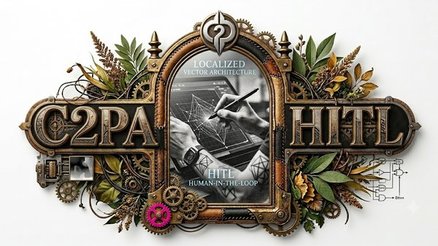
Introduction
The Auteur-Engineer's Workflow: Building on the foundational philosophy established in Part 1, Sovereign Vision: Mastering Taste and Synthetic Orchestration in AI, this guide outlines the technical roadmap to achieve system autonomy. Transitioning from third-party vendors to a proprietary operational moat requires executing the following structural shifts:
- Computational Ownership: Move from renting black-box probability to fully controlling computational parameters.
- Vector Access: Operate within a localized, open-weights environment to access underlying vector architectures.
- Visual Logic Enforcement: Deploy custom infrastructure to guarantee all generative outputs adhere to a heavily guarded, singular aesthetic standard.
- Pipeline Configuration: Construct, tune, and cryptographically lock a parameterized generation loop.

Prerequisites
Before deploying the pipeline, ensure the host environment meets these foundational requirements:
- Infrastructure Configuration: Establish a localized open-weights engine (e.g., Stable Diffusion XL, Flux.1, or newer variants) on self-hosted hardware or a managed local platform. A dedicated GPU with at least 16–24 GB VRAM (RTX 4090 or equivalent/A100-class recommended) provides comfortable performance for training and inference.
- Baseline Assets: Prepare 15–50 high-fidelity proprietary reference images accompanied by structured JSONL taxonomy schemas for localized LoRA aesthetic locking (Advanced Horizon: 1,000+ chosen/rejected image pairs for foundational DPO alignment).
- Tooling Setup: Install and configure ComfyUI, Diffusers libraries, local fine-tuning environments (Kohya_ss or OneTrainer), and Content Authenticity Initiative (CAI) CLI tools.
- Estimated Allocation: Reserve 2–4 hours to establish the baseline configuration and structural adaptation architecture (excluding the extensive dataset compilation and training cycles required for advanced DPO alignment).
1. Prevent Algorithmic Homogenization
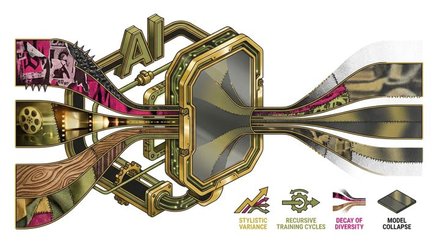
Foundational models naturally regress toward the statistical mean of their training corpus. Relying on recursive synthetic generation leads directly to model collapse, as documented in Nature: AI models collapse when trained on recursively generated data. To actively neutralize this issue—often termed The Curse of Recursion—architects must enforce strict data curation protocols:
- Anchor Latent Spaces: Curate high-signal, human-authored ground-truth data to continuously stabilize the latent space.
- Force Divergence: Deploy robust human-in-the-loop (HITL) curation networks that reward statistical variance.
- Override Averages: Prevent the system's drive toward an uninspired "High-Quality Average" by prioritizing outlier aesthetic markers.
2. Condition Structural Outputs via Adapters
Relying strictly on natural language semantic inputs often fails to guarantee rigorous spatial, dimensional, or structural compliance. While newer Diffusion Transformer (DiT) architectures (e.g., Flux.1) handle spatial logic more natively than legacy UNet models, deterministic structural grounding remains highly valuable. To translate subjective preference into mathematical necessity, implement the following architectural constraints:
- Spatial Adapters: Integrate deterministic mechanisms like ControlNet or IP-Adapters (tailoring strength to complement the native capabilities of DiT-based models).
- Visual Boundaries: Inject proprietary structural boundaries—such as wireframes, depth maps, or pose information—directly into the diffusion process.
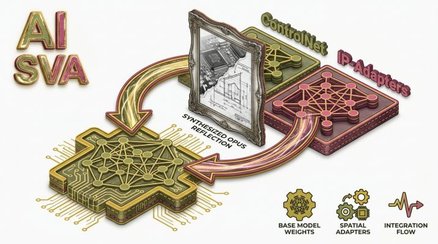
Practical Example: In ComfyUI, a typical hybrid node setup might include the base model → Flux or SDXL loader → ControlNet (lineart/depth) at 0.6–0.85 strength → targeted LoRAs → unified sampler.
3. Enforce Vision via Stylistic Adaptation & Preference Optimization
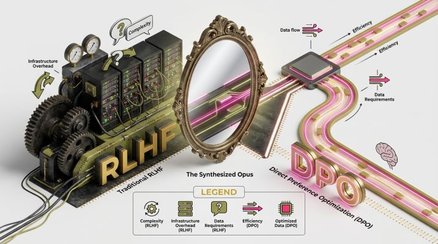
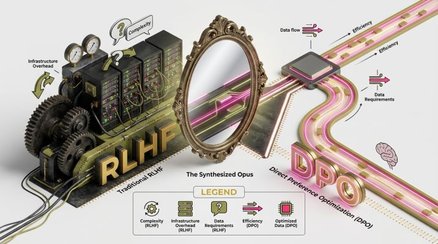
Following structural alignment, tone and aesthetic gradients must be mathematically bound to the model. True technical sovereignty requires distinguishing Structural Adaptation (locally achievable by a solo auteur) from foundational Preference Alignment (more resource-intensive). To bind explicit stylistic nuances to structural logic, apply these targeted optimization techniques:
- Primary Method: Targeted LoRA Stacking: Deploy heavily curated Low-Rank Adaptations (LoRAs) configured precisely (e.g., Rank 64 / Alpha 32) within ComfyUI. Stacking multiple focused LoRAs with careful tuning provides strong aesthetic control with minimal concept drift.
- Advanced Horizon: DPO Mechanisms: For permanent weight-shifting, utilize Direct Preference Optimization (DPO). Note that Diffusion-DPO performs best with substantial data—1,000+ well-structured “Chosen” versus “Rejected” image pairs are recommended for stable results.
- Data Scaling Note: Smaller datasets (50–200 pairs) can still produce usable stylistic direction but risk overfitting; they work better for narrow, targeted LoRAs than broad preference alignment.
4. Freeze State and Embed Cryptographic Provenance
To ensure operational stability and eliminate stylistic drift, enforce rigorous state-freezing protocols:
- Weight Versioning: Version all custom network weights, lock inference seeds, and archive explicit hyperparameter configurations.
- Provenance Integration: Apply Content Authenticity Initiative (CAI) tools post-generation to embed C2PA metadata, creating verifiable records of human authorship and workflow.
- Pipeline Interfaces: Bind autonomous generative pipeline execution to strictly formatted JSON Schema Specification interfaces for predictable scaling.
Example Hyperparameter Lock:
{
  "base_model": "flux-1-dev",
  "loras": [
    {"name": "auteur_style_v1", "weight": 0.85, "rank": 64}
  ],
  "controlnet": {
    "strength": 0.75,
    "model": "depth"
  },
  "seed": 42,
  "sampler": "euler",
  "steps": 28,
  "cfg": 3.5
}
Verification & Troubleshooting
Successfully deploying this ecosystem aligns stochastic synthesis with a verifiable baseline. This produces technically precise outputs and strengthens copyright defensibility. When resolving pipeline issues, apply these deterministic corrections:
- Catastrophic Forgetting: Lower the Text Encoder learning rate and diversify structural ground-truth data.
- Concept Bleeding: Use regularization images during training and tighten Booru-style taxonomy tags.
- Overfitting / Degraded Output: Reduce adapter weights during generation if high-contrast artifacts or distortions appear.
The true power of this architecture lies in the deliberate orchestration of multi-adapter nodal pipelines to override rented probability. Before scaling to production, validate the full pipeline in a localized test environment using your reference sketches and structured constraints.
Further Reading
- ControlNet Original Paper (arXiv:2302.05543)
- Hugging Face Blog: Diffusion-DPO for SDXL
- Content Authenticity Initiative (CAI): Implementing C2PA Pipelines
- Nature: AI models collapse when trained on recursively generated data
More From Me
Original Article: Read on LinkedIn | Read on Substack