AI Impacts: The Workload Paradox & Decision Fatigue
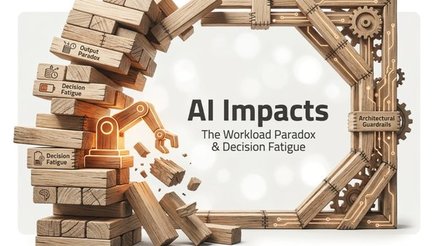
- Part 3 of 8: Drowning in Excellence
Introduction
Building on the productivity baselines established in AI Raises the Bar, organisations face a counter-intuitive reality: higher output speed frequently multiplies responsibilities. As task execution time approaches zero, the number of assigned tasks naturally expands to fill the gap.
This Jevons' Paradox of knowledge work exposes a critical flaw in modern organisational design via two primary failures:
- Artefact Generation: We've optimised for the rapid generation of artefacts such as code, reports, and strategic communications.
- Evaluation Scaling : We haven't been able to scale our capacity for human-led evaluation.
Industrial-era time management lacks the capacity to resolve AI-era exponential output. This analysis details the cognitive mechanics behind the "Fallacy of Busywork" and the resulting backlog congestion.
By dissecting the misalignment between high-speed generative output and human-locked review cycles, we present a structured framework rooted in Socio-Technical System Design to recalibrate priorities through three operational shifts:
- Recognising Costs : Identifying the hidden operational drag of decision fatigue.
- Systemic Offloading : Transitioning from linear human-in-the-loop review cycles to systemic cognitive offloading.
- Architectural Guardrails : Deploying non-linear operational guardrails to protect cognitive capital.
The Output Paradox

Efficiency gains inherently drive an increase in resource consumption. As defined in the MIT Sloan Management Review's modern understanding of knowledge work, this dynamic creates an environment of intense artefact generation.
Accelerated timelines require strict governance to manage the resulting outputs via two control points:
- Strategic Alignment : Vast quantities of outputs conceal foundational misalignments.
- Data Fidelity : Raw speed converts into disorganised, high-fidelity noise if unguided by robust systems.
The Workload Paradox: Output vs Outcomes

Scaling execution speed exposes a hard bottleneck in review capacity, dividing into three distinct systemic traps:
- Software Development Trap : Standard boilerplate code and functions are generated in seconds, yet engineering metrics via the Stanford HAI AI Index Report demonstrate that pull request cycle times, manual verification, and customer integration remain unchanged.
- The Management Loop : Faster documentation loops induce the "fallacy of busywork" within management tiers.
- Synthetic Refinement : Insights from the McKinsey Global Institute reveal that high-volume generation drives demand for multi-variant iterations, trapping teams in refinement cycles that fail to advance customer metrics.
Decision Fatigue Returns

Interacting with generative models forces a pivotal shift from creation to continuous evaluation. Managing this shift exposes three critical vulnerabilities:
- Executive Function Limits : Research published by the National Center for Biotechnology Information (NCBI) indicates that constant micro-decisions surrounding editing, prompt engineering , and error-checking rapidly drain mental energy.
- Leadership Exhaustion : This aligns with earlier insights detailing how trivial choices depletes leadership reserves, compounding decision fatigue .
- Vigilance Fatigue : Foundational behavioural studies from the American Psychological Association (APA) confirm that cognitive depletion induces impulsivity, defaults, and elevated error rates, directly undermining the quality assurance of AI-generated content.
Systemic Failure Indicators
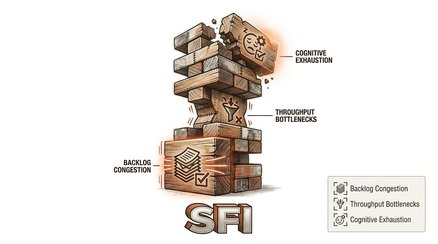
Operational distress in a high-throughput environment typically surfaces through three primary indicators:
- Backlog Congestion : Internal task queues and code review backlogs swell exponentially upstream, reaching record-high throughput.
- Throughput Bottlenecks : The processing bottleneck is mathematically bound by human verification limits.
- Cognitive Exhaustion : Cross-functional teams report severe context-switching fatigue, multiplying distractions while overarching strategic milestones face chronic delays.
Systemic Cognitive Offloading

From a systems-design perspective, human cognitive batching and traditional time-boxing fail mathematically when execution speed approaches zero. The backlog will consistently outpace the batch, requiring organisations to abandon linear productivity methods.
Effective defence against this vector requires scaling via four non-linear operational frameworks:
- Programmatic Quality Gating : Eradicate the assumption that every synthetic artefact requires human review by deploying automated testing and AI-driven first-pass reviews ("Evals").
- Algorithmic Filtering : Implementing LLMs -as-a-Judge and deterministic testing pipelines autonomously filter low-quality synthetic data , shrinking backlog volume before it reaches human queues.
- Strategic Verification : Shift from line-by-line artefact review to systemic architectural validation, allocating human cognitive capital to verify the logic of algorithmic guardrails over manual audits of Zero-shot generation.
- Autonomous Orchestration : Transition from legacy prompt-and-response paradigms to autonomous agentic loops to mitigate the micro-decision fatigue noted in NCBI research, using multi-agent frameworks to handle micro-corrections and compress the review surface area.
Measuring true outcomes remains highly complex and organisation-specific. Poorly calibrated automated evaluations risk inadvertently discarding novel solutions or introducing automated biases in heavily regulated markets.
Conclusion & Strategic Advice
Navigating the AI workload paradox requires treating human attention as a strictly finite resource. Using generative AI purely as a Zero-shot generator with manual human-in-the-loop review is an outdated approach.
By combining generative capacity with automated guardrails, deterministic code, and multi-agent orchestration, it ensures that exponential volume does not dilute value. A rigorous Socio-Technical System Design helps prevent review bottlenecks that slow deployment pipelines and burn out subject matter experts .
As automation assumes a larger share of execution, the friction of managing these interconnected systems grows. Addressing the creeping complexity of cross-domain expectations remains mandatory for building scalable workflows.
To continue building scalable workflows, we will detail this specific dynamic next in Too Many Hats: Managing Role Expansion in the AI Era.
Audit your internal pull request and document-review backlogs today. Challenge your structural limits by evaluating whether you build deterministic systems that programmatically filter the noise, or generate an exponential volume of artefacts for an exhausted human queue to evaluate.
Navigating the AI era requires treating human attention as a strictly finite resource. Are you building deterministic systems that programmatically filter out the noise, or just generating an exponentially increasing volume of artefacts for an exhausted human queue to evaluate? 💬 Let me know your thoughts in the comments and ♻️ share this post with your network!
Further Reading
- Narrowing Action Choices with AI Improves Human Sequential Decisions
- AI Prediction Leads People to Forgo Guaranteed Rewards
- When AI Gets it Wrong: Reliability and Risk in AI-Assisted Decision Systems
More From Me
Original Article: Read on LinkedIn | Read on Substack