AI Impacts: How AI-Driven Role Expansion Dilutes Performance
- Part 4 of 8: Too Many Hats
Introduction
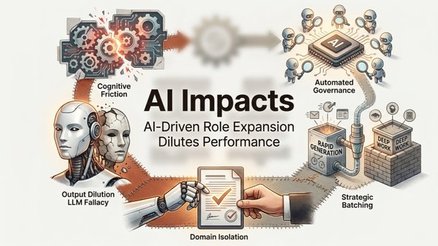
Building on the productivity scaling challenges detailed in The Workload Paradox & Decision Fatigue, the collapse of operational boundaries in modern professional ecosystems fundamentally destabilises production pipelines. Integrating generative tools drastically lowers execution barriers across typesetting automation, rigorous editing workflows, and distribution logistics.
Expanding horizontal roles to cover narrative structure, graphic illustration, and legal formatting introduces two severe operational taxes:
- Cognitive Friction : Rapid context switching between distinct functional domains actively degrades working memory and focus.
- Output Dilution : The "jack-of-all-agents" workflow structure compromises overall delivery quality.
Architecting automated, multi-agent governance systems establishes the structural boundaries required to replace manual auditing. This infrastructure protects our core expertise and maintains baseline delivery quality.
1. Introduction to Collapse of Boundaries

Generative technologies rapidly blur functional lines, forcing individual practitioners to cross traditional domain boundaries. Evaluating complex intent understanding alongside generative models highlights two distinct friction points: Prism: Towards Lowering User Cognitive Load in LLMs via Complex Intent Understanding :
- Computational Overhead : Professional suites demand high resource allocation to process disparate synthetic outputs.
- Cognitive Load : Users perform mentally taxing coordination protocols rather than engaging in active, focused creation.
2. The "Jack-of-All-Agents" Trap
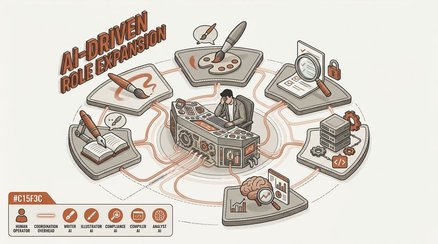
Executing complex multi-disciplinary architectures—such as the Aether-Pine asset workflow utilising local CLI automation, vision-language models (VLMs) , and specialised compilers —forces a single operator to function concurrently as writer, illustrator, compliance editor, and compilation engineer. This aggregation generates massive coordination overhead that frequently exceeds effective cognitive capacities: United Minds or Isolated Agents? Exploring Coordination of LLMs under Cognitive Load Theory .
Transitioning operational models requires replacing exhaustive system auditing with three structural validation layers:
- Automated Governance : Orchestrating VLMs and compilers requires dedicated AI-driven testing pipelines for baseline generation.
- Agent Integration : Workflows must process synthetic outputs through multi-agent verification systems rather than relying on a singular human bottleneck.
- Strategic Oversight : Operators maintain strict command over final validation, as ultimate strategic intent and professional liability resist automation.
3. The True Cost of Context Switching
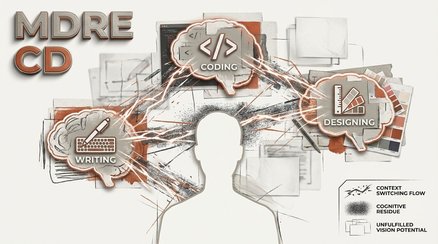
Rapid focus shifting actively blocks working memory resets, accumulating "cognitive residue" that keeps operators tethered to prior processes. This fragmentation incurs a massive productivity tax by shattering the state of flow through random micro-transitions: Two Sides of the Same Coin: Software Developers' Perceptions of Task Switching and Task Interruption .
Operating within hybrid human-AI environments introduces two primary neuro-ergonomic failure points:
- Elevated Error Rates : Constant context switching between creative ideation and cross-disciplinary auditing massively increases mental demand.
- Systemic Distraction : Processing machine-speed AI outputs without automated governance frameworks forces continuous transitions, entirely disrupting deep work states.
4. The Performance Dilemma
<img width="438" height="244" src="https://potnoddle.github.io/images/ai-impacts-how-ai-driven-role-expansion-dilutes-performance-5.jpg" alt="Chart of "Good Enough" average output vs. Premium human-optimised output" style="display: block; margin: 20px auto; max-width: 100%; border-radius: 8px; height: auto;" />
Operating outside established core domains using AI frequently triggers the Dunning-Kruger effect . High-performance models render polished aesthetics that mask fundamental defects, instantiating an " LLM fallacy" where users misattribute synthetic fluency as personal competence: The LLM Fallacy: Misattribution in AI-Assisted Cognitive Workflows .
Bypassing traditional CI/CD (Continuous Integration/Continuous Deployment) pipelines or staging environments exposes workflows to three critical vulnerabilities:
- Structural Complacency : Deliverables presenting as visually finalised cause operators to skip foundational stress tests and deployment validations.
- Automation Bias : Evaluating model-generated code without deep domain familiarity leads to superficial visual inspections and profound error tolerance: How Readable is Model-generated Code? Examining Readability and Visual Inspection of GitHub Copilot .
- Expertise Degradation : Heavy reliance on generative interfaces directly limits the creative self-efficacy of experienced practitioners: The Impact of Generative AI on Architectural Conceptual Design .
5. How to Keep Your Hat On

- Domain Isolation : Protect core technical identities by blocking out external operational scopes.
- Role Batching : Allocate distinct time blocks to specialised domains to prevent dynamic, reactive context shifts.
- Multi-Agent Verification Systems : Deploy LLM-as-a-Judge parameters and self-correction architectures to auto-evaluate synthetic outputs before human inspection: ChatEval: Towards Better LLM-based Evaluators through Multi-Agent Debate .
- Cross-Disciplinary Peer Review : Route mission-critical AI-augmented outputs to domain experts to finalise validation, ensuring strict liability management: Editing with AI: How Doctors Refine LLM-Generated Answers to Patient Queries .
Governing protocols must align directly with business contexts to protect critical thinking faculties: Evaluating Intra-firm LLM Alignment Strategies in Business Contexts .
Conflicts & Caveats: Generalists retain critical value in agile environments where lean operations mandate multi-hat execution despite the documented cognitive tax. Industry maturity strictly dictates the baseline ratio between specialised focus and cross-disciplinary output.
Conclusion & Strategic Advice
Generative tools are most effective when paired with structured automated execution. Protecting active working memory requires deploying a 4-quadrant matrix for project delivery:
- High-Stakes / Low-Expertise : Delegate final verification to a dedicated human domain expert. Operational liability demands manual oversight.
- Low-Stakes / Low-Expertise : Implement AI-Assisted Verification . Construct specialised, localised multi-agent QA pipelines to audit and debug baseline generation before human interaction.
- High-Stakes / High-Expertise : Isolate deep work time. Apply AI strictly as an augmentative utility while maintaining absolute manual command over structural integrity.
- Low-Stakes / High-Expertise : Process rapid AI generations in bulk, mandating strictly batched human reviews to eliminate micro-switching.
As we transition pipeline operations to multi-agent direction, we see distinct operational shifts detailed in Creator to Director: Navigating the Psychological Toll of Multi-Agent Orchestration. Upgrading pipelines to systemic automated governance isolates high-friction context switches into dedicated operational blocks.
Generative tools are potent accelerators—but only when paired with structured, automated execution boundaries. 💬 Where do you draw the line between leveraging AI and protecting your core expertise? Drop your thoughts below and ♻️ share this with your network!
Further Reading
- The Developer's Guide to Context Switching and Flow State
- Cognitive Load Theory in Modern Engineering Workflows
- AI and the End of the Jack-of-All-Trades Model
More From Me
- How Context Switching destroys Developers' Productivity and how to fix it!
- Managing Decision Fatigue for Technical Directors and Project Managers
- Dunning-Kruger or when confidence equals incompetence
- How you can Utilise Flow to ensure Happy and Productive Developers!
- Cognitive Distance: Navigating the Limits to T-Shaped Skills
- Your Career Runway Just Got Longer: How AI Lets You Focus on Wisdom, Not Tech
- The Hidden Perils of Cost-Cutting in AI: Safeguarding Expertise in a Knowledge Economy
- The Creative Pause: Why Taking Breaks Is Essential for Inspiration and Flow
- The Context Gap: AI Code Generation Still Demands Humans
- Beyond the 'God Prompt': A New Playbook for High-Stakes AI
Original Article: Read on LinkedIn | Read on Substack