Skunk Works: The 70/30 Capital Split
- Part 1 of 5 – Stop Funding Bureaucracy, Fund the Builders
Introduction
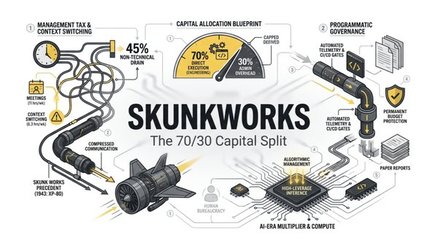
When evaluating capital allocation, enterprise R&D budgets regularly stall due to extensive administration. Up to 70% of budgets never reach the builders, absorbed by status meetings, steering committees, and compliance layers.
This capital distribution requires structural realignment through three specific principles:
- Kelly Johnson's Precedent : In 1943, Johnson demonstrated that absolute restriction of management layers accelerates delivery exponentially.
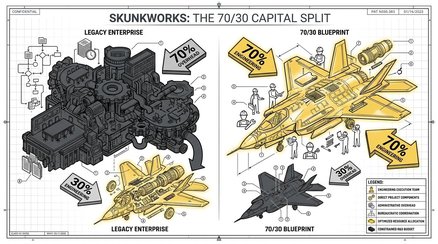
- The 70/30 Blueprint : This mechanic allocates 70% of budgets strictly to direct engineering execution while enforcing a maximum 30% cap on administrative overhead.
- Algorithmic Telemetry : By dismantling the communication explosion and managing the new algorithmic tax, we can compress coordination layers and redirect capital into architectural velocity.
The Hidden Management Tax
From a systems-design perspective, R&D budgets create a systemic capital drain, diverting resources from technical execution. The 60–70% administrative overhead figure provides an upper-bound estimate drawn from legacy enterprise environments burdened by heavy PMO structures.
This data establishes two operational baselines:
- Legacy Transformation : The 70/30 split serves as an aggressive structural target for established companies.
- Greenfield Standard : AI -native pods must utilise this ratio as a strict operational baseline from day one.
The telemetry confirms extensive efficiency losses across three distinct metrics:
- Time Deficits : Engineers lose an average of 11 hours weekly in meetings and 6.3 hours to context switching , extracting nearly 45% of a working week from deep technical flow; ByteIota Research, 2024 .
- Scrum Inefficiency : 68% of tech leaders report Scrum ceremonies consuming more time than value created; Medium / Tech Leadership Survey, 2025 .
- Process Degradation : 69% of developers lose over 8 hours per week to structural process inefficiencies; ShiftMag Developer Survey .
Kelly Johnson's Original Thesis
In June 1943, Clarence "Kelly" Johnson assembled 23 engineers and 30 mechanics in a circus tent to develop the XP-80 jet fighter . With an 180-day deadline, the team delivered a prototype in 143 days , significantly ahead of standard procurement timelines.
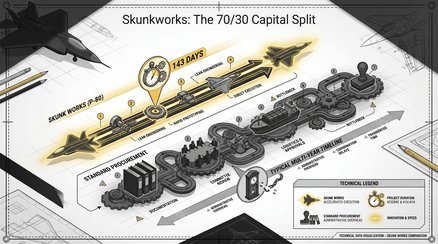
Johnson engineered this velocity through strict personnel limitations:
- Headcount Compression : Johnson's 14 Rules and Practices explicitly restricted team size to 10–25% of standard headcounts to compress communication paths.
- Contextual Application : Commercial software demands contextualisation of these hardware-focused rules to maintain operational relevance.
- Universal Tenet : The core principle requires compressing human coordination channels to their absolute functional minimum to ensure capital funds direct execution.
The Communication Explosion & Brooks' Law Mutation
Fred Brooks quantified communication overhead mathematically in The Mythical Man-Month (1975). He established the formula P = n(n - 1) / 2 to calculate structural complexity.
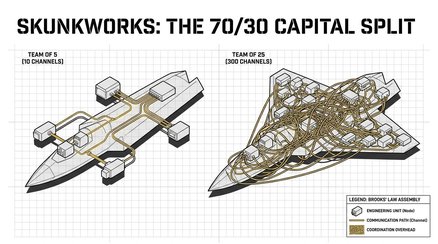
Adding personnel exponentially increases coordination pathways within any given project:
- Historical Scaling : A team of 5 requires 10 channels, whereas a team of 25 expands to 300 channels.
- Algorithmic Mutation : Integrating autonomous agents alters this formula, meaning n now includes asynchronous AI nodes alongside human developers.
- Network Expansion : Deploying an AI swarm to compile boilerplate introduces a distinct class of non-human structural nodes.
Managing these expanded networks requires precise architectural governance:
- Cognitive Load Monitoring : Evaluating hallucination rates, pipeline regressions , and agentic loops drives an exponential increase in tracking requirements.
- Human Isolation : The Skunk Works model minimises collaborative friction by strictly limiting human headcount.
- Node Automation : Technical leads must simultaneously automate and govern all non-human nodes to maintain velocity.
The Modern Enforcement Model — Enforcing the 70/30 Split
A modern Skunk Works capital allocation model applies a strict binary filter evaluating Direct Execution Capital against Coordination Overhead .
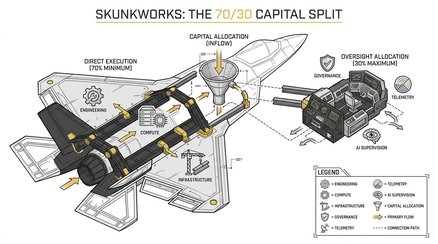
The framework mandates a precise 70/30 capital division across two core categories:
- Direct Execution (70% Minimum) : This funds direct engineering talent, primary inference compute, and deployment infrastructure.
- Oversight Allocation (30% Maximum) : This budget supports Governance, Telemetry, and AI Supervision.
Integrating AI replaces human bureaucratic administration with algorithmic management frameworks. Technical teams must implement three tactical mechanisms to enforce this ratio and avoid the Overhead Displacement Fallacy:
- Telemetry Implementation : Swap manual status reporting for automated engineering telemetry, utilising live CI/CD dashboards, trunk visibility, and code-as-documentation .
- Programmatic Governance : Install code-driven compliance gates to supersede non-technical veto authority.
- Capital Redirection : Restrict meeting attendance strictly to executing engineers, routing the recovered capital to fund LLMOps and agentic compute costs.
This architecture systematically eliminates the human management translation layer. The system relies entirely on deterministic algorithmic oversight to extract data from the build pipeline.
The AI-Era Multiplier & The Algorithmic Tax
Current benchmarks from multi-agent frameworks, including SWE-agent and Devin , validate AI operational leverage as a mechanical reality. Capital expenditure is demonstrably shifting away from human administrative salaries directly into high-leverage inference compute.
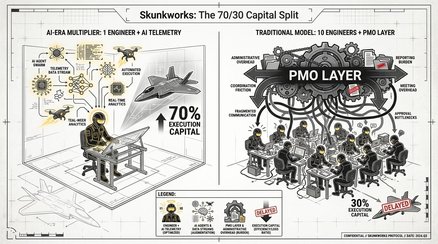
Operating local AI compute clusters forces a single senior engineer to manage an asynchronous swarm of AI agents alongside writing code. Maintaining stability across this environment requires three layers of extreme technical rigour:
- Automated Evaluations : Engineers must deploy continuous evaluations to synthesise boilerplate and automate dependency graphs safely.
- Pipeline Guardrails : Strict CI/CD parameters must govern the network.
- Deterministic Testing : Code pipelines require absolute deterministic testing to control the non-deterministic outputs of LLMs .
This requirement creates the Algorithmic Management Tax. Designing pod architectures around rigorous AI leverage requires exact funding allocation:
- Overhead Utilisation : The designated 30% overhead budget explicitly funds AI -driven telemetry, LLM governance pipelines, and agent supervisor compute.
- Operational Baseline : Actively funding model governance converts the 70/30 split from a theoretical concept into an ironclad operational reality; Source: McKinsey State of AI 2025 .
Conclusion & Strategic Advice
The transition to high-velocity R&D requires solving a specific organisational physics problem. Enforcing a strict 70/30 capital split dismantles the human communication explosion inherent in large teams and establishes automated, programmatic governance.
Technical leaders must apply a strict execution matrix across two deployment environments:
- Greenfield Deployment : Launch a single, AI -leveraged pod outside legacy PMO structures to establish the 70/30 baseline from day one.
- Legacy Transitions : Implement programmatic compliance gates and automated engineering telemetry to support capping legacy coordination spend at 30%.
To review the exact mechanics of automating this transition, examine Skunk Works: Non-Invasive Telemetry .
Audit your capital allocations, account for the algorithmic tax, expose the human overhead, and strictly reclaim the budget for the executing engineers.
💬 Are you ready for the "autonomous pod" era? Drop your thoughts below and ♻️ share this post with your network!
Further Reading
More From Me
Original Article: Read on LinkedIn | Read on Substack