Optimizely GEO Engine: Building with Content Recommendations
Introduction
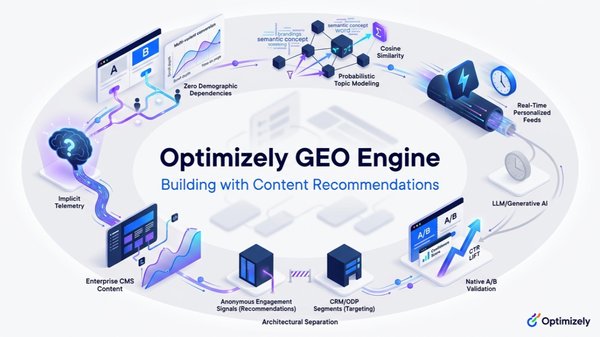
Relying on manual tags and explicit CMS rules to personalise content presents severe scaling limitations. Optimizely Content Recommendations replaces deterministic rule trees by deploying a Natural Language Processing (NLP) pipeline that calculates interest profiles based entirely on content consumption metrics.
Mapping an indexed corpus against historical reader engagement requires specific architectural dependencies to enable autonomous affinity scoring across the platform:
- Semantic Extraction : The engine identifies topic clusters and measures interaction depth to automate the generation of context-aware digital ecosystems.
- Infrastructure Boundaries : The EPiServer.Personalization.ContentRecommendations package requires an active Optimizely CMS installation and does not operate as a standalone SDK.
- Deployment Constraints : This CMS dependency dictates the integration path for systems engineers building headless or composable architectures.
1. Core Architecture and Product Evolution
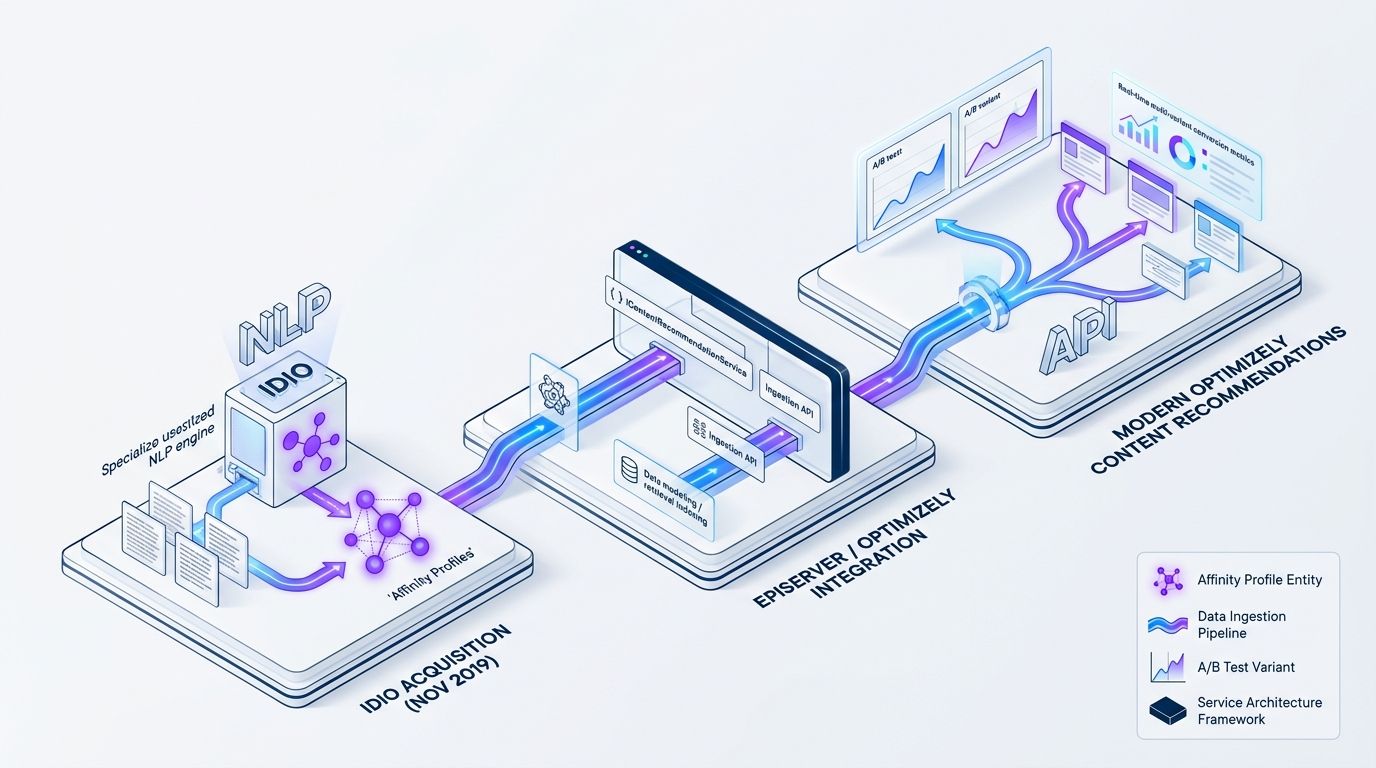
Optimizely's acquisition of Idio on 18 November 2019 introduced predictive analytics directly into the digital experience ecosystem. The modern Optimizely Content Recommendations engine focuses strictly on content affinity, operating independently of general-purpose Customer Data Platforms (CDPs) .
This standalone capability executes autonomously through two specific operational principles:
- Implicit Tracking : The engine calculates engagement trajectories based entirely on how readers navigate an indexed corpus, eliminating the need for demographic or transactional data.
- Autonomous Prediction : By measuring these consumption patterns, the system outputs the most mathematically viable narrative recommendations without requiring external identity resolution integrations.
2. NLP Pipeline Mechanics and Affinity Profiling
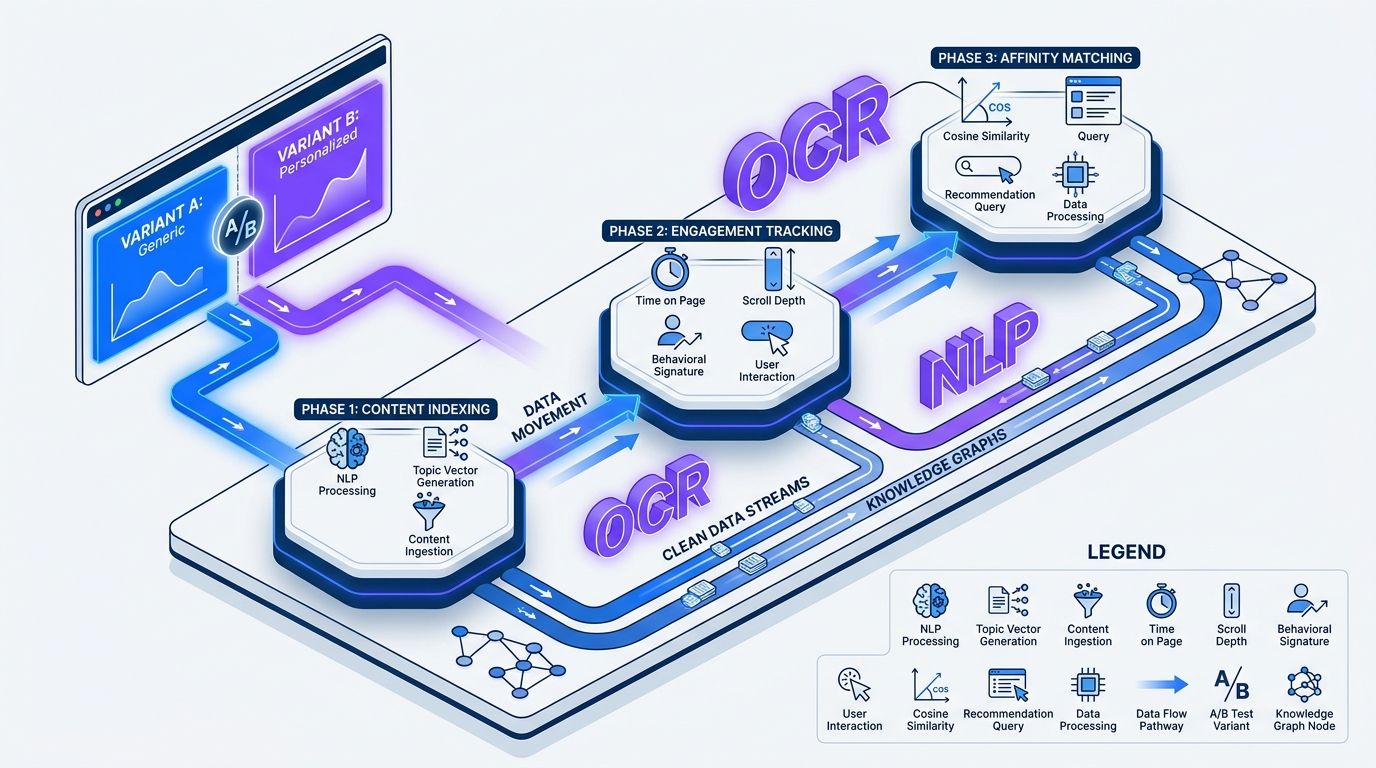
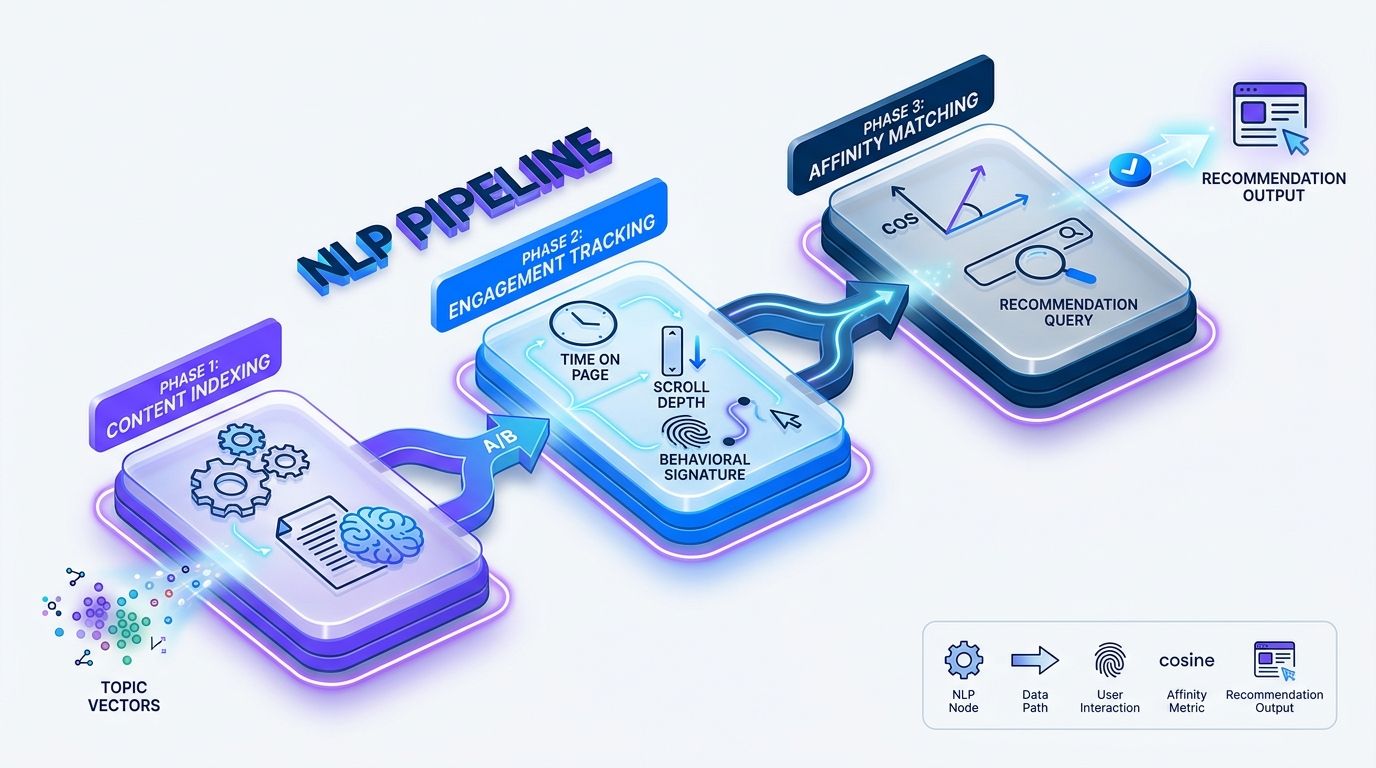
The NLP engine replaces manual taxonomy assignments by executing a three-phase probabilistic pipeline:
- Phase 1 — Content Indexing : The crawler ingests pages registered in the Optimizely CMS, applying NLP to extract semantic concepts from the body text and structured markup to generate a weighted "topic vector" for each asset.
- Phase 2 — Engagement Tracking : When a visitor accesses content, telemetry metrics including time on page and scroll depth incrementally append the article's topic vector to the visitor's behavioural signature.
- Phase 3 — Affinity Matching : During a recommendation query, the engine computes the cosine similarity between the visitor's accumulated affinity vector and the semantic topic vectors of unread assets to surface top statistical matches.
This probabilistic topic modelling architecture evaluates term density and semantic overlap to compute interest, mirroring principles found in Latent Dirichlet Allocation . The framework bypasses the computational latency associated with LLM -based generative AI and vector search ( RAG ) paradigms.
A visitor consistently consuming technical architecture documentation will trigger similar technical posts based purely on this mathematical tracking logic:
- Performance Efficiency : The model delivers real-time recommendation feeds without the computational overhead of generative retrieval processing.
- Algorithmic Determinism : Mathematical engagement trajectories govern the output parameters, stripping subjective categorisation from the delivery layer.
3. C# Integration and Regional Configuration
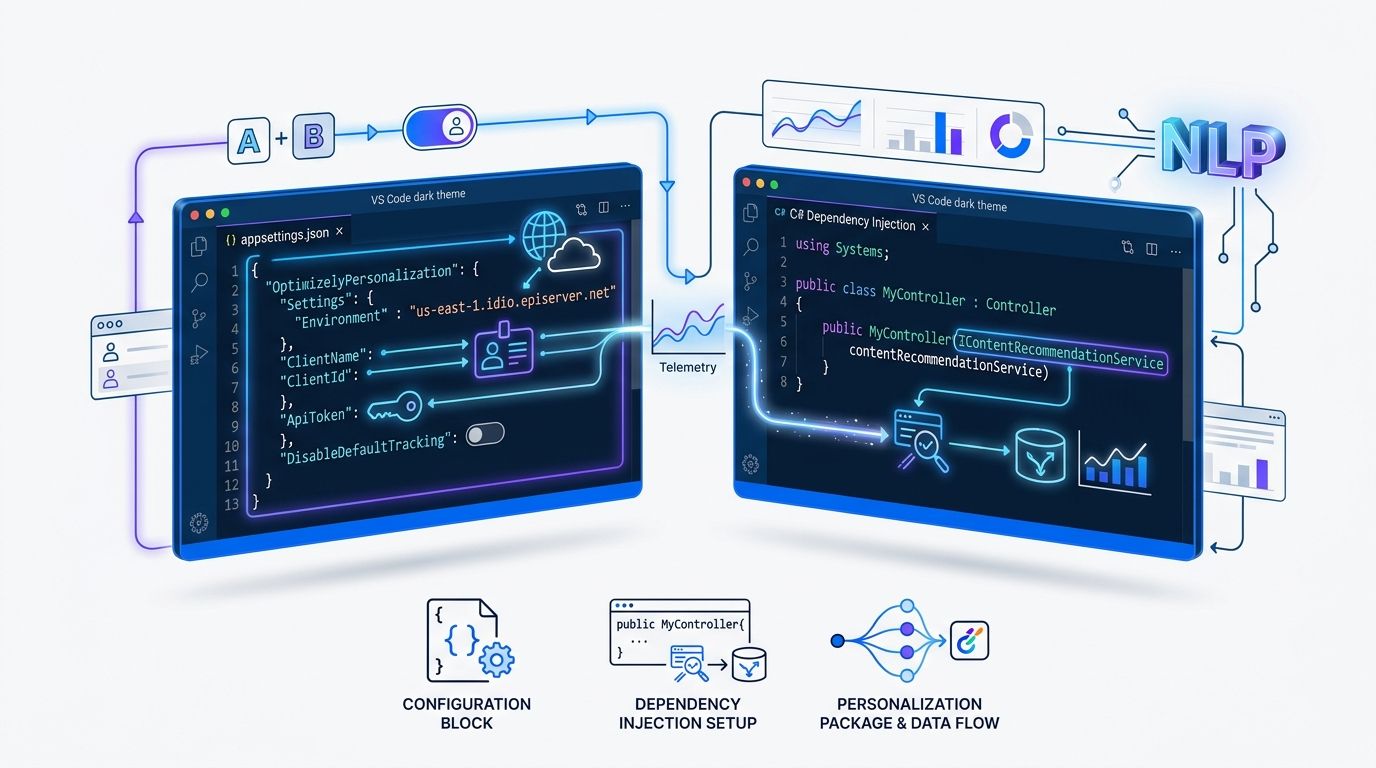
Deploying the EPiServer.Personalization.ContentRecommendations package requires explicit API credentials configured in the appsettings.json file. The legacy namespaces remain an active dependency, forcing the environment string to reference the original Idio network domains directly:
"EPiServer": {
  "ContentPersonalization": {
    "Environment": "us-east-1.idio.episerver.net",
    "ClientName": "brand-alloy",
    "ClientId": "idio-client-id-abc",
    "ApiToken": "idio-secret-token-xyz",
    "DisableDefaultTracking": false
  }
}
Setting DisableDefaultTracking: false ensures the SDK passively fires tracking payloads during page rendering, minimising the requirement for manual telemetry instrumentation.
4. Controller Execution and Dependency Injection
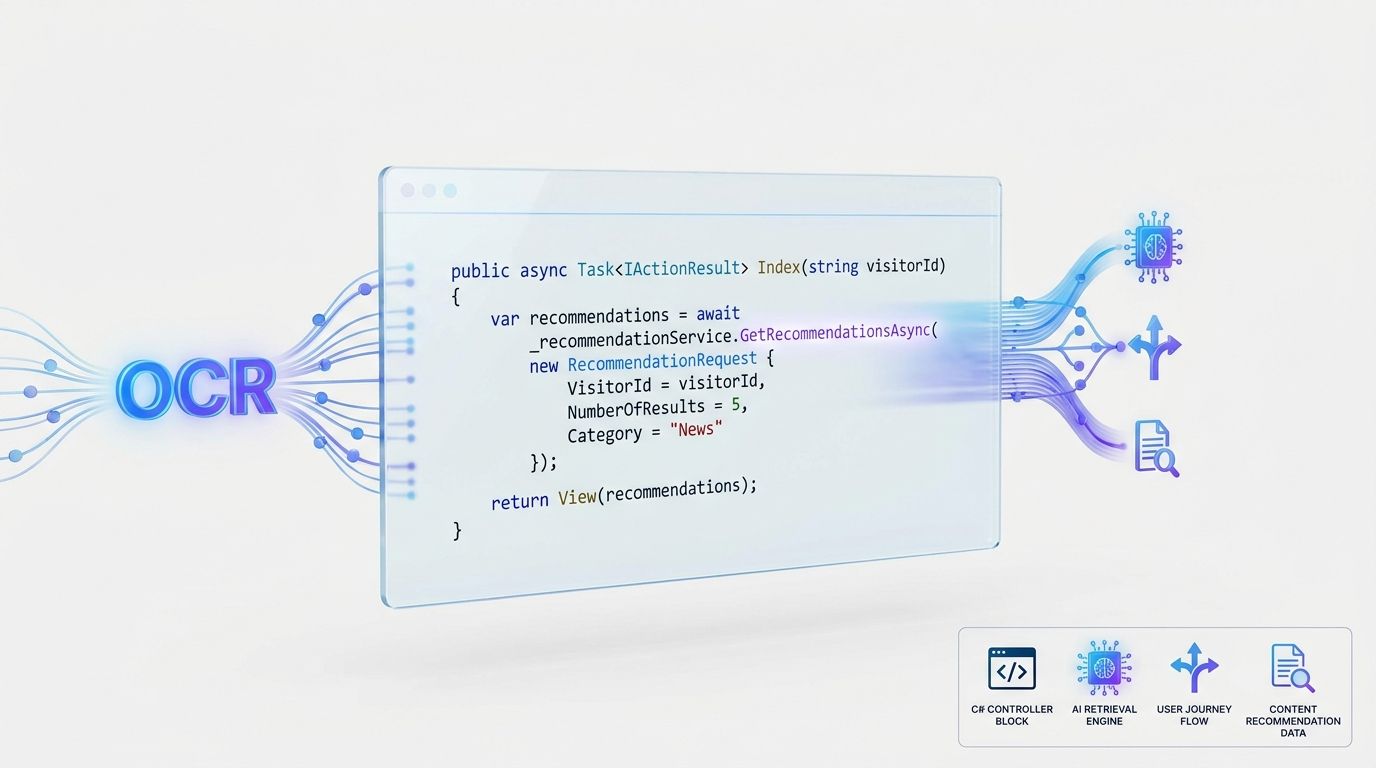
The IContentRecommendationService exposes query methods designed for standard dependency injection into active controllers and view components:
public async Task<IActionResult> Index(string visitorId)
{
    var recommendations = await _recommendationService.GetRecommendationsAsync(new RecommendationRequest
    {
        VisitorId = visitorId,
        NumberOfResults = 3,
        Category = "Technology"
    });
    return View(recommendations);
}
The system requires strict backend logic to map the VisitorId against the corresponding user context accurately:
- Cookie Extraction : Backend systems must explicitly parse the _fs_uid or designated ODP tracking cookie directly from the HttpContext.Request.Cookies collection to populate the ID parameter.
- Semantic Segmentation : Passing the Category parameter enforces definitive semantic boundaries within the query space to prevent topic cross-contamination across highly diversified publishing environments.
5. External API Ingestion and Source Harmonisation
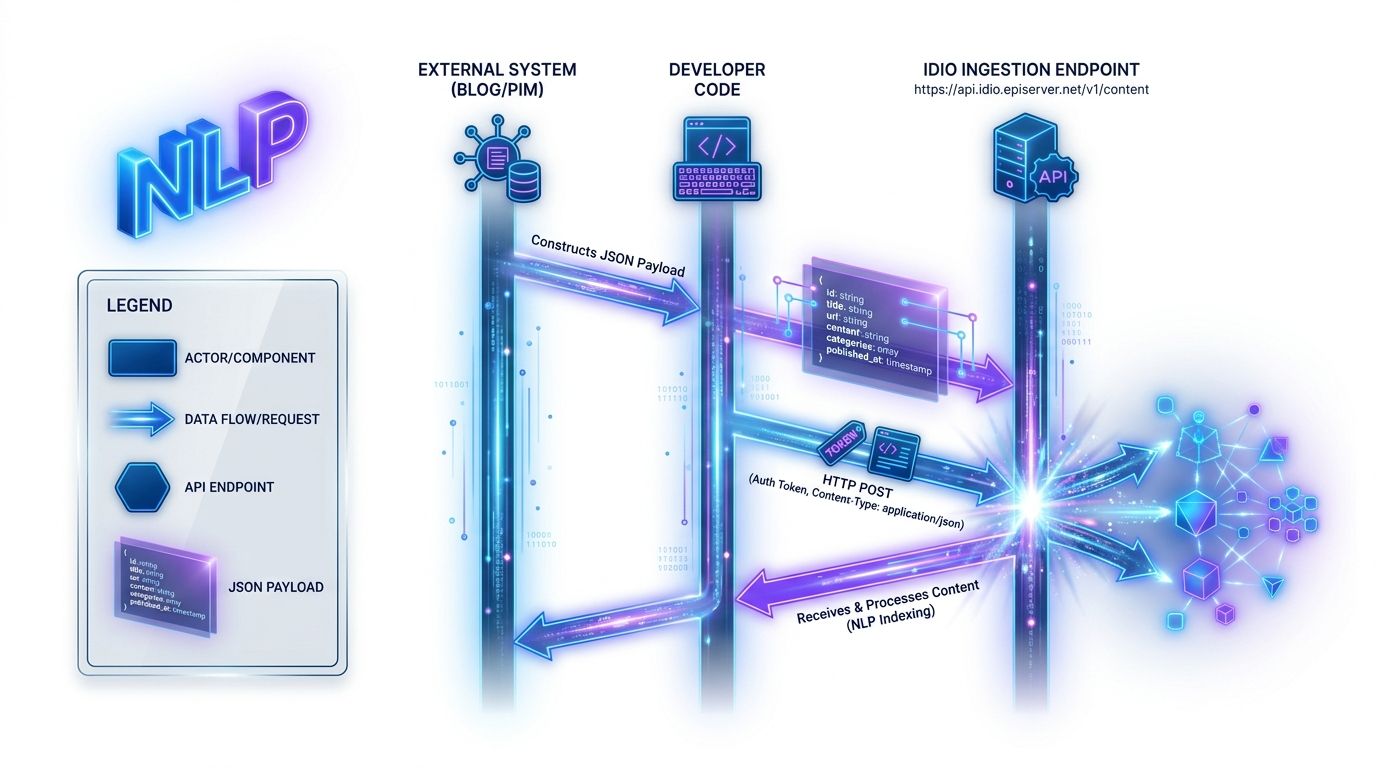
A programmatic ingestion API allows the NLP engine to vectorise external content repositories, enabling unified cross-platform indexing. Developers integrate external inputs, such as partner blogs or independent PIM environments, by executing HTTP POST requests containing structured JSON payloads to the v1/content endpoint.
Constructing an actionable payload requires mapping external metadata precisely to the core ingestion schema properties:
var requestUri = "v1/content";
var contentItem = new
{
    id = contentId,
    title = title,
    url = url,
    content = bodyText,
    categories = new[] { category },
    published_at = DateTimeOffset.UtcNow.ToString("o")
};

// POST to https://api.idio.episerver.net/v1/content
// Authorization: Token {ApiToken}
// Content-Type: application/json
Engineers must cross-reference payload schemas against the Optimizely developer documentation before initialisation. This strict mapping protocol ensures a single recommendation index, regardless of where the architecture originated.
6. Architectural Delegation: Recommendations vs ODP Segments
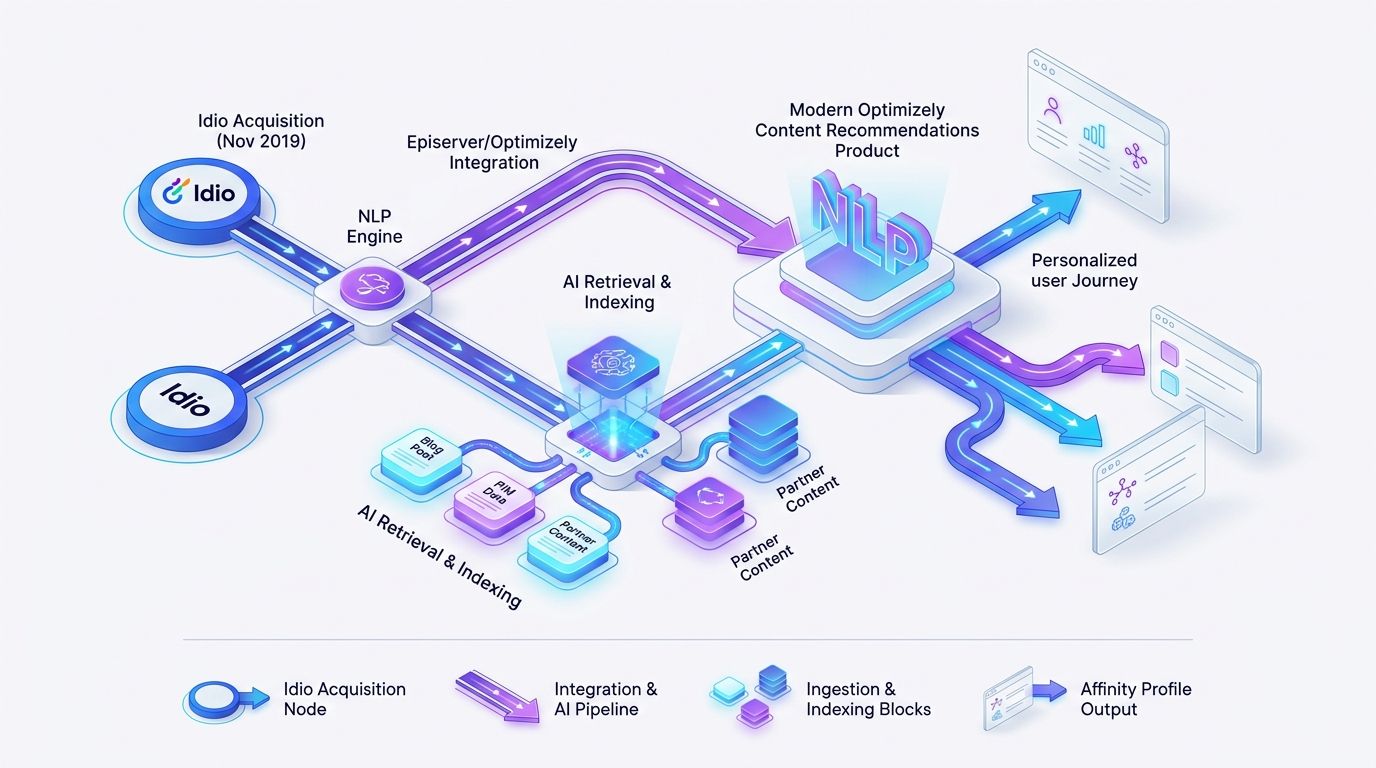
Content Recommendations and ODP Segments operate as two distinct personalisation sub-systems within the Optimizely stack, splitting platform responsibilities across targeted operational layers:
- Implicit Affinity Modelling : Content Recommendations calculates and surfaces article-level output based exclusively on anonymous reading patterns and semantic engagement signals.
- Explicit Behavioural Targeting : ODP Segments consume multi-channel event telemetry and CRM inputs to execute macro-level manipulations, including overarching calls-to-action or global pricing rules.
7. Known Infrastructure Constraints and Limitations
Deploying probabilistic engines inherently introduces three primary infrastructure friction points into the deployment pipeline:
- Indexing Latency : The NLP crawler operates under a cold start limitation, imposing up to a 24-hour processing delay on newly published assets before they populate query results.
- Density Constraints : Content assets registering under 300 words lack the textual density required for the statistical model to formulate confident vectors.
- Credential Exposure : The ApiToken serves as a strict server-side secret; exposure within client-side code architectures directly compromises environment security.
8. Native A/B Testing and Telemetry Validation
Optimizely Content Recommendations includes an integrated A/B testing module designed to validate algorithmic confidence variables empirically. This native framework eliminates the need to add third-party tools to measure the base engine's output efficacy.
Platform engineers configure concurrent test environments to track interaction metrics directly across competing algorithmic logic:
- Strategy Comparison : Teams execute mathematical validation by running a purely affinity-driven feed directly against a structurally filtered baseline category feed.
- Performance Tracking : The platform calculates the deterministic Click-Through Rate (CTR) delta, guaranteeing that widget deployments run at maximum statistical engagement.
Conclusion & Strategic Advice
Optimizely Content Recommendations rearchitects static publishing hubs into adaptive, affinity-driven environments. Implementing the NLP pipeline alongside the external API ingestion endpoints ensures definitive cross-platform content harmonisation.
Pairing computed content vectors with broader behavioural tools establishes the foundation for sustaining highly contextual reader journeys at an enterprise scale:
- Architectural Progression : To operationalise this specific capability within your wider audience strategy, advance to the subsequent technical phase: Optimizely Personalisation: Wiring ODP Segments and Content Recommendations into Visitor Groups.
- Density Requirements : Ensure all publishing-tier inputs have sufficient textual density to enable machine-readable semantic extraction.
- Automated Curation : Deploy probabilistic matching logic to outpace the limitations of manual taxonomy configuration.
💬 How is your team balancing manual content curation with autonomous, algorithm-driven personalisation? Drop your insights below and ♻️ share this breakdown with your technical network!
Further Reading
- Optimizely Developer Portal: Personalization & Recommendations
- The Math Behind the Magic: How Natural Language Processing Categorizes Content
- Building Real-Time Recommendation Engines with C# and .NET
More From Me
Original Article: Read on LinkedIn | Read on Substack