Optimizely Opal Agents: Operational Guide to Orchestration Pipelines
Introduction
Building on the structural blueprints established in Optimizely Opal: The Hub-and-Spoke Architecture , this guide transitions from architectural theory to operational execution.
Deploying generative AI exclusively as a chat interface fails to provide a sustainable technical differentiator. Market requirements call for intelligent orchestration: to ensure brand consistency, automate discoverability, and measure the real-world return on MarTech investments.
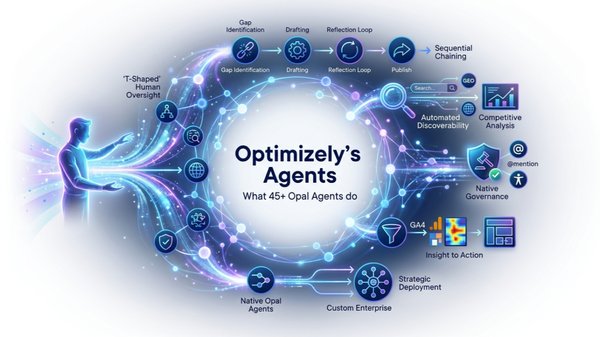
Projected for mid-2026, the Optimizely Opal Platform executes over 45 purpose-built agents to govern the marketing pipeline. This operational guide covers three capabilities: mapping agents by function, defining deterministic multi-agent workflows, and implementing governance tools to automate digital pipelines.
1. From AI Assistant to Orchestration Pipelines
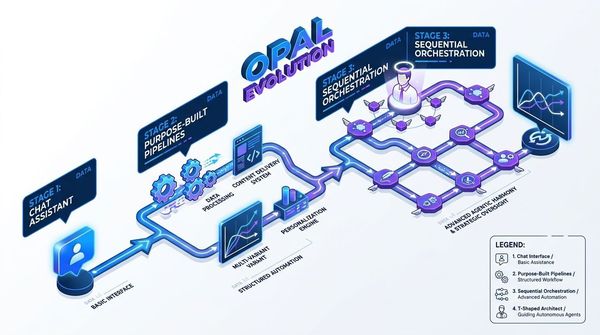
Defining the structural boundaries between chat interfaces and automation infrastructure requires categorising Opal's agents into three specific operational constraints:
- Event-Triggered Pipelines : The agents function as highly specialised LLM architectures that utilise constrained tool-use and strict system prompts to execute targeted tasks.
- Deterministic Execution : Opal runs 45 precise routines to manage standard outputs, including scheduled audits, content briefs, and reports, without human intervention.
- Deployment Validation : System capabilities and exact agent counts scale continuously. Administrators must verify the Optimizely Product Roadmap for tier-specific inclusions before deployment.
2. The Content & SEO Agents
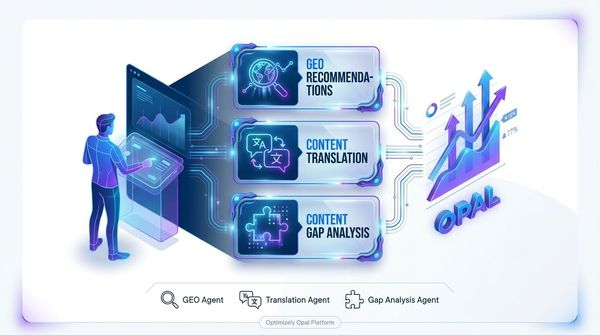
The platform processes content creation and search discoverability through four dedicated agent architectures:
- GEO Recommendations : The system analyses site content against AI crawler signals to calculate schema modifications for Generative Engine Optimisation.
- AEO Gap Finder : Integrating Conductor intelligence, the agent benchmarks brand citations within AI-generated answers against competitors to output high-priority content gaps.
- Translation & Drafting : The pipeline processes initial drafts and translations directly from CMP briefs while applying strict brand-aware voice parameters.
- SEO Metadata & Alt-Text : The architecture computes descriptive alt-text and automated title tags for publishing queues, dynamically mitigating accessibility debt.
3. The Analytics & Insight Agents
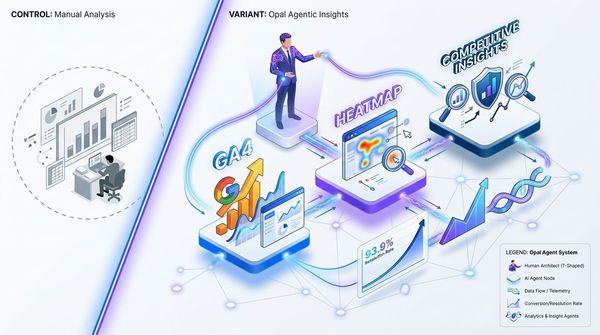
Opal converts raw analytical data into editorial actions using three distinct insight tools:
- GA4 Report Generation : The agent converts Google Analytics 4 data payloads into direct performance summaries, including bounce rates and drop-offs, bypassing manual dashboard configuration entirely.
- Heatmap Analysis : The system parses session recordings using a heatmap to calculate underperforming layout zones and output structural layout modifications.
- Competitive Insights & Content Audits : The architecture tracks external messaging shifts and audits while simultaneously auditing internal content against Optimizely Opal Platform freshness parameters.
4. The Accessibility & Compliance Agents
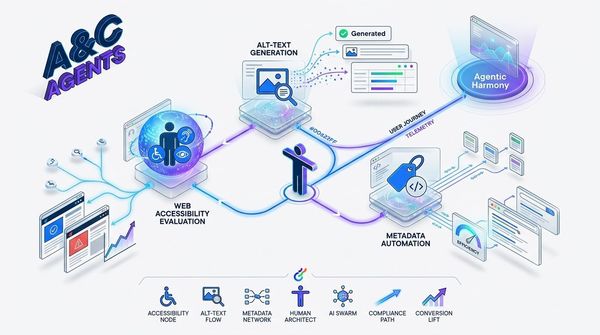
Enterprise standards and risk mitigation are enforced across the platform via three compliance checking components:
- Web Accessibility Evaluation : The pipeline performs strict audits against WCAG 2.2 criteria to flag colour contrast failures and missing ARIA attributes .
- Brand Voice Compliance : The agent validates draft outputs against central instruction sets and automatically filters off-brand structural conventions.
- Legal & Disclaimer Reviews : The system identifies regulated terminology and comparative claims, routing them directly into human-in-the-loop review queues.
5. Agent Workflows: Sequential Agent Chaining
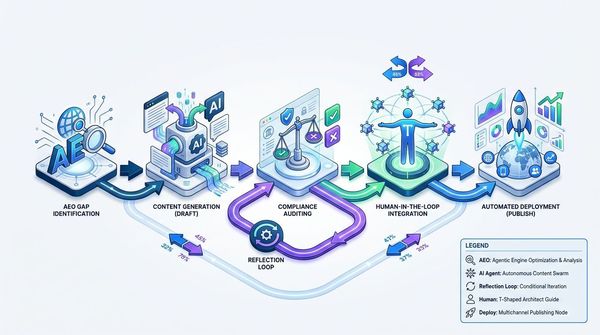
Agent Workflows scale output when chained into strictly sequential, conditional pipelines that are triggered by routine schedules or CMS /CMP webhooks . These deterministic scripts manage failure states through five structured execution phases:
- Phase 1: Gap Identification : The AEO Gap Finder identifies missing citation domains to initiate the workflow.
- Phase 2: Content Generation : The Content Drafting Agent processes the resulting brief to output an initial text payload.
- Phase 3: Compliance Auditing : The Brand Voice Compliance Agent executes an audit of the text payload. If this check fails, the system triggers Agentic Reflection & State Management , feeding specific structural and tonal corrections back to the drafting layer for a self-correcting iteration.
- Phase 4: Human-in-the-Loop Integration : Upon passing automated compliance, the system triggers a CMP task for final human editorial refinement.
- Phase 5: Automated Deployment : Following human approval, the SEO Metadata Agent tags the asset and pushes it to the publishing queue.
6. Instruction Mentions: Applying Saved Prompts Inline
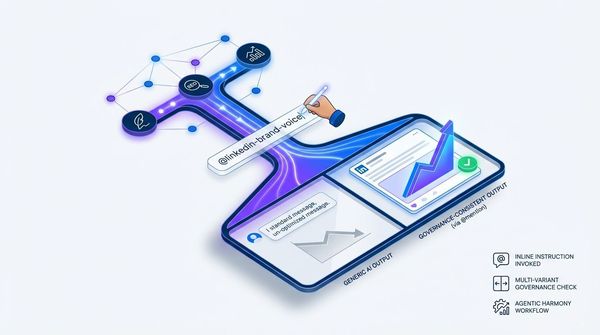
Governance rules are encoded centrally and deployed directly at the interface layer through two primary interaction mechanics:
- Syntax Invocation : Users apply standard @mention commands to invoke pre-configured system parameters (e.g., @linkedin-brand-voice).
- Centralised Governance : Interface-level constraints replace manual user prompting, locking brand rules into a unified repository to ensure standardisation across all outputs.
- UI Verification : System administrators must verify the exact UI placement for mentions against current product documentation before user training deployment.
7. Agent Visibility Analytics Dashboard (Projected June 2026)
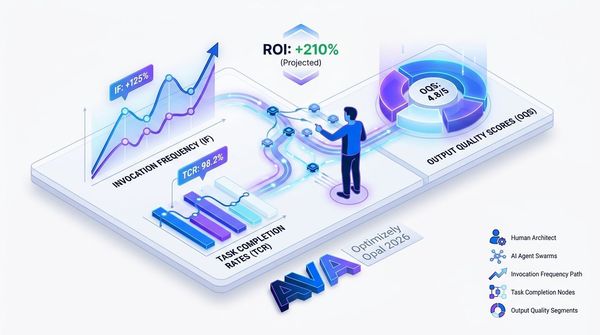
Targeted for a June 2026 roadmap release, the Agent Visibility Analytics dashboard measures output quality and system utilisation through three primary data streams:
- Metric Tracking : The dashboard logs agent invocation frequencies, task completion rates, and AI crawler traffic trends.
- Conductor Integration : Native API integration ties internal orchestration velocity to external search visibility metrics.
- ROI Measurement : The platform provides hard data tying AI deployments directly to empirical, measurable ROI .
8. When to Use Opal Agents vs Custom Pipelines
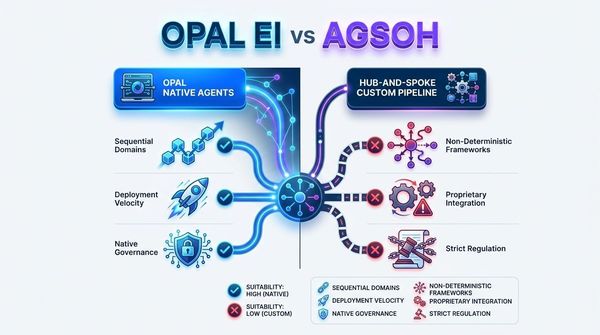
From a systems-design perspective, architectural success requires matching the infrastructure layer to specific data constraints through two distinct deployment models:
Deploy Native Opal Agents When:
Native agent deployment requires evaluating the environment against three strict operational parameters:
- Sequential Domains : The functional use case operates within defined, strictly linear pipelines, including SEO generation or standard analytics processing.
- Deployment Velocity : The project timeline prioritises rapid system integration over deep, ground-up customisation.
- Native Governance : Security and tonal constraints are adequately controlled via native Instruction Mentions.
Deploy Custom Hub-and-Spoke Pipelines When:
Custom pipeline development becomes necessary when system requirements hit three specific technical thresholds:
- Non-Deterministic Frameworks : Workflows require multi-agent negotiation architectures, such as LangGraph and AutoGen , operating outside standard sequential logic.
- Proprietary Integration : The data pipeline depends on external systems, bespoke data lakes , and complex ERPs .
- Strict Regulation : Local regulatory environments mandate on-premises execution or zero-cloud data processing.
Conclusion & Strategic Advice
Optimizely Opal scales generative AI with event-driven agents and strict interface governance, keeping high-volume output safely on-brand.
- Deploy Native Agents: Use sequential agents for quick wins in discoverability and compliance pipelines.
- Isolate Custom Frameworks: Restrict bespoke multi-agent setups to complex, non-deterministic integrations requiring proprietary data routing.
Next Step: Audit your manual pipelines to establish an automation baseline, and stay tuned for our upcoming guide: Building Opal Agent Workflows: A Practical Configuration Guide (Coming Soon!).
💬 Are your teams still relying on manual AI prompting, or have you transitioned to purpose-built orchestration pipelines? Drop your insights below and ♻️ share this post with your network!
Further Reading
- Architecture : LLM Powered Autonomous Agents - Lilian Weng
- Discoverability : What is Answer Engine Optimisation (AEO)? - Search Engine Land
- Compliance : WCAG 2.2 Guidelines - W3C
More From Me
Original Article: Read on LinkedIn | Read on Substack