Microcontroller Threat: Asymmetric Warfare with Cheap Silicon
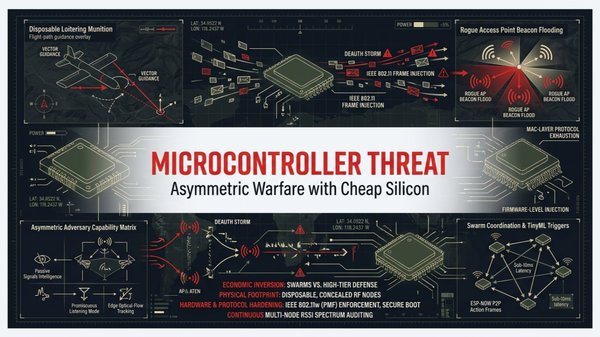
- Part 2 of 6 - Packet Injection, Rogue AP Honeytokens, and Kinetic Swarm Guidance
Introduction
Building on the foundational analysis of edge sensing in Microcontroller Threat: $5 Silicon Reshaping Perimeter Security , the same hardware architectures that enable low-cost perimeter defence also enable acute offensive capabilities. At unit costs between $3 and $10, commercial off-the-shelf (COTS) microcontrollers —specifically the ESP8266 , ESP32 , and ESP32-S3/C6 ecosystems—have evolved into high-impact, attritable electronic warfare and tactical signals intelligence (SIGINT) assets.
The modern asymmetric threat model expands beyond native 2.4 GHz radios through two primary architectural vectors:
- Sub-GHz Transceiver Orchestration : The ESP32 acts as a high-speed computational core driving external RF transceivers (e.g., LoRa , CC1101, FSK via SPI / I2C / I2S ) for electronic warfare evasion across non-standard bands.
- Expanded Protocol Exploitation : Hardware integration of IEEE 802.15.4 ( Zigbee / Thread ) in variants like the ESP32-C6 extends adversary access directly into industrial control and perimeter sensor fabrics.
Prerequisites & Dual-Use Context : Technical analysis of adversary offensive tactics is detailed strictly for defensive red-teaming , threat modelling , and hardware-hardening protocols. The following breakdown categorises the operational vectors of weaponised commercial silicon across targeted protocol exploitation, passive intelligence collection, and kinetic payload execution.
The Dual-Use Dilemma of $5 Silicon
The commercial availability of dual-core processing, direct baseband access, and expansive peripheral buses creates an extreme economic asymmetry. Adversaries field disposable, highly distributed attack nodes at negligible cost, overwhelming conventional defence economics across three operational areas:
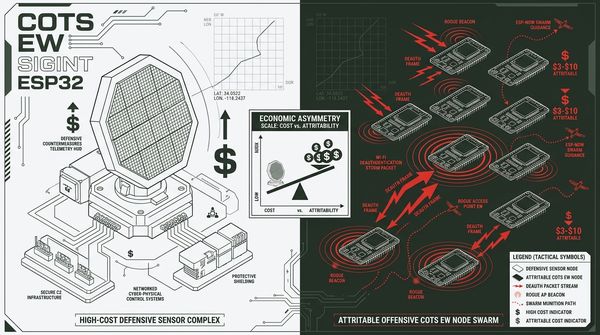
- Capital Inversion : Swarms of disposable $5 nodes force defenders to expend high-tier electronic counter-countermeasures or kinetic air-defence assets.
- Physical Footprint : Compact system-on-chip ( SoC's ) form factors enable rapid field concealment within standard commercial enclosures, tree lines, or supply corridors.
- Power Delivery Constraints : Deployments pairing standard ESP modules with low-cost RF power amplifiers (e.g., SKY65377 or RFX2401C) aim for +30 dBm (1 Watt) output, but a raw ESP32 GPIO or 3.3V rail cannot sustain these transient current spikes without triggering brownouts; functional field units mandate discrete buck converters and thermal mitigation hardware.
Category 1: Asymmetric Signals Intelligence & RF Interception
Low-power microcontrollers deployed in promiscuous listening mode operate as un-attributable SIGINT collectors across perimeters and transit routes.
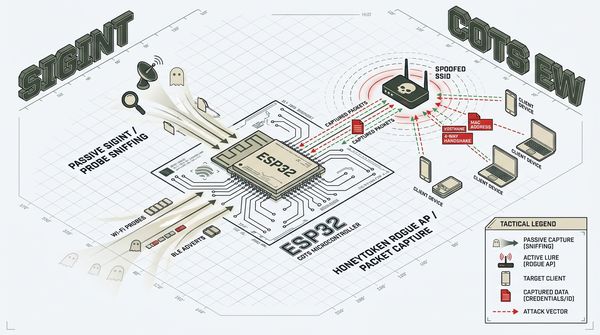
Adversary signal interception relies on two primary collection techniques:
- Passive Movement Heatmapping : Operating purely as non-transmitting receivers, nodes log unencrypted 802.11 probe requests and Bluetooth Low Energy (BLE) advertisement UUIDs to generate temporal heatmaps of patrol routines while defeating direction-finding triangulation.
- Honeytoken Rogue Access Points : Concealed ESP32 nodes broadcast spoofed SSID beacons mimicking tactical networks, harvesting client MAC addresses , device hostnames, and cryptographic four-way handshakes for offline hash extraction upon association attempts.
Category 2: Targeted Protocol Exploitation & RF Denial
An ESP32 lacks the instantaneous baseband bandwidth and output power to act as a physical-layer barrage jammer against military frequency-hopping waveforms. Instead, low-level firmware access to raw IEEE 802.11 frame injection enables precise, MAC-layer protocol exploitation without requiring expensive software-defined radios .
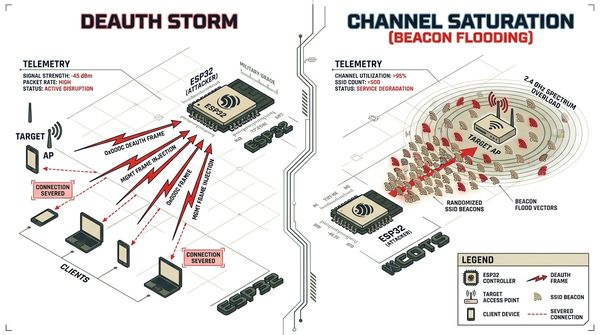
Defenders encounter two primary protocol exhaustion mechanisms:
- Deauthentication Storms : Spoofed 802.11 management frames force immediate disconnections on networks lacking Protected Management Frames (PMF), as documented by Carbajal & Akbarfam (2026) and Arora (2018) . Even with WPA3 and PMF enforced, attackers pivot to downgrade attacks or unassociated probe targeting.
- Beacon Flooding : Rapidly broadcasting thousands of randomised SSIDs saturates 2.4 GHz access-point tables, exhausting target client memory and degrading channel availability through protocol parsing overhead rather than raw RF saturation.
Category 3: Kinetic Guidance & Swarm Payload Triggers
COTS microcontrollers turn electronic signals into physical action with low-latency networking and on-device machine intelligence.
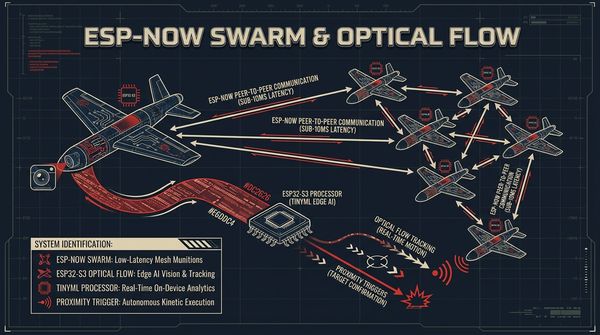
Kinetic integrations leverage two main architectural capabilities:
- Routerless ESP-NOW P2P Clusters : Peer-to-peer ESP-NOW clusters transmit positioning and detonation data with sub-10 ms latency, avoiding central routers. Native ESP-NOW offers single-hop, deterministic latency without mesh routing overhead. However, RF environments may need bridging to long-range sub-GHz links.
- Edge Vision Confirmation : Utilising hardware vector extensions on the ESP32-S3, quantised TinyML models process raw image feeds from CMOS sensors such as the OV2640. As documented in A Benchmark Reference for ESP32-CAM Module (Nowroz et al., 2025) , on-device visual inference executes real-time optical-flow tracking and proximity triggers locally at the edge.
Conclusion & Strategic Advice
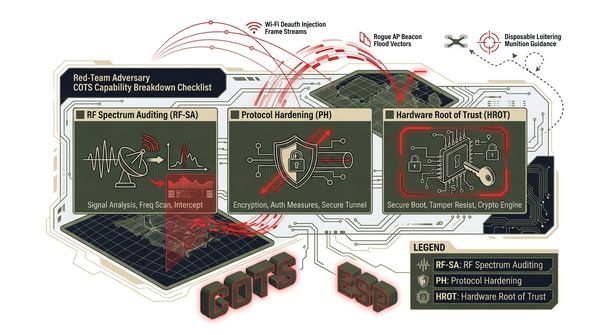
The convergence of raw packet injection, peer-to-peer protocols, peripheral sub-GHz orchestration, and edge neural processing makes disposable silicon an urgent threat vector. Robust mitigation requires three core engineering defences:
- RF Spectrum Auditing : Enforce continuous spectrum anomaly detection and multi-node RSSI triangulation, as detailed in Geometric and Signal Strength Dilution of Precision (DoP) Wi-Fi (Zirari et al., 2009) .
- Protocol Hardening : Mandate IEEE 802.11w (PMF) across all fleet hardware to neutralise frame injection, alongside active monitoring for downgrade attacks.
- Hardware Root of Trust : Secure internal nodes via cryptographically enforced Secure Boot and Flash Encryption hardware blocks.
For tactical countermeasures and operational blueprints on sanitising contested environments, continue to the next instalment: Microcontroller Threat: Hunting and Hardening Hostile Nodes .
💬 How is your organisation adapting perimeter defence and red-teaming against disposable, low-cost silicon threats? Share your perspective below and ♻️ repost to alert your technical network!
Further Reading
- ESP-IDF ESP-NOW API Programming Guide
- ESP-IDF Wi-Fi Driver API Reference & Low-Level Frame Controls
- Espressif ESP-DL Neural Network Inference Framework User Guide
More From Me
Original Article: Read on LinkedIn | Read on Substack