Microcontroller Threat: Zero-Emission TinyML at the Edge
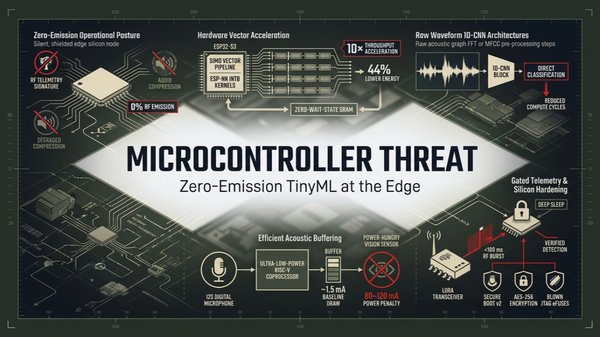
- Part 4 of 6 - Xtensa LX7 Vector Instructions, Silent Acoustic Classifiers, and Zero-Emission Standby
Introduction
Building on our examination of defensive countermeasures in Microcontroller Threat: Hunting and Hardening Hostile Nodes , physical persistence in contested environments requires eliminating the single largest operational liability: continuous RF emissions. Streaming uncompressed or compressed raw sensor telemetry immediately exposes physical positions to hostile signals intelligence (SIGINT) and radio direction-finding platforms.
Operating under hostile surveillance mandates a zero-emission standby posture. Attritable edge hardware must process high-bandwidth environmental signals at the silicon boundary, maintaining complete radio silence until an onboard model confirms a verified detection.
Historically, deploying machine learning to resource-constrained microcontrollers suffered from severe throughput bottlenecks and prohibitive power overheads. Low-cost commercial off-the-shelf (COTS) devices execute real-time threat classification within tight power envelopes by combining four architectural primitives:
- Dual-Core Silicon : Distributes scheduling and workload execution across dedicated processing units.
- Ultra-Low-Power (ULP) Coprocessors : Offloads continuous background monitoring via dedicated coprocessors during deep sleep.
- Hardware Vector Extensions : Accelerates mathematical operations via single-cycle vector instructions.
- Quantised Model Architectures : Deploys state-of-the-art quantised neural networks within internal memory limits.
The following architectural blueprint details how to implement vector-accelerated TinyML pipelines to achieve persistent, passive edge sensing.
The Vulnerability of Transmitting Raw Sensor Data
Continuous telemetry transmission provides electronic-warfare systems with an unambiguous emitter profile. Beyond electromagnetic exposure, transmitting compressed audio degrades downstream classification accuracy by up to 57% when lossy codecs are introduced, as demonstrated in Coding Artefacts in Acoustic Scene Classification .
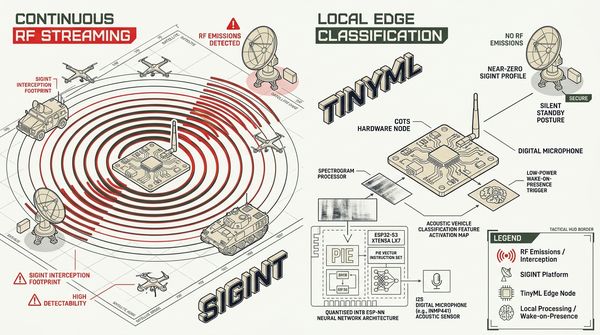
Survival in contested environments requires shifting the inference threshold directly to edge silicon. The node operates as a passive collector, evaluating ambient signals locally and suppressing all transmission until an actionable event occurs.
Hardware Vector Acceleration on the ESP32-S3
Executing neural network models on edge silicon historically encountered severe latency penalties under scalar execution paths. Analysis of embedded pipelines in TinyML Analysis of Xtensa Microprocessors highlights the compute overhead inherent in unaccelerated inference loops.
The Espressif ESP32-S3 addresses scalar execution bottlenecks via dedicated vector execution hardware:
- Dual Xtensa LX7 Architecture : Integrates two Xtensa LX7 cores equipped with Processor Instruction Extensions (PIE).
- SIMD Vector Pipelining : Executes parallel 16-bit multiplications and dot-product calculations in single clock cycles via SIMD instructions.
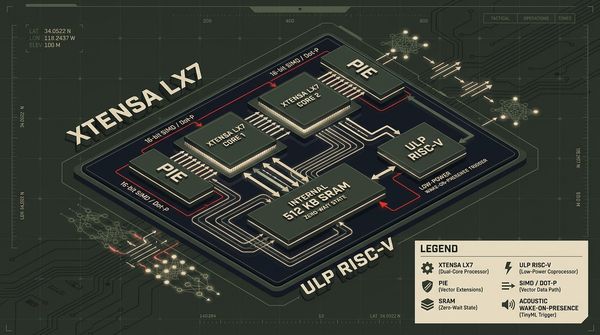
Maintaining an operating envelope below ~120 mW during inference requires executing routines entirely within the 512 KB internal SRAM .
On-chip memory execution and assembly optimisation provide three core performance advantages:
- Zero-Wait-State SRAM Access : Bypassing external memory bus ( PSRAM ) transactions reduces energy consumption by up to 44%, as demonstrated in MEMA Runtime Framework for TinyML .
- ESP-NN Kernel Acceleration : Coupling the assembly-optimised Espressif ESP-NN library with INT8 post-training quantisation evaluated in Low Precision Quantisation for TinyML yields up to a 10× throughput acceleration over scalar routines.
- Localised Attention Topologies : Emerging micro-architectures detailed in Toward Attention-based TinyML extend these vector performance gains to compact edge topologies.
Designing a Silent Threat Sensor (Acoustic vs Visual)
Selecting an edge sensing modality requires balancing analytical fidelity against continuous energy consumption. Vision platforms such as the OV2640 camera draw 80 mA to 120 mA during active capture, imposing thermal and battery penalties that preclude long-term autonomous deployment, as documented in ESP32-CAM Performance Reference Benchmarks .
Conversely, digital I2S microphones (e.g., INMP441) draw approximately 1.4 mA. Attempting to gate acoustic detection behind ultra-low-power PIR or seismic sensors introduces an operational failure because they cannot retroactively sample passed acoustic signals.
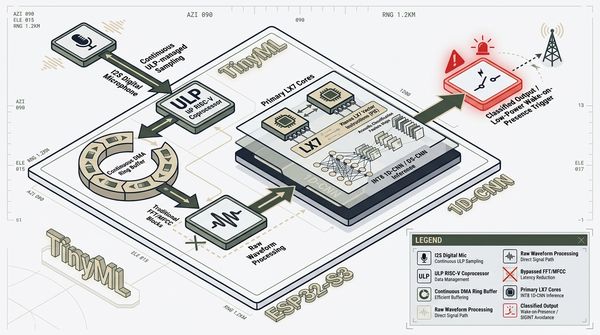
True persistent acoustic perimeter monitoring requires maintaining continuous audio buffering without waking the main cores via three processing stages:
- Continuous ULP Buffering : The ULP RISC-V coprocessor maintains a continuous I2S DMA ring buffer and executes lightweight acoustic thresholding. Meanwhile, the primary LX7 cores remain in deep sleep, establishing a baseline draw of ~1.5 mA.
- Raw Waveform Processing : Micro-edge audio pipelines slash SRAM footprints and compute cycles by bypassing the latency overhead of Fast Fourier Transforms (FFTs) and traditional Mel-frequency cepstral coefficients (MFCCs) , extracting features directly from raw temporal data.
- INT8 1D-CNN / DS-CNN Inference : Upon a threshold wake event, the primary LX7 cores evaluate buffered audio using 1D-Convolutional Neural Networks (1D-CNN) or Depthwise Separable CNNs ( DS-CNN ). These architectures rapidly classify acoustic signatures against engine harmonics, tracked vehicles, and perimeter disruptions, adapting spatial-temporal fundamentals detailed in Acoustic Scene Classification with Convolutional Networks and Domain Generalisation on Efficient Acoustic Scene Classification .
While INT8 quantisation introduces a minor precision trade-off relative to floating-point models, it bounds model parameters within internal zero-wait-state SRAM.
Waking the Telemetry Payload on Verified Detections
Persistent operation requires strict duty-cycle and hardware state management. Multi-stage wake parameters are evaluated through reinforcement-learning scheduling policies in Simulating Battery-Powered TinyML Systems .
Because continuous acoustic buffering establishes a ~1.5 mA power floor, RF telemetry activation operates strictly on an event-driven basis to preserve battery reserves.
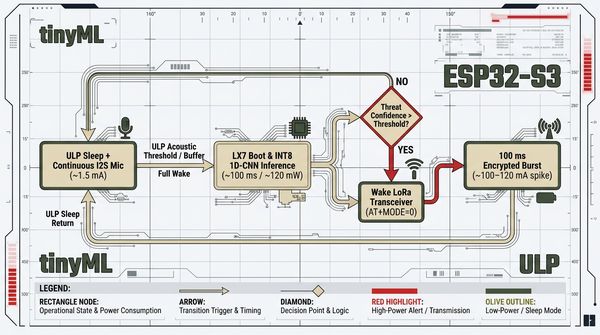
The long-range telemetry module (e.g., Reyax LoRa ) is held in hardware sleep (AT+MODE=1, drawing ~0.5–10 µA).
Telemetry transmission follows a three-stage execution profile:
- Gated Activation : The host MCU wakes the transmitter and dispatches an encrypted alert via AT+SEND only after high-confidence verification, then immediately returns the SoC to ULP sleep.
- RF Window Suppression : Restricting the active RF emission window to under 100 ms evades SIGINT direction-finding systems.
- Transient Load Handling : The transmission burst induces a transient current draw of ~100–120 mA at 15–20 dBm, requiring high-discharge battery chemistries and robust decoupling capacitors to prevent a microcontroller brown-out .
Strategic Hardening for Attritable Deployments
Deploying low-cost intelligence at the physical perimeter exposes hardware to capture and physical extraction attacks, as outlined in Adversarial Attack Transferability in TinyML .
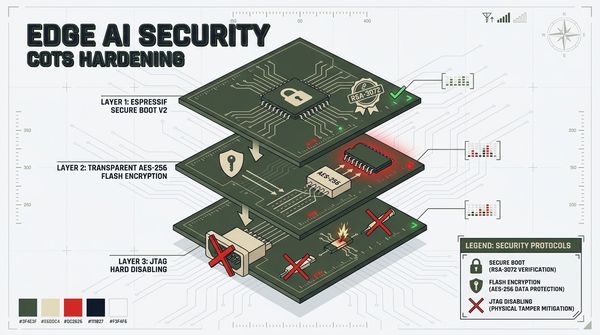
Attritable sensor nodes require three layers of hardware-enforced protection:
- Espressif Secure Boot v2 : Verifies the RSA-3072 signature chain before execution.
- Transparent AES-256 Flash Encryption : Prevents physical readout of proprietary model weights and network telemetry keys using AES-256 .
- JTAG Hard Disabling : Burns physical eFuses to permanently lock JTAG hardware debugging interfaces.
Conclusion & Strategic Advice
Vector-accelerated TinyML fundamentally alters attritable sensing economics. Enforcing INT8 execution inside internal SRAM, utilising modern ULP coprocessing, and binding telemetry to verified inference events enables nodes to achieve persistent operational endurance while eliminating continuous RF vulnerability.
Deploying low-emission sensor architectures requires four core implementation choices:
- Digital Acoustic Sensing : Prioritise digital acoustic sensing over optical paths, utilising ULP coprocessors for continuous buffering to capture transient anomalies.
- Raw Waveform Topologies : Transition from heavy MFCC spectrogram generation to efficient 1D-CNN or DS-CNN architectures operating on raw audio waveforms to maximise internal SRAM capacity.
- Hardware-Accelerated Kernels : Constrain all neural network layer tensors using ESP-NN assembly kernels.
- Power and Flash Security : Enforce cryptographic flash encryption and explicitly provision hardware power-delivery networks for transient ~120 mA RF transmission spikes.
In the next instalment, Microcontroller Threat: Orchestrating Autonomous Swarms , we examine how decentralised nodes coordinate autonomous swarm mesh networks without centralised command infrastructure.
💬 How will sub-milliwatt vector acceleration and on-device TinyML reshape autonomous edge intelligence across contested environments? Share your insights below and ♻️ share this post with your network!
Further Reading
- Espressif ESP-NN Neural Network Acceleration Library
- TensorFlow Lite for Microcontrollers Architecture Guide
- Edge Impulse DSP and Acoustic Feature Extraction Pipelines
More From Me
Original Article: Read on LinkedIn | Read on Substack