Microcontroller Threat: Hunting and Hardening Hostile Nodes
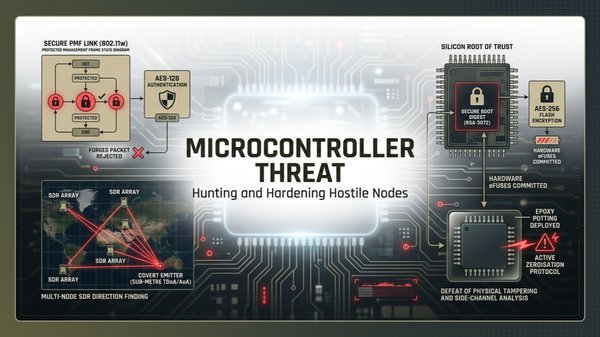
- Part 3 of 6 - 802.11w PMF, RSSI Triangulation, and Flash Encryption Hardening
Introduction
Building on the asymmetric attack surfaces analysed in Microcontroller Threat: Asymmetric Warfare with Cheap Silicon , defending contested operational airspace requires shifting from passive perimeter defence to active silicon-layer neutralisation. Five-dollar commercial off-the-shelf (COTS) microcontrollers —specifically the ESP32 and ESP8266 architectures—have democratised electronic disruption.
Modified firmware enables disposable nodes to execute disruption across three operational vectors:
- Electronic Jamming : Executing high-rate Wi-Fi deauthentication jamming to sever tactical command links.
- Deceptive SIGINT : Broadcasting deceptive honeytoken access points to intercept operational telemetry.
- Swarm Triggers : Functioning as attritable triggers and forward relay nodes for autonomous systems.
Defeating high-volume, disposable silicon cannot rely on traditional physical perimeter security. Operational resilience demands a tripartite counter-measure blueprint:
- Protocol-Level Cryptographic Enforcement : Enforcing frame authentication to drop spoofed management traffic automatically.
- Phase-Coherent RF Interception : Deploying radio frequency (RF) direction-finding arrays to resolve emitter coordinates.
- Hardware-Backed Root-of-Trust Hardening : Implementing silicon-level root-of-trust architectures that mitigate physical side-channel vulnerabilities .
Neutralising the Disposable Silicon Threat
Disposable microcontrollers present a distinct operational asymmetry: they are easily concealed, mass-manufactured, and functionally expendable. When weaponised for persistent RF disruption or forward signal collection, their low unit cost allows adversaries to flood contested sectors.
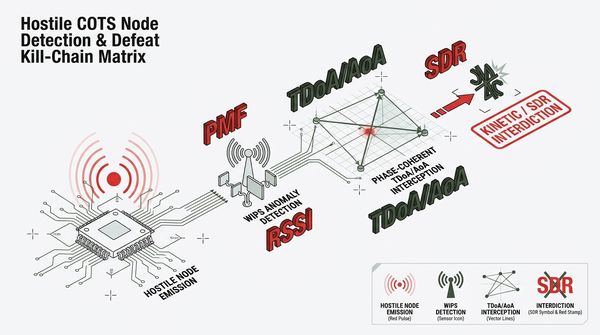
Neutralising this asymmetric vector requires integrating three distinct capabilities into an active defence pipeline, bridging NIST SP 800-153: Guidelines for Securing Wireless Local Area Networks (WLANs) and contemporary electronic warfare doctrines:
- Protocol Enforcement : Mandating cryptographic verification across all management frames.
- Phase-Coherent RF Surveillance : Continuous spectrum scanning to isolate anomalous packet cadence and localise emitters.
- Silicon Anti-Tamper Hardening : Locking physical flash storage and execution pathways against forensic extraction.
Technical Defence 1: Enforcing 802.11w Protected Management Frames
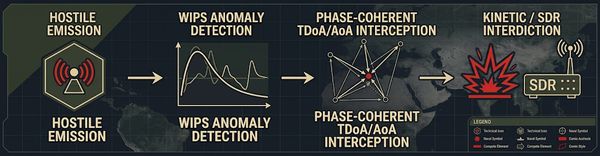
Commercial deauthentication jammers exploit unencrypted 802.11 management frames, forging disconnection notifications to sever tactical command links. Defeating frame-injection attacks requires three technical implementations:
- Protocol Enforcement : Enforce mandatory IEEE 802.11w Protected Management Frames (PMF) across all field access points and edge transceivers.
- Cryptographic Integrity : PMF applies Counter Mode Cypher Block Chaining Message Authentication Code Protocol (CCMP) to unicast management frames and AES-128-CMAC Broadcast Integrity Protocol (BIP) to broadcast frames.
- Operational Outcome : Compliant transceivers automatically drop unauthenticated management packets, rendering commodity injection attacks functionally inert, as validated in A Software-Defined Testbed for Quantifying Deauthentication Resilience in Modern Wi-Fi Networks (Carbajal & Akbarfam, 2026) . While PMF nullifies forged disconnection packets, it does not mitigate raw RF noise flooding; COTS microcontrollers reprogrammed as crude PHY-layer RF noise jammers require kinetic or active-RF interdiction.
Caveat: Legacy 2.4 GHz tactical hardware lacking 802.11w support cannot authenticate protected management frames. Incompatible legacy nodes must be segmented onto isolated physical networks or upgraded to modern WPA3 architectures to prevent residual deauthentication vulnerabilities.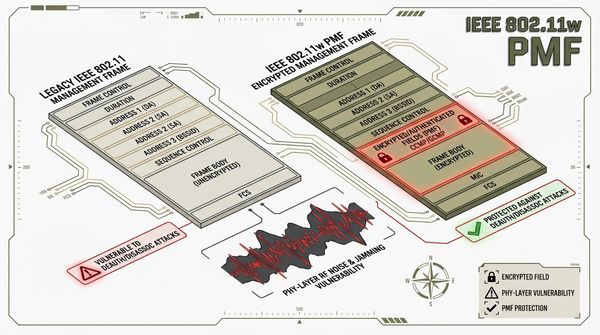
Technical Defence 2: Phase-Coherent SDR Triangulation & Rogue AP Defeat
Covert COTS packet sniffers and rogue access points generate distinct transmission cadence signatures in the 2.4 GHz and 5 GHz bands, as outlined in A Wireless Intrusion Detection System for 802.11 WPA3 Networks (Dalal et al., 2021) .
Historically, localising hidden emitters relied on Received Signal Strength Indicator (RSSI) and trilateration . In complex tactical environments, RSSI trilateration fails against sub-watt microcontrollers emitting burst transmissions due to three physical constraints:
- Shadow Fading Variance : High-scatter environments inflate shadow fading variance, expanding the calculated localisation polygon across entire city blocks.
- Signal Degradation : Multipath fading and structural attenuation distort amplitude readings across non-line-of-sight propagation paths.
- Power Spoofing : Dynamic transmission power adjustments intentionally degrade range estimation algorithms.
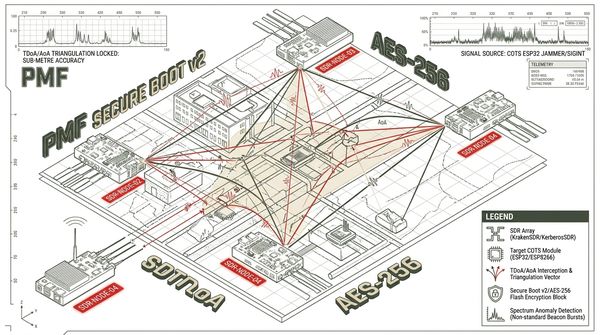
Tactical deployments resolve target positions by operating Time Difference of Arrival (TDoA) and Angle of Arrival (AoA) frameworks across three tiers:
- Spectrum Anomaly Detection : Wireless Intrusion Prevention Systems (WIPS) continuously evaluate beacon broadcast cadence and burst anomalies characteristic of ESP-based flooding tools.
- Phase-Coherent SDR Arrays : Target coordinates are resolved using multi-node, phase-coherent Software-Defined Radios (SDR) (comparable to KrakenSDR or KerberosSDR hardware). By calculating the precise time difference (TDoA) and incident phase angle (AoA) of arriving RF bursts across multiple antennas, these systems achieve sub-metre physical pinpointing.
- RSSI as a Low-Tier Fallback : RSSI estimation operates strictly as a supplementary metric for coarse proximity alerts when phase-coherent arrays are obstructed or offline.
Technical Defence 3: Secure Boot, Encryption, and Anti-Tamper Hardening
Friendly COTS transceivers operating in contested forward zones face inevitable physical capture. Cryptographic locking at the silicon level acts as a critical attrition barrier, preventing immediate firmware extraction and cryptographic key recovery across three hardware controls:
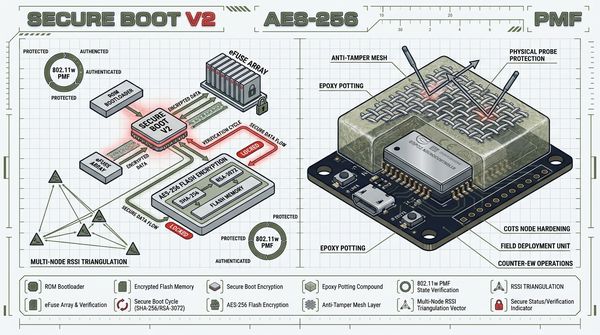
- Secure Boot v2 : SHA-256 digests of an RSA-3072 public key are permanently committed to hardware eFuses . At every boot cycle, the read-only memory (ROM) bootloader validates the RSA-PSS signature appended to the firmware binary before execution, as detailed in the ESP-IDF Secure Boot v2 Documentation .
- AES-256 Flash Encryption : Flash contents remain encrypted at rest using an internal key burned into read/write-protected eFuses, fully documented in the ESP-IDF Flash Encryption Documentation .
- Silicon Readout Lockout : Permanently blowing the DISABLE_DL_DECRYPT and DISABLE_DL_CACHE eFuses prevents debug routines from reconstructing plaintext via serial UART bootloader dumps.
Hardware Bypasses & Side-Channel Realities
Cryptographic boundaries restrict unsophisticated extraction attempts but do not prevent advanced laboratory analysis. Contemporary hardware vulnerability disclosures confirm that ESP32 series silicon remains vulnerable to Voltage Fault Injection (FI) and Electromagnetic Fault Injection (EMFI) side-channel attacks that bypass ROM bootloader signature checks.
Defending against physical decapping and glitching attacks requires two physical hardening measures:
- Hardware Zeroisation : Deploying active hardware zeroisation protocols to erase cryptographic keys upon tamper detection.
- Physical Encasement : Applying dense epoxy potting or anti-tamper mesh layers to deny physical probe access to silicon buses and passive components.
This multi-tiered approach establishes silicon hardening as an asymmetric attrition barrier against reverse engineering.
Operational Takeaway for Tactical Hardware
- Protocol: Mandatory IEEE 802.11w PMF / AES-128 BIP — Threat Neutralised: MAC-Layer Deauth (Note: Fails vs PHY-Layer Jamming)
- RF / Physical: Phase-Coherent SDR Arrays (TDoA / AoA) — Threat Neutralised: Concealed Emitters, Rogue APs, Sub-Watt COTS Nodes
- Hardware: RSA-3072 Secure Boot, AES-256, & Epoxy Zeroisation — Threat Neutralised: Reverse-Engineering, Key Extraction, Fault Injection (FI)
Conclusion & Strategic Advice
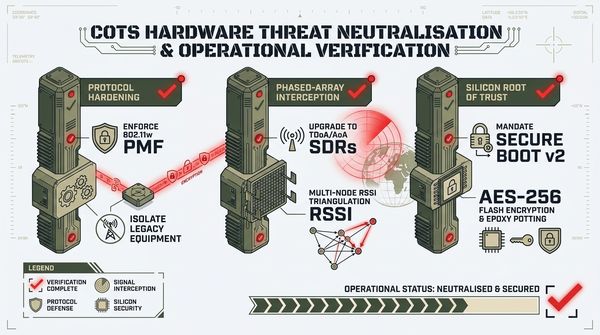
Neutralising disposable silicon requires closing protocol gaps, monitoring RF spectrum with phased arrays, and deploying cryptographic hardware roots of trust with tamper prevention. Protecting tactical deployments from vulnerable COTS nodes relies on three key operational pillars.
- Protocol Hardening : Enforcing IEEE 802.11w to neutralise baseline MAC-layer deauthentication vectors.
- Phased-Array Interception : Operating phase-coherent TDoA/AoA arrays to expose covert emitters with sub-metre accuracy.
- Silicon Root of Trust : Coupling hardware eFuse encryption with zeroisation architectures to render captured hardware functionally unusable.
In the next instalment, Microcontroller Threat: Zero-Emission TinyML at the Edge , we explore deploying completely silent, zero-emission edge ML nodes designed to sense and trigger without emitting detectable RF signatures.
Execute a comprehensive audit of deployed tactical wireless endpoints across three immediate mandates:
- Protocol Audit : Verify that Protected Management Frames (IEEE 802.11w) are strictly enforced across all active transceivers.
- Spectrum Surveillance : Upgrade RF direction-finding infrastructure to phase-coherent, multi-channel SDR arrays.
- Physical Hardening : Mandate industrial-grade epoxy potting and tamper-zeroisation circuits on all forward-deployed silicon.
💬 As expendable commercial silicon disrupts traditional defence hardware economics, how will attritable edge sensing redefine modern tactical intelligence? Share your perspectives below and ♻️ repost to spread the insights across your network!
Further Reading
- Wi-Fi Alliance: WPA3 and Protected Management Frames Specification
- NIST SP 800-162: Guide to Attribute Based Access Control (ABAC) Definition and Considerations
- GNU Radio: Signal Processing & Direction Finding Modules
- Espressif Security Advisory & Hardening Guide
More From Me
Original Article: Read on LinkedIn | Read on Substack