Optimizely Opal: Resisting Website Decay with Agents
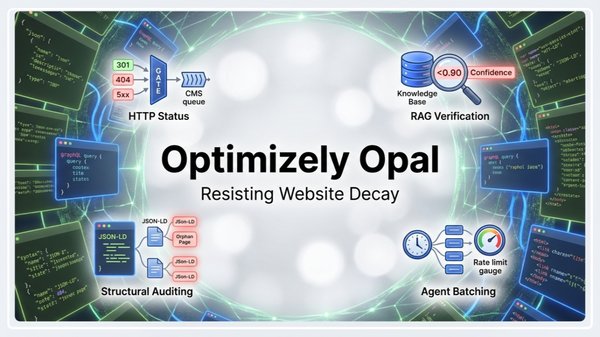
Introduction to Content Decay
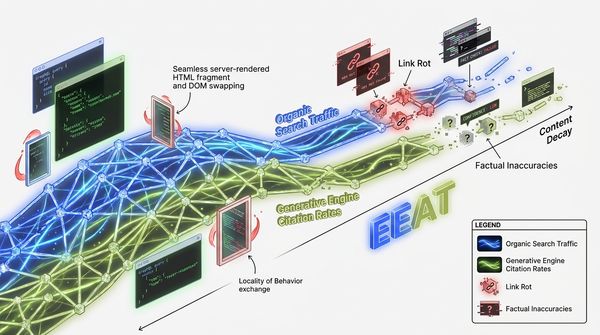
Published digital estates degrade through continuous entropy. Empirical studies show that 20% to 50% of external links break over time, and the typical web page lifespan rarely exceeds three years. Link Rot: Why 20-50% of Web Links Die Within Years .
Unchecked digital decay triggers three primary operational liabilities across web architectures:
- Organic Search Deprecation : Traffic declines as search engines lower crawl priority for unmaintained pages.
- Generative Engine Erasure : Generative Engine Optimisation (GEO) models reduce citation frequency for pages containing broken references or unverified claims.
- Compliance Exposure : Stale regulatory disclosures and unmonitored assertions create direct legal vulnerability.
Optimizely Opal gives you the building blocks to counter this operational erosion. Implementing autonomous site governance requires three architectural controls:
- Continuous Auditing : Transitioning system maintenance from manual periodic reviews into continuous background agentic processes.
- Graph-Level Discovery : Deploying the native Content Refresh Analysis agent across Optimizely Graph to evaluate unmaintained assets against inactivity thresholds and editorial guidelines.
- Compute Management : Scheduling multi-agent evaluation of CMS inventories during off-peak windows to optimise LLM credit usage and manage API rate limits.
Link Checking with Status Codes
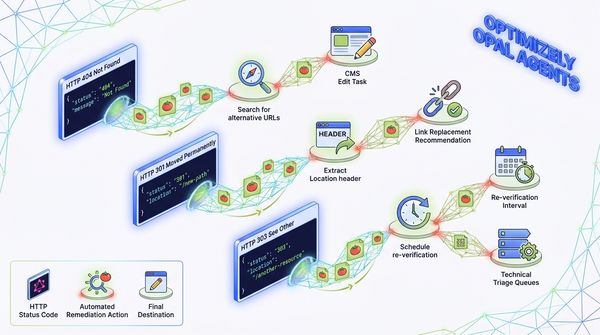
Binary status checks fail to provide actionable operational context. Specialised agents deploy the browse_web tool alongside custom tools configured via the Tools overview to execute four distinct status remediation paths:
- HTTP 404 Not Found : Identifies inaccessible resources, searches the database for valid alternative URLs, and logs an edit task directly in the CMS.
- HTTP 301 Moved Permanently : Extracts the target Location header and submits an automated link replacement recommendation to maintain link equity .
- HTTP 303 See Other : Identifies temporary redirections on transactional endpoints and registers scheduled re-verification intervals to monitor endpoint stability.
- HTTP 403, 5xx, & Timeouts : Isolates permission errors and unreachable server states, dispatching them directly into technical triage queues.
Fact Checking with Confidence Scores
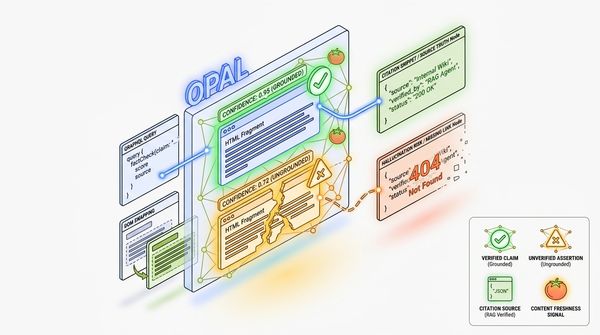
Large language models present structural risks of hallucinating during autonomous verification tasks. To prevent ungrounded modifications, Optimizely Opal connects verification agents to internal knowledge bases via its Retrieval-Augmented Generation (RAG) overview .
The verification pipeline executes factual validation across four sequential stages:
- Corpus Grounding : The agent extracts source records from regulatory documentation, product catalogues, and approved brand repositories.
- Semantic Evaluation : Operating under deterministic prompt-engineering frameworks, the agent benchmarks published claims against verified source records to compute confidence ratings.
- Ungrounded Assertion Flagging : Claims lacking corroborating documentation receive low confidence ratings (e.g., <0.90), generating contextual replacement snippets for review.
- Systemic Reliability : The workflow tracks scoring consistency over time using Evaluations in Opal overview , triggering mandatory editorial review for sub-threshold outputs rather than executing automated deletions.
Highlighting Missing Elements
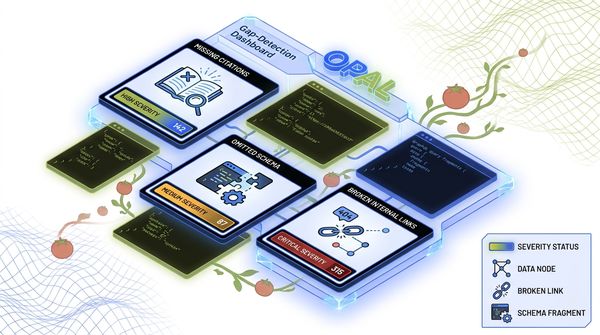
Content decay involves missing technical structure alongside broken external references. Older pages routinely lack the semantic metadata and internal graph links modern generative engines require.
Specialised Opal agents identify and surface structural omissions across three core areas:
- Citation Auditing : Identifying unlinked factual assertions and missing primary source references.
- Internal Graph Connectivity : Flagging orphan articles and absent cross-links to relevant product or category pages.
- Structured Data Compliance : Detecting absent or outdated schema markup as outlined in Optimizely Opal and AI features .
Extending the Content Refresh Analysis agent with this gap-detection logic surfaces structural tickets directly into interactive Opal Canvases or native CMS comment threads.
Additional Decay-Resistance Patterns
Holistic content governance requires orchestrating multiple specialised agents across three adjacent decay vectors:
- E-E-A-T Auditing : The E-E-A-T Checker agent evaluates author credentials, authority metrics, and trust signals ( E-E-A-T ) to protect organic search rankings.
- Generative Engine Optimisation : GEO Auditor agents inspect JSON-LD schemas and crawler accessibility using Optimizely Opal GEO capabilities .
- Media Expiration : Content Marketing Platform (CMP) automations identify Expired assets , replacing unlicensed media with compliant fallback assets.
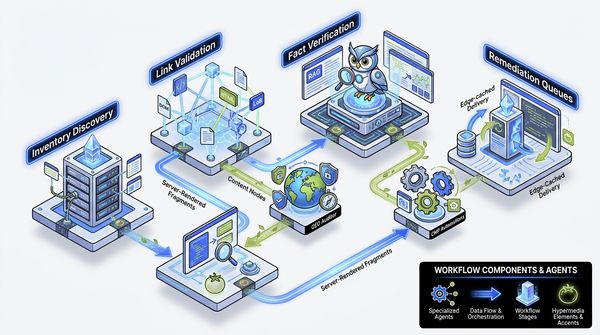
Chaining these modular agents into scheduled overnight batch workflows aggregates findings into a single prioritised triage queue without exhausting API limits or compute credits during peak operational hours.
Conclusion & Strategic Advice
Mitigating content decay requires shifting from episodic cleanups to continuous, agentic site auditing. Engineering an automated pipeline with Optimizely Opal agents maintains digital integrity across large web estates with minimal manual overhead.
Implementation follows three operational phases:
- Inventory Indexing : Run the native Content Refresh Analysis agent across the CMS estate to establish an inactivity baseline.
- Status-Aware Verification : Deploy custom link checking and RAG-grounded validation routines to resolve broken endpoints and outdated factual claims.
- Scheduled Execution : Configure multi-agent pipelines to execute in off-peak batches, controlling API latency and operational credit consumption.
💬 How is your organisation tackling content decay and generative engine optimisation (GEO)? Share your thoughts below and ♻️ repost to help your network build decay-resistant web architectures!
Further Reading
- W3C: Cool URIs Don't Change — URI Management Principles
- MDN Web Docs: Comprehensive HTTP Response Status Codes Guide
- Google Search Central: Tracking and Managing HTTP Status Code Errors
- Pew Research Center: Analysis of Long-Term Link Rot and Digital Decay
More From Me
Original Article: Read on LinkedIn | Read on Substack