The Ephemeral Kernel: Isolates vs Containers for AI Agents
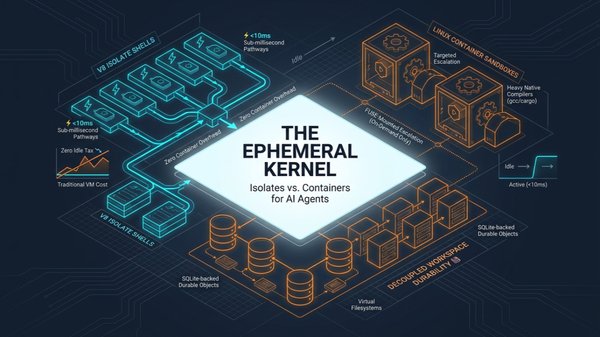
- Part 1 of 3 - Decoupled State, Sub-10ms Cold Starts, and Isolate-First Shell Execution
Introduction
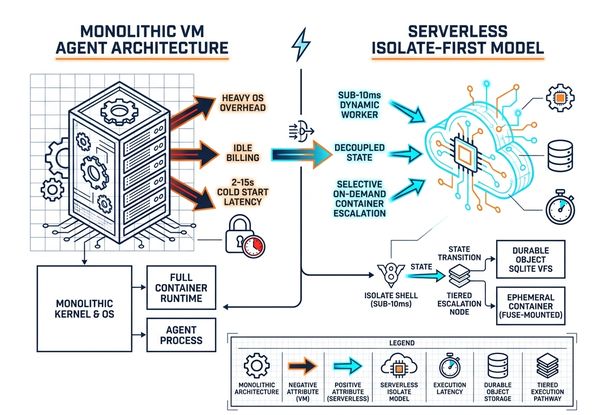
Provisioning monolithic Linux virtual machines or dedicated Docker containers for autonomous AI agents introduces severe operational inefficiencies. Legacy virtualisation models create two primary infrastructural bottlenecks:
- Inverted Utilisation Curves : Autonomous workloads spend over 80% of their operational lifecycle blocked on I/O , external tool calls, and model inference tokens, while dedicated kernels idle at full baseline compute cost.
- Prohibitive Provisioning Latency : Legacy virtual machine provisioning incurs cold-start latencies spanning 2 to 15 seconds, penalising each operational step and degrading interactive loops and multi-agent coordination pipelines.
Transitioning from hardware-bound sandboxing to a multi-tiered serverless architecture resolves these compute overheads. Decoupling execution from state delivers two major operational advantages:
- Sub-10ms Sandboxing : Decoupling volatile execution from durable filesystem state using V8 isolates , Dynamic Workers, and SQLite -backed storage yields sub-10ms execution sandboxes for routine operations.
- Targeted Compute Escalation : Bounding container cold-start overhead strictly to native compilation tasks slashes overall operational overhead by up to 80% compared to monolithic architectures.
The Infrastructure Cost of AI Agents
Traditional sandbox virtualisation treats every agent task as a full-system lifecycle event, compounding infrastructure cost and latency. Dedicated virtual machines lock memory and CPU allocations regardless of whether an agent compiles code or awaits a downstream webhook response, via Cloudflare Computer Repository .
This rigid resource allocation undermines horizontal scaling across multi-agent fleets. Holding long-lived runtime state inside running operating system images expands credential attack surfaces and complicates recovery workflows following execution failures Cloudflare OS Platform Architecture .
Isolates vs Containers: The Ephemeral Kernel
The @cloudflare/computer runtime eliminates execution waste by implementing a three-tier execution hierarchy that dynamically matches compute overhead to command complexity:
- Isolate Shell ( just-bash): Executes routine POSIX operations (ls, grep, cat, string parsing) within V8 Dynamic Workers via Workers RPC , completing tasks in under 10ms without container boot overhead.
- Isolate JavaScript : Runs ECMAScript modules in fresh, memory-isolated V8 contexts bound directly to the virtual filesystem.
- Container Sandbox : Escalates execution to an ephemeral Linux container via FUSE only when native binary compilation or heavy system dependencies are required.
This tiered model enforces rigorous execution security at the runtime boundary through two primary mechanisms:
- Cryptographic Memory Boundaries : The V8 sandbox natively enforces memory and execution boundaries around the just-bash interpreter.
- Containment of Privilege Escalation : Structural isolation prevents arbitrary code execution or privilege escalation from escaping the isolate runtime before an explicit container escalation is authorised.
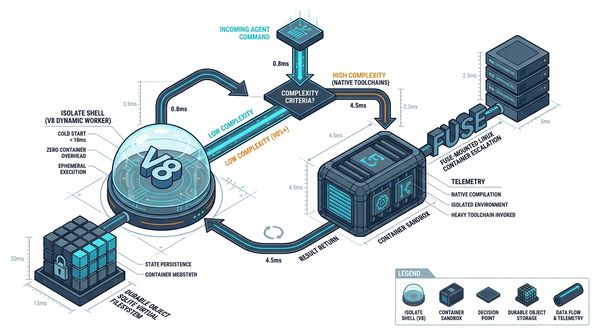
Dynamic Workers and Durable Objects operate at enterprise GA status, whereas @cloudflare/computer and cloudflare-os represent emerging open-source primitives. The just-bash interpreter is purposefully optimised for core shell routines and delegates complex C-extension builds directly to the container tier.
System Mechanics: Durable Objects Filesystem
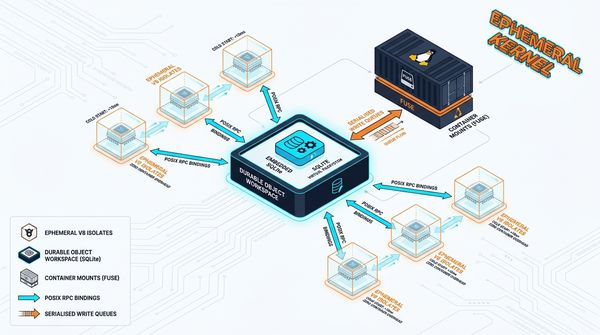
Because V8 isolates are stateless by design, long-term state durability is decoupled from ephemeral worker lifecycles. Workspaces mount directly to Cloudflare Durable Objects backed by embedded SQLite instances across four functional dimensions:
- POSIX-Compliant Interface : Exposes node:fs/promises primitives, allowing standard developer toolchains to execute read and write calls without custom storage drivers.
- State Seeding : Workspaces support rapid pre-seeding from Cloudflare R2 object storage buckets or Git repositories upon initialisation Cloudflare Durable Objects Storage Documentation .
- Concurrency and Contention Mechanics : Serialised write queues and aggressive in-memory caching prevent the single-threaded execution model of Durable Objects from creating bottlenecks during multi-agent swarm operations, ensuring parallel filesystem I/O resolves without locking the underlying SQLite database.
- Synchronisation via computerd : When a task escalates to a container sandbox, the computerd background daemon synchronises filesystem mutations back to the SQLite store over RPC ; architects must account for latency and memory overhead when synchronising deep dependency trees such as node_modules folders.
Hybrid Kernel Execution Scaling
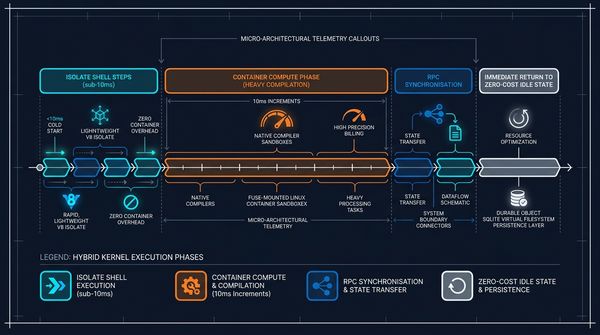
Dynamic complexity evaluation governs container lifecycles to optimise compute resource utilisation. The hybrid execution pipeline manages container escalation through three distinct stages:
- On-Demand Container Invocation : Commands requiring native toolchains such as gcc or cargo trigger an on-demand container instance.
- Granular Active Accounting : The container instance is billed in granular 10ms active execution increments, while the physical compilation phase spans several seconds of sustained compute.
- RPC State Flush and Teardown : The runtime flushes modified files back to the Durable Object workspace via RPC and terminates the container immediately to eliminate idle resource allocation Cloudflare Dynamic Workers Guide .
The runtime also natively integrates the Model Context Protocol (MCP) over WebSockets . This exposes standardised tool schemas to external models without requiring bespoke middleware bridges.
Conclusion & Strategic Advice
Shifting agent execution from persistent virtual machines to an isolate-first ephemeral kernel transforms sandbox infrastructure from an inflexible capital drain into an agile operational primitive.
When establishing next-generation agent architecture, apply these three core criteria:
- Adopt Isolate-First Workflows : Direct 90%+ of standard shell, script, and file transformations into V8 isolates to maintain sub-10ms response loops.
- Decouple Durability from Compute : Retain all workspace state within embedded SQLite Durable Objects rather than local container block storage, leveraging queued RPC writes to manage concurrent multi-agent I/O.
- Isolate High-Complexity Binaries : Confine heavy compilation steps to strictly bounded, ephemeral container instances, accepting the physical boot and RPC sync penalties while leveraging the granular billing model.
In Part 2 of this series, Economics of Edge Agents , we analyse the operational expenditure models and financial trade-offs of large-scale agent fleet deployments.
Further Reading
- Cloudflare Computer Repository - Official open-source repository for the decoupled agent runtime.
- Cloudflare OS Platform Architecture - Architectural patterns for isolate-based operating environments.
- Cloudflare Durable Objects Documentation - Technical documentation for stateful edge storage and SQLite persistence.
- Model Context Protocol Specification - Open standard for unifying AI agent tool interfaces and data connections.
More From Me
- Model Context Protocol: Universal Adapter for Agentic AI🌐
- Agentic AI Swarms: Unleashing Collaborative Intelligence (Part 1)
- Architecting Zero-Trust Systems: A Guide to Web Cybersecurity
- The 2026 AI Threat Landscape: Machine-Speed Autonomous Agents
- Edge-Model Shift: Escaping the Token Tax
Original Article: Read on LinkedIn | Read on Substack