Economics of Edge Agents: A Serverless Cost Breakdown
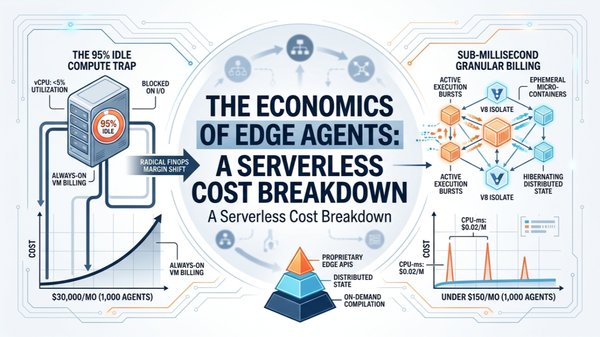
- Part 2 of 3 - Deconstructing the Billing Trap, with 1,000-Agent Cost Math
Introduction
Building on the foundational sandboxing primitives established in Part 1: Ephemeral Kernel , scaling autonomous agent infrastructure introduces a critical macroeconomic hurdle: infrastructure allocation mismatch. Traditional architectures assign dedicated virtual machines to long-running agent execution loops.
Autonomous agents spend the vast majority of their lifecycle blocked on external I/O operations:
- Inference Latency : Waiting on large language model query responses.
- External Integrations : Awaiting third-party API payloads and tool validations.
- Human-in-the-Loop Controls : Pausing execution states for asynchronous human approvals.
Paying continuous hardware rates for idle compute converts operational expansion into an unsustainable financial liability. Transitioning to an isolate-first, event-driven serverless topology replaces static capacity over-provisioning with sub-millisecond compute billing.
Evaluating the architectural unit economics across V8 isolates , ephemeral micro-containers, and distributed state primitives reveals how decoupling execution from persistent hosting reduces agent operational costs by more than 95%.
Achieving these aggressive margins requires navigating a central architectural tradeoff:
- Vendor Platform Coupling : Securing these margins involves tying the agent architecture to a proprietary edge ecosystem’s APIs, like distributed SQLite and isolate boundaries, trading platform flexibility for better unit economics.
The VM Billing Trap for AI Agents
Standard enterprise cloud footprints rely on persistent virtual instances (such as AWS EC2 t3.medium instances) to host long-running agent command loops. Because agent operations are heavily dominated by network wait states and sequential tool calls, provisioned vCPUs routinely operate at under 5% actual utilisation, as observed in platforms like Cloudflare Computer on GitHub .
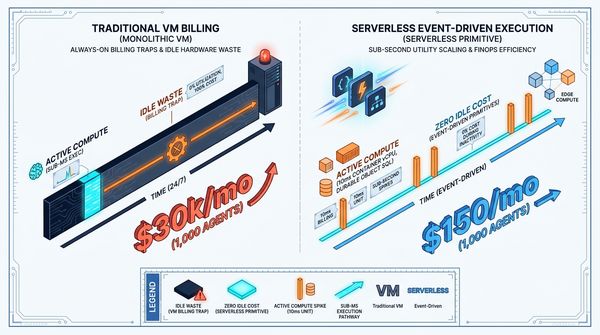
Enterprises maintain constant hourly hardware spend for unutilised memory and dormant compute cycles. Infrastructure overhead scales linearly with total fleet size rather than completed functional tasks Cloudflare OS Platform Architecture .
This model creates compounding operational overhead:
- Unproductive Capital Allocation : Provisioned compute capacity remains allocated during sustained I/O wait states.
- Adverse FinOps Profiles : The resulting FinOps telemetry demonstrates that idle waiting cycles convert directly into ongoing operational waste.
Deconstructing Serverless Component Costs
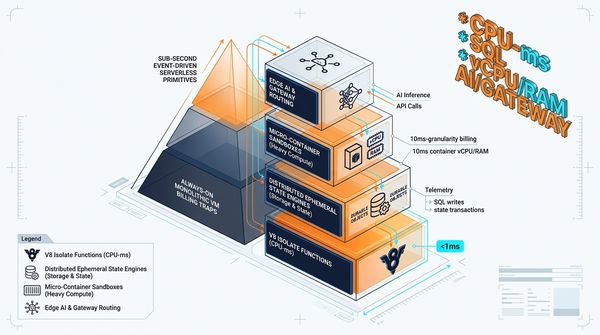
Decomposing agent runtimes across four granular edge primitives restructures cost allocation strictly around active execution cycles:
- V8 Isolate Functions (Edge Workers) : Ephemeral compute charged at $0.02 per million CPU milliseconds, handling lightweight orchestration, parsing, and routing within sub-15ms windows Cloudflare Workers Pricing .
- Distributed Ephemeral State Engines (Storage & State) : Persisted SQLite storage billed at $1.00 per million write requests and $0.20 per GB-month. Dormant agent workspaces automatically enter memory hibernation when event loops are idle, preserving system state without consuming active CPU cycles Cloudflare Workers Pricing .
- Micro-Container Sandboxes (Heavy Compute) : Ephemeral Linux environments invoked strictly for native compilation or heavy binaries, billed in 10ms increments ($0.000020 per vCPU-second; $0.0000025 per GiB-second RAM) and terminated instantly upon exit Cloudflare Workers Pricing .
- Edge AI & Gateway Routing : Model inference billed per neuron or routed through edge gateways with centralised response caching to eliminate duplicate upstream token generation Cloudflare Workers Pricing .
The Comparative Math: 1,000 Active Agents
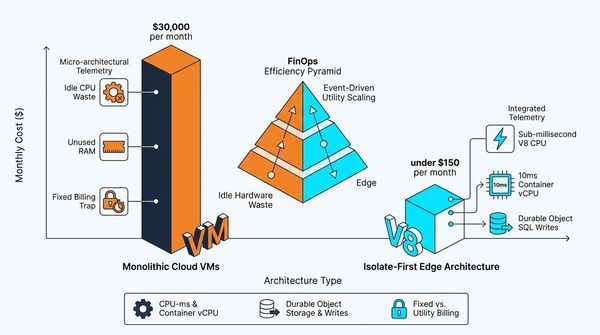
Evaluating a production baseline of 1,000 automated pull-request review agents demonstrates the quantitative magnitude of this architectural shift. In this workload, each agent operates for a 5-minute window per hour, spending 99% of that window awaiting I/O or LLM responses while executing 15 lightweight filesystem checks and 2 compilation passes:
- Monolithic Cloud VMs : 1,000 dedicated t3.medium instances (2 vCPU, 4GB RAM) running continuously at ~$0.0416/hour produce a fixed infrastructure baseline of $30,000 per month .
- Isolate-First Edge Architecture : Shell checks execute in lightweight V8 isolates, while compilation triggers ephemeral micro-containers. Crucially, container billing applies strictly to the microseconds of active compilation. The FinOps Mathematics : 1,000 agents running 2 compiler passes an hour generate approximately 1.44 million monthly invocations. At a sub-second compilation duration of ~0.2 seconds per invocation, total compute equals approximately 80–83 hours of billable execution per month. Aggregate Operational Cost : Active billing aggregates strictly over those ~83 cumulative hours of actual execution (~$6.00). Combined with isolate requests and storage, this architecture yields a total monthly footprint of under $150 Cloudflare Computer Repository .
Evaluating serverless agent deployments requires assessing two critical engineering constraints:
- Workload Duty Cycle Sensitivity : Realised FinOps savings remain sensitive to the workload duty cycle . Compute-bound operations running 24/7 (such as continuous local model fine-tuning) remain better suited to reserved instances, whereas intermittent, I/O-bound agent loops achieve 80–95% cost reductions on serverless primitives.
- Vendor Platform Coupling : To achieve these aggressive cost reductions, we need to adopt specialised proprietary runtime APIs. Utilising highly specific implementations (like Cloudflare Durable Objects or proprietary V8 bindings) creates architectural lock-in, exchanging multi-cloud portability for disruptive unit economics.
Transforming Compute to Utility
Transitioning to event-driven serverless architectures converts agent infrastructure from static overhead into variable operational utility. Deterministic orchestration primitives (such as Cloudflare Workflows ) allow execution states to hibernate during external calls without accumulating compute charges.
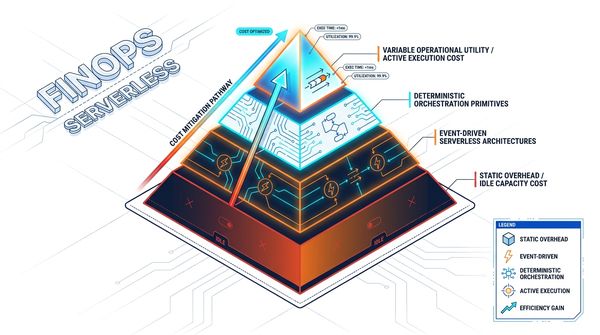
Billing maps directly to functional completions rather than idle capacity, delivering clear visibility into unit economics at enterprise scale.
Conclusion & Strategic Advice
Migrating agent runtimes to isolate-first serverless primitives eliminates the idle capacity penalty and aligns infrastructure spend directly with business output.
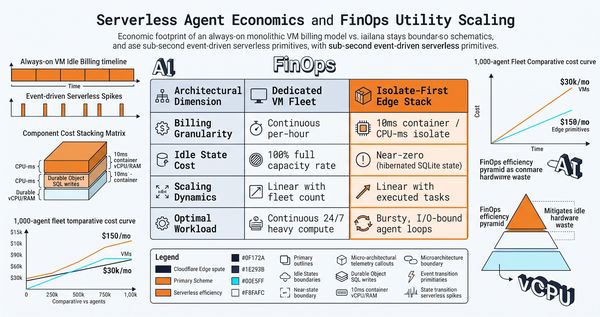
For bursty, multi-tenant agent fleets, engineering teams should adopt a three-tier operational model:
- Orchestration : Deploy V8 isolates for lightweight routing, parsing, and execution scheduling.
- Persistence : Utilise hibernating distributed state engines for zero-compute dormant storage.
- Execution Sandboxes : Provision just-in-time micro-containers strictly for native binaries and compilation passes.
Continue to Part 3: Security by Distrust to examine how to enforce granular capability-based security across distributed agent nodes.
Further Reading
- Cloudflare Workers Documentation: Pricing and Limits
- Cloudflare Workflows: Durable Execution Architecture
- Serverless Compute Over V8 Isolates: Micro-VM and Isolate Benchmarks
More From Me
- Edge-Model Shift: Escaping the Token Tax
- Beyond Moore’s Law: The Economics of Compute
- Agentic AI Swarms: Navigating Risks and Shaping the Future (Part 2)
- Understanding CodeAct and MCP: A Guide for Professionals
- The AI Market Paradox: Hardware Deflation and the Shift to Localised Compute
Original Article: Read on LinkedIn | Read on Substack