Optimizely Cloud: The Azure and AWS Reality
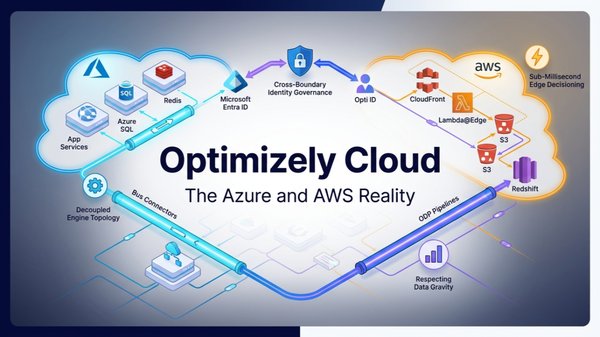
- Part 1 of 7 : Mapping Azure PaaS Hosting Against AWS Edge and Data Pipelines
Introduction
Commercial packaging frequently obscures infrastructure topography. Optimizely One presents as a unified Digital Experience Platform (DXP) to simplify procurement, yet the underlying software estate does not reside on a single hyperscaler .
Assuming a single-cloud boundary across the entire portfolio introduces severe architectural vulnerabilities. When systems decouple across cloud fabrics, unmapped dependencies generate three distinct operational frictions:
- Compute and Engine Divergence : Core content management and commerce engines require deeply rooted platform-as-a-service (PaaS) capabilities natively hosted on Azure. In contrast, backend data processing and experimentation engines execute on distributed serverless compute across Amazon Web Services (AWS) and Google Cloud Platform (GCP) .
- Operational Overhead : Uncoordinated multi-cloud topologies introduce brittle authentication handshakes, API latency , and unanticipated cross-cloud egress costs.
- Data Gravity : Workloads encounter performance bottlenecks when architectural planning overlooks data gravity across disparate provider boundaries.
This analysis—the first in a seven-part architectural series—dissects the multi-cloud topology of the Optimizely ecosystem. From a systems-design perspective, technical architects must evaluate the interaction model across three specific infrastructure tiers:
- Hosting Dependencies : Mapping native Azure PaaS hosting dependencies against AWS and GCP SaaS hosting tiers.
- Edge and Ingestion Layers : Structuring edge compute alongside high-throughput data ingestion pipelines.
- Enterprise Federation : Establishing secure hybrid connectivity, federating identity, and aligning cloud landing zones with physical platform topography.
The Multi-Cloud Reality Behind a Single-Vendor DXP
Optimizely One consolidates content, commerce, experimentation, and customer data under a unified commercial agreement to reduce vendor sprawl ( SalesHive Optimizely Review ). Physical infrastructure remains decoupled across vendor boundaries.
Optimizely's published Services Description confirms that deployment availability spans Microsoft Azure, AWS, and GCP, partitioned strictly by Software Service and region.
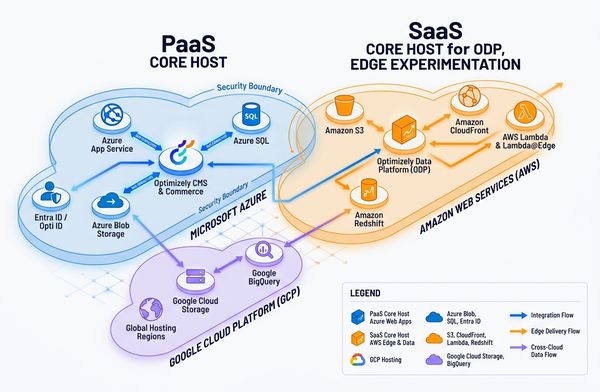
A baseline architectural reality governs this topology: not every hyperscaler region or data centre supports every service. Treating the platform as a single cloud-isolated deployment creates flawed perimeter assumptions.
When structuring multi-cloud integrations—such as streaming experimentation logs from an AWS-hosted backend into an Azure Data Lake—architects must evaluate three core perimeter controls:
- Egress Economics : Accounting for transit bandwidth costs when routing high-volume telemetry across cloud providers.
- Network Boundaries : Scoping private peering and ingress rules to specific microservices rather than broad contract-level assumptions.
- Security Policies : Enforcing consistent network security perimeters across distinct hyperscaler environments.
Native on Azure: Why the DXP Core Runs There
The Content Management System (CMS) and Commerce Connect platforms run on ASP.NET Core and operate natively on Microsoft Azure, available as a fully managed PaaS via the Microsoft Azure Marketplace .
Standard runtime topologies deploy across load-balanced Azure Web Apps sharing Azure SQL databases and Blob Storage ( Optimizely Azure Web Apps Deployment Guide ).
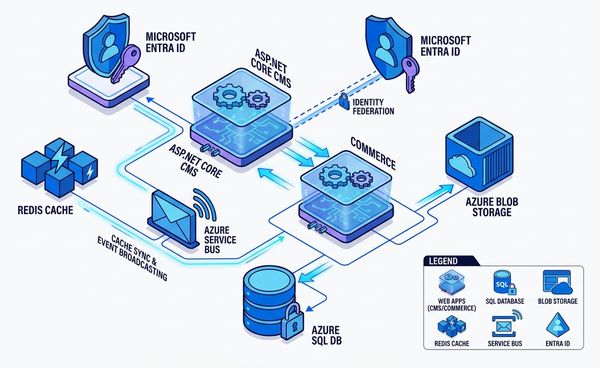
The core PaaS runtime infrastructure on Azure coordinates distributed operations across three architectural layers:
- Event Broadcasting : Azure Service Bus handles event distribution and cache invalidation across active application instances.
- Distributed State Caching : Redis serves as the standard implementation for distributed state caching, ensuring compliance with Microsoft PaaS deployment standards.
- Enterprise Identity Federation : Access control directly integrates with Microsoft Entra ID via OpenID Connect with custom app roles ( Optimizely Entra ID Integration ), synchronising with the centralised Opti ID management plane ( Optimizely DXP Development Considerations ).
AWS as the Edge, Data, and SaaS Host
While Azure provides the PaaS host runtime for content workloads, classifying AWS merely as an integration layer is a categorical error. Amazon Web Services (and Google Cloud Platform) natively hosts the multi-tenant SaaS components of the DXP, specifically the Optimizely Data Platform (ODP) and Web/Feature Experimentation.
The compute, data processing, and persistence layers execute on AWS and GCP architecture, establishing AWS as a co-primary host rather than a secondary connector.
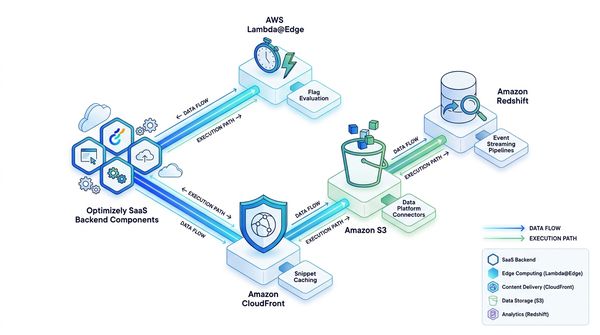
Within this natively hosted AWS footprint, the platform delivers four high-performance edge and integration capabilities:
- Edge Decisioning : Feature Experimentation provides starter kits targeting AWS Lambda@Edge behind Amazon CloudFront distributions, executing flag rules and variations at sub-millisecond network hops ( Optimizely Edge SDK ).
- Origin-Shielded Snippets : Web Experimentation enables script self-hosting via an S3-origin CloudFront distribution with Lambda-triggered cache invalidation webhooks ( CloudFront Snippet Self-Hosting Guide ), bypassing third-party DNS overhead.
- Warehouse Streaming : Feature Experimentation decision logs stream directly into Amazon Redshift as append-only fact tables for join analysis against core transactional schemas.
- Bulk Data Pipelines : As a natively hosted component, the Optimizely Data Platform (ODP) relies on Amazon S3 as its primary ingestion and batch export transport layer ( AWS Connector Documentation ).
Choosing Your Integration Points: A Practical Framework
Evaluating Optimizely infrastructure requires moving past binary "Azure versus AWS" debates in favour of component-level interface mapping and acknowledging multi-cloud boundaries.
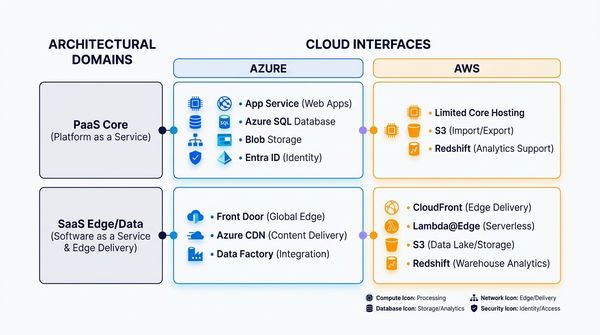
Architects must align system requirements across four discrete architectural domains:
- Content & Commerce Workloads : Direct all deployment, database scaling, and authentication governance toward Azure App Service, Azure SQL, and Entra ID identity boundaries.
- Cross-Boundary Identity and Network Peering : When crossing from the Azure PaaS boundary into the AWS SaaS boundary, architects must explicitly map Entra ID for the CMS core against Opti ID for the broader control plane. Secure inter-cloud traffic by structuring API gateways and verifying peering limits.
- Multi-Cloud Data Pipelines & Egress Management : Respect data gravity. When routing ODP data or streaming experimentation metrics, avoid funnelling heavy analytical extraction through CMS-level application tiers on Azure. Ingest directly via Amazon S3 buckets and Redshift staging tables to minimise cross-cloud API latency and mitigate egress costs.
- Low-Latency Edge Execution : Implement Feature Experimentation SDKs within AWS Lambda@Edge and CloudFront distributions to execute variations at the edge before requests reach backend origins.
Conclusion & Strategic Advice
Optimizely's strength is its modular hybrid footprint. Azure powers the ASP.NET transactional core, while AWS and GCP natively host the SaaS data and experimentation engines while providing high-throughput edge execution.
Enforcing an Azure-exclusive or AWS-exclusive network topology undermines platform efficiency, ignores data gravity, and creates administrative friction across cloud boundaries.
Continue the architectural breakdown in Part 2: Optimizely Cloud: CMS Out-of-the-Box on Azure , which explores native Azure PaaS configuration, App Service scaling tiers, and isolated network topologies.
Are you running Optimizely on Managed DXP or orchestrating custom PaaS in your own cloud subscriptions? Drop your thoughts below 💬and share this breakdown with your engineering network ♻️!
Further Reading
- Optimizely Launches Digital Experience Platform on Microsoft Azure Marketplace (Business Wire)
- Deploying Optimizely CMS to Azure Web Apps (Optimizely World)
- Optimizely Feature Experimentation on AWS Lambda@Edge (Optimizely Developer Docs)
- Self-Host Optimizely Tracking Snippets via Amazon CloudFront (Optimizely Docs)
- Optimizely Data Platform Amazon Web Services Connector (Optimizely Connectors)
More From Me
Original Article: Read on LinkedIn | Read on Substack