Optimizely Cloud: CMS Out-of-the-Box on Azure
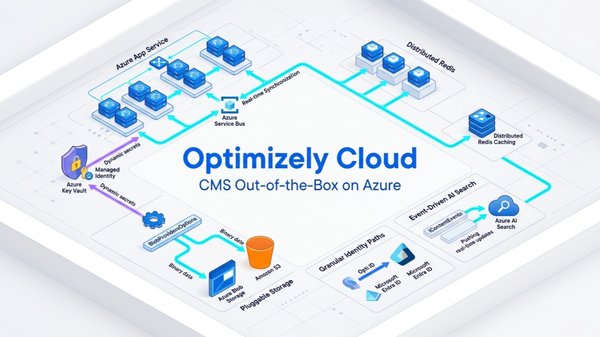
- Part 2 of 7 : Default Web Apps Infrastructure, Pluggable S3 Storage, and Entra ID
Introduction
Building on the foundational cloud landscape analysed in Part 1, Optimizely Cloud: The Azure and AWS Reality , let's take a closer look at the runtime hosting tier for modern enterprise content platforms. Deploying Optimizely CMS onto Microsoft Azure is frequently misconstrued as locking an application into an inseparable, single-cloud monolith.
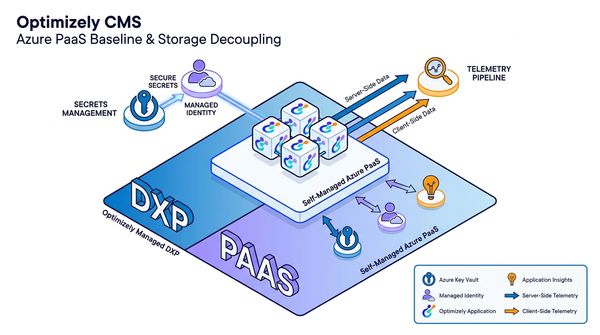
To architect securely and efficiently, enterprise technical leaders must establish a clear operational distinction across two deployment models:
- Optimizely Managed DXP : A fully managed SaaS / PaaS hosting environment where Optimizely natively provisions and manages the underlying cloud infrastructure.
- Self-Managed Azure PaaS : A customer-orchestrated deployment where enterprise DevOps teams configure first-party NuGet packages directly within their own Azure subscriptions.
Evaluating these out-of-the-box capabilities requires examining four core operational boundaries: compute hosting , binary storage , telemetry and secrets , and identity orchestration .
The Azure Hosting Model CMS Gives You at Deploy Time
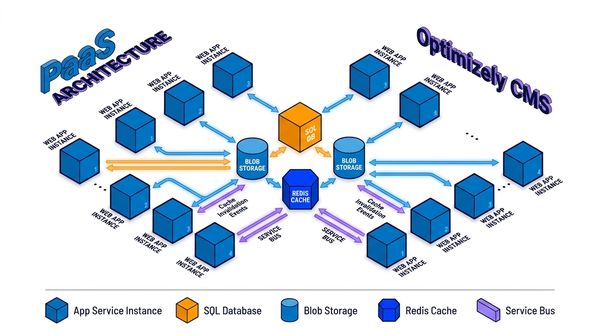
Production deployments of Optimizely CMS on Azure execute as an elastic, multi-instance cluster running on Azure App Service . Rather than isolating state per compute node, scaled Azure Web Apps instances bind directly to centralised backing services.
The runtime compute topology coordinates cross-instance state through four core services:
- Azure App Service : Provides scalable, multi-instance hosting for the stateless .NET 6/8 application tier.
- Azure SQL Database : Acts as the shared relational data store across all active compute instances.
- Azure Service Bus : Serves as the event multicasting backbone to ensure deterministic cache invalidation and publication state across instances, as documented in the Deploy CMS 12 sites to Azure Webapps guide .
- Azure Cache for Redis : Maintains high-throughput distributed caching across ephemeral compute nodes, avoiding legacy sticky sessions while preserving content consistency.
Storage Is a Choice, Not an Azure Default
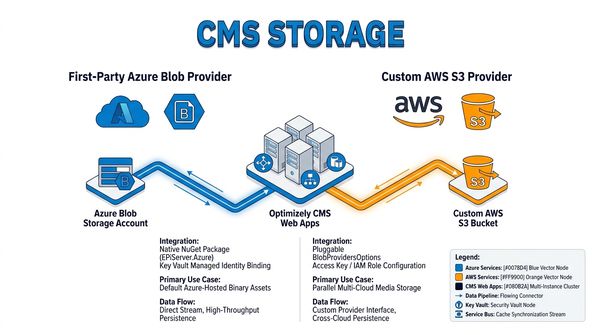
The platform default uses the EPiServer.Azure package to persist binary assets into Azure Blob Storage . However, media persistence is governed by an abstract, pluggable provider model configured via BlobProvidersOptions ( BLOB storage and providers ).
Hosting compute on Azure App Service does not mandate persisting binary assets within Azure storage containers. Architecture teams can implement two distinct storage models:
- First-Party Azure Blob Provider : Distributed via NuGet, natively utilising Azure Managed Identity or standard connection strings for turnkey Azure deployments.
- Custom AWS S3 Provider : Implemented through custom provider registration, streaming read and write operations directly to Amazon S3 buckets for organisations subject to AWS-specific compliance or governance policies.
Secrets, Telemetry, and Operational Ownership
Operational security requires eliminating static, plaintext credentials across all application environments. Pairing Azure Key Vault with Azure Managed Identity enables dynamic, runtime injection of connection strings and API keys into application memory, as outlined in New Features in DXP Cloud Services .
Secret management delivery depends directly on the chosen hosting model:
- Optimizely Managed DXP : Provisions Azure Key Vault and Managed Identity configurations automatically at deploy time.
- Self-Managed Azure PaaS : Requires engineering teams to orchestrate Key Vault, role assignments, and Managed Identity manually using Infrastructure as Code tools like Terraform or Bicep .
Full-stack observability is embedded through Azure Application Insights , operating across two distinct telemetry planes:
- Server-Side Diagnostics : Traces ASP.NET Core request pipelines, SQL dependency execution timings, and Service Bus message latency, as highlighted in Enabling Cloud Support for CMS 12 .
- Client-Side Real User Monitoring (RUM) : Instruments front-end telemetry to capture real user page load metrics and browser execution performance independently of the backend payload.
Identity: Opti ID vs Entra ID — Picking the Right Path
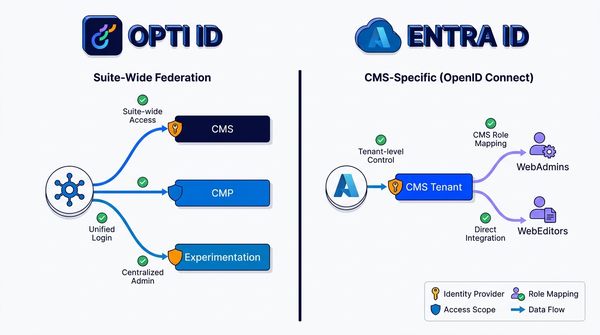
Enterprise access control separates into two integration models based on administrative scope:
- Opti ID (Suite-Wide Federation) : Operates as Optimizely's centralised identity layer, providing unified single sign-on across CMS, Content Marketing Platform (CMP), and Experimentation.
- Microsoft Entra ID via OpenID Connect (CMS-Specific) : Establishes a direct integration using Microsoft.AspNetCore.Authentication.OpenIdConnect and ISynchronizingUserService , synchronising directory security groups directly to internal CMS roles ( WebAdmins , WebEditors ) as detailed in Integrate Azure AD with Optimizely CMS 12 using OpenID Connect .
Site Search: Azure AI Search and Event-Driven Architecture
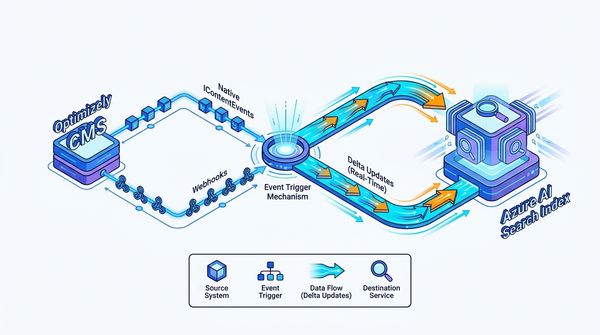
Decoupling content indexing into Azure AI Search provides granular query scoring and cognitive enrichment for custom search topologies. Background polling against the Optimizely ServiceAPI is an anti-pattern that introduces sync latency, excessive compute consumption, and concurrency complexity.
Modern architectures implement an event-driven push model with three key capabilities:
- Real-Time Delta Indexing : Hooks directly into native IContentEvents (specifically PublishedContent) or uses Webhooks to push content changes to Azure AI Search immediately upon publication.
- Resource Efficiency : Eliminates scheduled polling overhead and avoids resource-intensive catalogue reindexing operations during editorial publishing cycles.
- Ecosystem Integration : Aligns the CMS data plane with Microsoft enterprise ecosystems, as detailed in Optimizely's partnership with Microsoft .
Conclusion & Strategic Advice
Deploying Optimizely CMS on Azure establishes a hardened PaaS baseline without locking enterprise architecture into a single vendor silo.
Architects should calibrate four critical infrastructure components to match organisational requirements:
- Compute and Event Clustering : Scale compute via Azure App Service and coordinate cluster cache invalidation through Azure Service Bus.
- Storage Provider Selection : Use first-party Azure Blob Storage or implement an Amazon S3 provider to satisfy enterprise governance mandates.
- Secrets Management : Enforce zero-trust credential handling by pairing Azure Key Vault with Managed Identity across both DXP and self-hosted environments.
- Identity Federation : Select between suite-wide federation via Opti ID or granular directory role mapping via direct Entra ID OpenID Connect.
In the next instalment, continue the architecture deep dive with Part 3, Optimizely Cloud: Azure Functions for CMS Integration , examining asynchronous background execution and event-driven integration pipelines.
Are you running Optimizely on Managed DXP or orchestrating custom PaaS in your own cloud subscriptions? Drop your thoughts below 💬and share this breakdown with your engineering network! ♻️
Further Reading
- Deploy CMS 12 Sites to Azure Web Apps - Optimizely Developer Documentation
- Integrate Azure AD with Optimizely CMS using OpenID Connect - Optimizely Docs
- Integrating Optimizely CMS with Azure AI Search - Perficient Technical Guide
- Azure App Service Architecture and Overview - Microsoft Learn
More From Me
Original Article: Read on LinkedIn | Read on Substack