OpenClaw Advantage: Why Your Agent's Brain Should Be a Markdown File
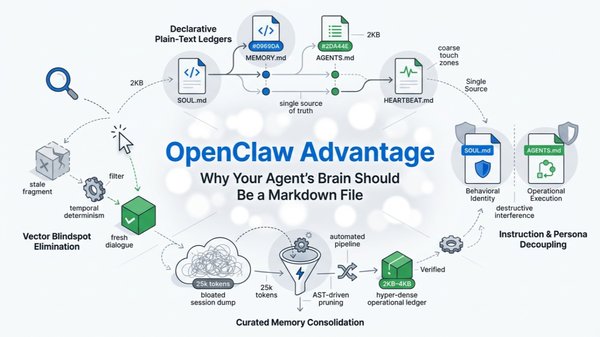
OpenClaw Advantage: Why Your Agent's Brain Should Be a Markdown File
- Part 1 of 8 - The File-First Cognitive Pattern for Transparent, Auditable AI State
Introduction
Autoregressive language models operate as stateless completion engines where runtime context dissolves upon execution termination. As analysed in Latent Space: The Persistence Barrier , token generation represents a transient transformation across static weights rather than durable cognitive recall.
Standard architectural responses attempt to bridge this persistence gap through two primary mechanisms:
- Raw Transcript Buffering : Appending conversational history directly into prompts introduces severe context pollution and non-deterministic state drift.
- Dense Vector Stores : Querying high-dimensional embeddings introduces retrieval noise and operational opacity during state reconstruction.
The file-first cognitive architecture solves this state-drift bottleneck through three core capabilities:
- Persistent Markdown Ledgers : Anchors persistent memory, operational rules, and behavioural identities in human-readable, version-controlled Markdown files.
- Deterministic Context Assembly : Provides predictable context construction while establishing rigorous human-in-the-loop auditability.
- Mathematical Retrieval Precision : Guarantees deterministic precision when accessing critical operational parameters.
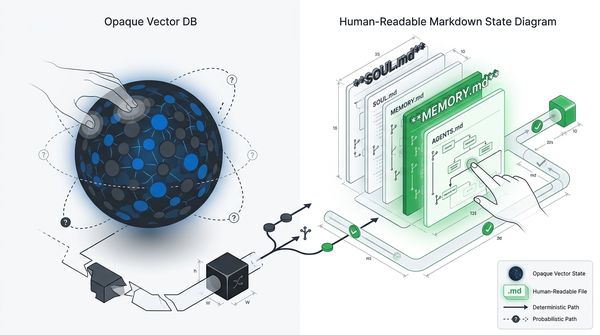
The Vector Store Blindspot and Hallucinated Memory
Vector embeddings calculate mathematical similarity across static token chunks, making them ill-suited for mutable operational state. Standard command-line tooling can't inspect, diff, or surgically edit high-dimensional vector clusters.
Deploying semantic search across rapidly mutating project specifications introduces three distinct operational failure modes:
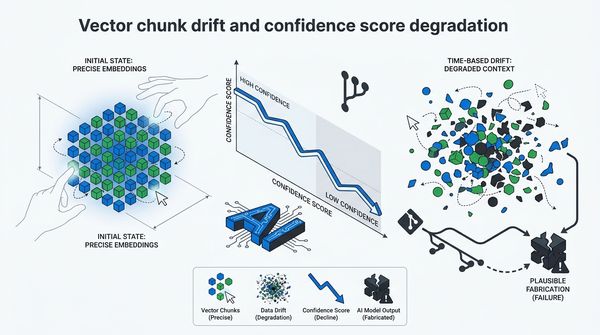
- Stale Context Retrieval : Semantic similarity matching frequently surfaces outdated or contradictory dialogue fragments without temporal awareness.
- Plausible Fabrications : Models synthesise speculative hallucinations to bridge conflicting fragments rather than acknowledging temporal invalidation, as detailed in Confidently Wrong: Mechanics of AI Sophistry and Hedging .
- Compounding Degradation : Standard vector metrics lack temporal determinism, creating latent failure modes that compound across multi-turn agent lifecycles.
The File-First Cognitive Architecture Pattern
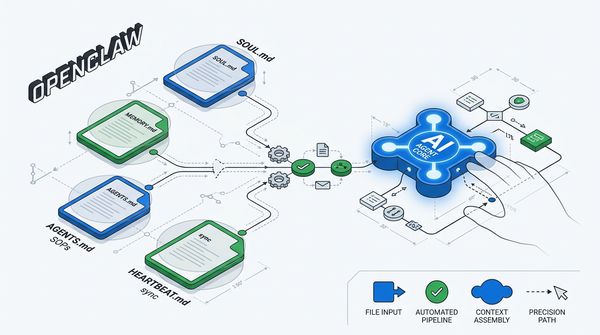
The OpenClaw runtime structures an agent workspace across four discrete, declarative plain-text files assembled directly into the context window:
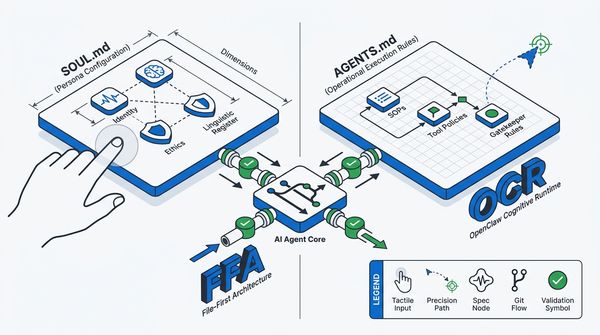
- SOUL.md: Isolates behavioural identity, linguistic register, ethical boundaries, and anti-sycophancy rules.
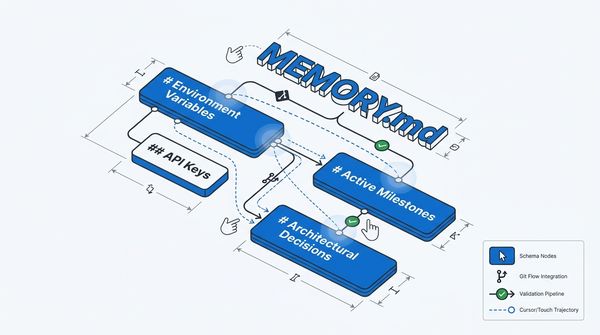
- MEMORY.md: Maintains verified facts, infrastructure parameters, environment variables, and active milestones.
- AGENTS.md: Operates as the execution manual, housing Standard Operating Procedures (SOPs), tool policies, and gatekeeper rules.
- HEARTBEAT.md: Configures autonomous periodic routines, health monitoring checklists, and scheduled triage tasks.
Treating these plain-text files as authoritative single sources of truth applies the core tenets of GitHub Spec-Kit: Executing Spec-Driven Development directly to persistent cognitive state. This file-centric pattern renders memory branchable, diffable, and fully auditable via standard version control workflows. (To inspect an interactive reference implementation of these files, explore the OpenClaw Starter Workspace on GitHub .)
Curated Memory vs Raw Conversation Ingestion
Injecting unedited session logs into prompt context creates cumulative token noise and attention degradation. The file-first pattern replaces transcript buffering through four systematic consolidation mechanics:
- Consolidation Pipeline : Parse ephemeral buffers at workflow termination or during scheduled routines to extract durable facts for MEMORY.md. While invoking secondary LLM reasoning steps to evaluate and summarise this data incurs a "Consolidation Token Tax" (background garbage-collection compute), the resulting cognitive efficiency and elimination of systemic hallucinations offset this backend compute overhead.
- Sanitisation Before Consolidation (Threat Modelling) : To defend against Indirect Prompt Injection , all external data streams undergo an isolated sanitisation pass. This strict boundary isolates core standard operating procedures from adversarial payloads encountered during external tool or web interactions.
- Structured Taxonomies : Facts are indexed under static headers (# Environment Variables, # Active Milestones, # Architectural Decisions), focusing attention mechanisms directly onto relevant state parameters.
- Deterministic Pruning : Deprecated configurations and completed tasks are surgically excised using LLM-driven schema-validation scripts paired with standard Markdown AST (Abstract Syntax Tree) parsers. This ensures temporal invalidation runs programmatically, preventing stale-state contamination.
Designing Persona as Configuration in SOUL.md
Monolithic system prompts that intertwine identity, domain state, and tool definitions degrade overall reasoning capacity. As demonstrated in The God Prompt Trap: Single-Prompt Reasoning Amplifies AI Failures , prompt overloading causes destructive instruction interference.
Decoupling persona configuration within SOUL.md from operational execution rules in AGENTS.md establishes three architectural benefits:
- Instruction Isolation : Separates baseline behavioural constraints from dynamic task execution logic to prevent rule collisions.
- Deterministic Guardrails : Enforces rigorous anti-sycophancy controls and concise active-voice output registers across all downstream tool calls.
- Security Decoupling : Implements automated credential redaction and governance policies without mutating functional execution pathways in AGENTS.md.
Context Window Economics and the Prompt Caching Fallacy
Expanded context windows offer unprecedented capacity, yet loading raw dialogue histories remains computationally counterproductive, as analysed in The Era of Extended Context: What If AI Could Read 10 Million Words at Once? .
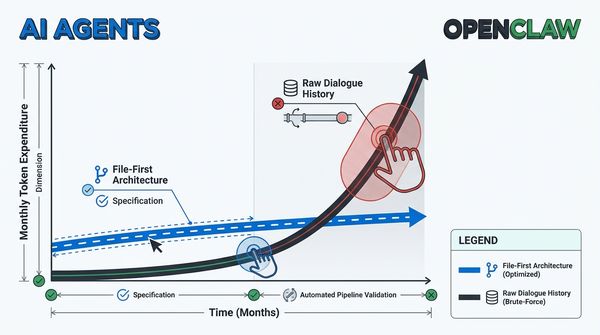
While modern Prompt Caching and KV cache scaling reduce raw financial costs and Time-to-First-Token (TTFT) latency, caching uncurated context still induces severe cognitive degradation. The file-first architecture prioritises four core operational dimensions over brute-force context expansion:
- Hyper-Dense State Storage : A structured 2KB to 4KB MEMORY.md ledger provides deterministic, temporally accurate context that eliminates parameter hallucination.
- Deterministic Payload Assembly : Replaces uncurated 25,000-token chat histories with structured, verified context payloads.
- Enforced Trust Boundaries : Integrating curated Markdown state with strict capability tokens establishes the trust boundaries defined in Security by Distrust: Capability Tokens and Simulated Realities .
- Loop Prevention : Eliminates the unbounded runtime execution loops detailed in The Meeseeks Paradox: When Your Completion Engine Won't Dissolve .
Conclusion & Strategic Advice
Vector databases excel at broad static retrieval, but deterministic agent memory demands filesystem simplicity.
Engineering durable agent systems requires two concrete architectural commitments:
- Operational Prerequisite : File-first architecture requires disciplined automated consolidation routines or human-in-the-loop curation to prevent unbounded Markdown growth. For multi-gigabyte corpora or complex relational data maps, pair structured Markdown operational state with modern Knowledge Graphs and GraphRAG . This hybrid architecture resolves scaling bottlenecks and maps entity relationships dynamically in enterprise deployments, while maintaining full auditability of core identity and procedures.
- Implementation Recommendation : Migrate core memory to MEMORY.md and isolate identity in SOUL.md to eliminate context pollution immediately.
Continue the architecture series in Part 2: OpenClaw Advantage: The Heartbeat Pattern and Proactive AI Beyond Chat , exploring autonomous execution beyond reactive chat prompts.
How are you tackling context drift and memory persistence in your autonomous agent pipelines? Drop your thoughts below 💬 and share this framework with your AI engineering network! ♻️
Further Reading
- OpenClaw Starter Workspace (GitHub) - Interactive file-first cognitive template with SOUL.md, MEMORY.md, AGENTS.md, and HEARTBEAT.md.
- Anthropic: Effective Context Engineering and Prompt Design
- arXiv: MemGPT - Towards LLMs as Operating Systems
- OpenAI: Agentic System Architecture & Memory Guidelines
More From Me
Original Article: Read on LinkedIn | Read on Substack