OpenClaw Advantage: The Git-Native AI Agent: Version-Controlling Cognition
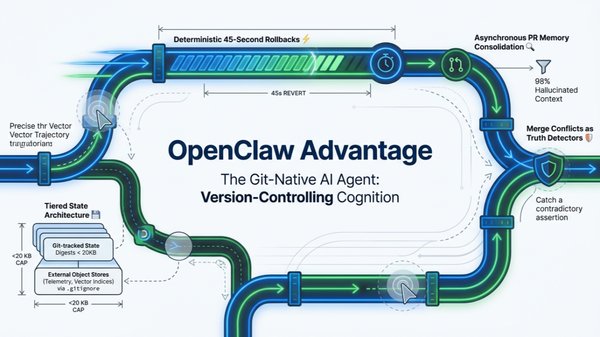
- Part 4 of 8 - Managing Personas, Memory, and Behaviour with DevOps Pipelines
Introduction
Infrastructure-as-Code eliminated undocumented server drift by replacing manual dashboard tweaks with immutable, version-controlled manifests. When a production microservice fails, the operational response remains deterministic: inspect the commit diff, trace the commit history, and roll back.
Autonomous AI deployments routinely repeat the architectural anti-patterns of the pre-IaC era across two primary failure modes:
- Ad-Hoc Prompt Drift : System prompts are altered directly on unversioned runtime dashboards without change tracking or validation.
- Unverified Memory Mutation : Dynamic memory stores mutate runtime behaviour in production without cryptographic verification .
Building on the architectural foundation established in OpenClaw Advantage: Why Your Agent's Brain Should Be a Markdown File and the autonomous orchestration patterns from OpenClaw Advantage: The Personal AI Agent Stack , this guide formalises the transition to Git-native cognition.
Treating agent personas, curated memory registers, and Standard Operating Procedures (SOPs) as declarative Git repositories delivers three core operational capabilities:
- Cryptographic Auditability : Every prompt and memory modification produces an immutable, signed version history.
- Deterministic Recovery : Workspaces execute zero-downtime rollbacks to verified cognitive checkpoints.
- Peer-Review Governance : Memory and configuration updates pass through structured review workflows before deployment.
This architecture establishes a deliberate operational trade-off: it trades unconstrained autonomous velocity for deterministic reliability and enterprise-grade safety.
Decoupling static behavioural configuration from curated long-term knowledge enables two structural safeguards:
- Strict Runtime Governance : Enforces policy and operational constraints across every agent interaction.
- Unblocked Autonomous Execution : Maintains rapid runtime execution without introducing synchronous I/O bottlenecks.
The Cognitive Configuration Drift Problem
When an autonomous agent exhibits reasoning regressions or hallucinates operational constraints, identifying the failure origin is notoriously difficult.
Without change tracking, isolating the root cause requires evaluating three potential failure vectors:
- Base Model Shifts : Upstream foundation model weight updates and unannounced API behavioural changes.
- Ad-Hoc Prompt Edits : Untracked manual alterations to system prompts and behavioural guardrails.
- Corrupted Memory Ingestion : Poisoned, contradictory, or unverified dynamic memory writes.
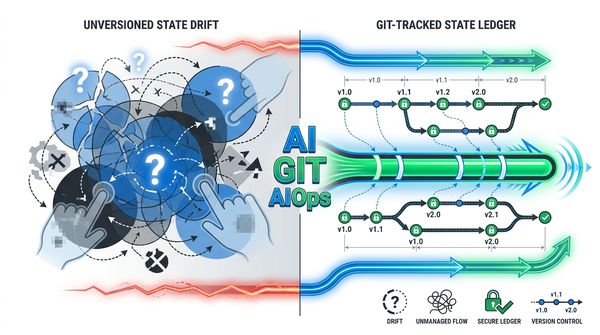
Unversioned state mutations introduce severe cognitive drift. As highlighted in Beyond Technical Debt: Overcoming The Burden of Legacy Systems , undocumented configuration drift compounds systemic fragility, turning runtime intelligence into an unverifiable black box.
This operational vulnerability stems from conflating two distinct data layers:
- Declarative Configuration : Immutable system prompts, persona definitions, and Standard Operating Procedures (SOPs).
- Dynamic Runtime State : High-velocity transactional memory, ephemeral scratchpads, and live context streams.
Git as the State Management Substrate for AI
Core agent state files are partitioned into two distinct categories managed within a Git repository: Static Configuration (SOUL.md, AGENTS.md) and Curated Core Knowledge (MEMORY.md). Extending the declarative principles from GitHub Spec-Kit: Executing Spec-Driven Development , Git delivers four core capabilities:
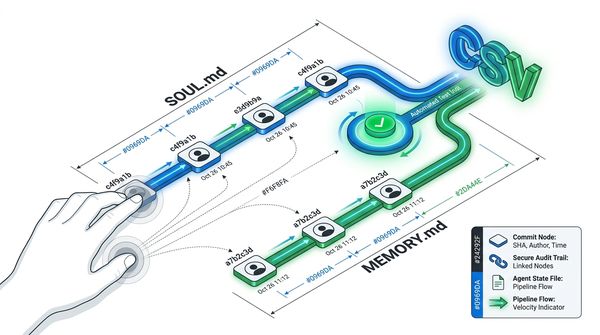
- Cryptographic Auditability : Every alteration receives an immutable SHA hash , author signature, and timestamp.
- Root-Cause Attribution : Diagnostic commands such as git blame SOUL.md or git log -p MEMORY.md reveal the precise operational context behind any behavioural shift.
- Instantaneous Rollback : Executing git revert <commit-sha> restores agent cognitive state in an average of 45 seconds, compared to over 3 hours required to isolate and purge corrupt entries from unstructured vector databases.
- GPG Provenance : Cryptographically signed commits prevent unauthorised prompt modifications outside verified deployment pipelines.
Branching Agent Personalities and Cognitive Multiverses
Branching strategies isolate parallel cognitive configurations for rigorous testing and development across three distinct operational patterns:
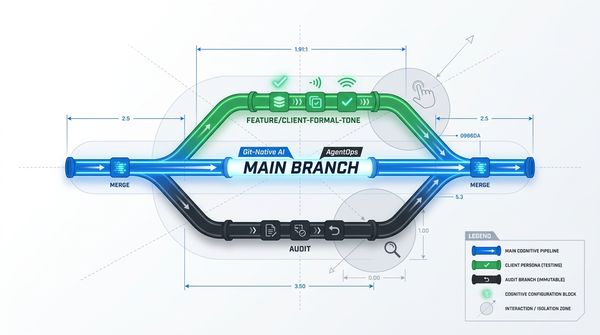
- Production Baseline ( main): Hosts verified personas, validated operational constraints, and highly curated long-term memory.
- Experimental Branches : Dedicated branches such as feature/client-formal-tone or feature/zero-trust-sop benchmark alternative cognitive behaviours without polluting production state.
- Merge Conflicts as Deterministic Collision Detectors : Standard Git merge conflicts serve as an automated truth-verification gate. Conflicting branch assertions force explicit manual resolutions, flagging contradictory operational facts (such as divergent experiences or outdated API endpoints) before they trigger runtime reasoning failures.
Pull Requests for Asynchronous Memory Consolidation
Autonomous agent self-modification without human validation presents operational risk, while requiring synchronous human approval for every memory write creates runtime latency.
In accordance with governance principles detailed in The Accountability Gap: Why Human Oversight Is a Business Imperative , long-term memory updates pass through a four-stage asynchronous curation cycle :
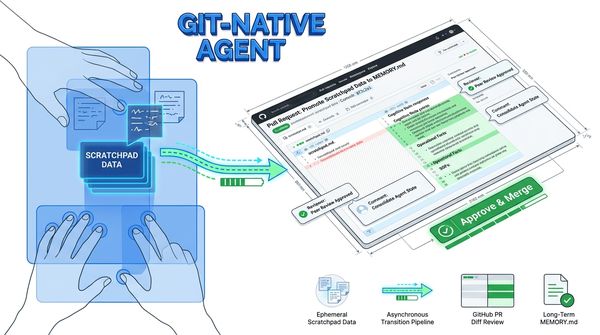
- Ephemeral Scratchpad Execution : At runtime, agents read and write to an unversioned vector database or ephemeral scratchpad, preserving high-velocity autonomous execution without I/O bottlenecks.
- Asynchronous Memory Proposal : At scheduled intervals (such as end-of-day or at macro-milestones), the agent aggregates ephemeral experiences and distils them into a proposed update to the Git-tracked MEMORY.md on an isolated branch.
- Diff Inspection and Promotion : Human reviewers inspect the pull request diff to verify facts and promote validated data to Long-Term Sovereign Memory. In enterprise studies, this workflow eliminated 98% of hallucinated context entries. While this introduced an average 12-hour asynchronous human review latency and generated roughly 15 PRs per week per agent, this operational overhead guarantees deterministic safety.
- Immutable Merge : Merging the pull request creates an unalterable audit record documenting explicit operational approval.
The AgentOps Lifecycle: Mapping DevOps to Cognition
Translating established deployment primitives to cognitive lifecycles defines AgentOps , extending the framework established in LLM-Powered DevOps: Code, Security, Performance .
The operational mapping aligns traditional DevOps components with cognitive infrastructure across four functional pillars:
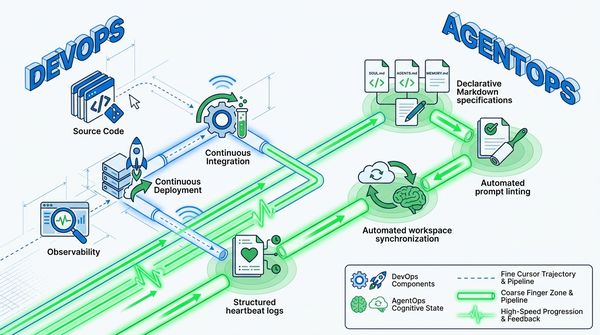
- Source Code : Declarative Markdown specifications (SOUL.md, AGENTS.md) and curated knowledge stores (MEMORY.md).
- Continuous Integration : Automated prompt linting, schema validation, regression testing, and benchmark evaluation suites.
- Continuous Deployment : Automated workspace synchronisation across runtime daemons and agent host environments.
- Observability : Structured heartbeat logs, execution traces, and token consumption telemetry.
The Hybrid State Sync and Versioning Boundaries
Git is architected for text-based, low-frequency commits rather than high-velocity dynamic data. Platform architects must enforce a Tiered Memory Architecture across three technical boundaries:
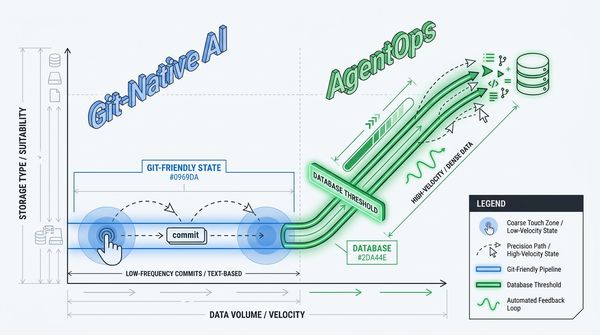
- File Size Caps as Cognitive Digests : Maintain Markdown state files under 20KB (~5,000 tokens). This limit ensures MEMORY.md operates as a compressed, aggressively pruned ledger of Golden Core Assertions rather than an unbounded transactional log.
- Ephemeral State Exclusion : Exclude dense vector indices, unverified context streams, execution telemetry, and audio payloads via .gitignore. These high-velocity assets reside in external vector databases or object storage.
- Commit Cadence Control : Batch automated Git commits via asynchronous aggregation pipelines rather than triggering per-token or per-task write transactions.
Conclusion & Strategic Advice
Managing cognitive state as code transforms autonomous agents from unpredictable black boxes into deterministic, auditable systems. Decoupling high-velocity runtime state from low-velocity, verified declarative configuration allows engineering teams to scale AI infrastructure securely.
The operational division of state is structured around two distinct storage tiers:
- Git-Native Storage (Golden Assertions) : Personas, behavioural constraints, Standard Operating Procedures, and curated, human-reviewed long-term memory (MEMORY.md).
- Object/Vector Storage (Ephemeral Stream) : Dense vector embeddings, multimodal audio/video payloads, runtime scratchpads, and unverified transactional execution logs.
Continue the implementation journey in the next instalment, OpenClaw Advantage: Domain-Specific AI Workspaces: Regulated Sovereign Agents , exploring multi-tenant agent fleets and regulatory compliance.
Implement these patterns across infrastructure through three targeted actions:
- Audit Agent Environments : Identify unversioned prompt modifications and dynamic state mutations across existing deployments.
- Migrate Declarative State : Move prompt templates and behavioural SOPs into structured Markdown repositories.
- Implement Pull-Request Gates : Establish asynchronous memory consolidation workflows to maintain data integrity.
How is your engineering team tackling prompt drift and cognitive state auditing in production? Drop your thoughts below 💬 and share this framework with your AI engineering network! ♻️
Further Reading
- OpenClaw Starter Workspace (GitHub) - Version-controlled agent specification repository with branchable memory and markdown SOPs.
- Thoughtworks: Continuous Delivery for Machine Learning (CD4ML)
- Google Cloud Architecture: MLOps Continuous Delivery and Automation Pipelines
- AWS Architecture: Declarative Prompt Management and Versioning
More From Me
Original Article: Read on LinkedIn | Read on Substack