OpenClaw Advantage: The Personal AI Agent Stack
- Part 3 of 8 - Why Individual Sovereignty Beats Enterprise Orchestration Bloat
Introduction
Building upon the deterministic file-backed memory established in Part 1: Why Your Agent's Brain Should Be a Markdown File and the scheduled daemon execution patterns explored in Part 2: The Heartbeat Pattern and Proactive AI Beyond Chat , scaling personal agentic systems requires confronting a core architectural fork: enterprise multi-tenant orchestration versus sovereign, local-first computing .
Enterprise AI suites prioritise multi-user access controls, audit compliance, and centralised telemetry. Applying these multi-tenant frameworks to individual technical workflows introduces three critical operational bottlenecks:
- Severe Execution Latency : Multi-tenant validation pipelines add round-trip network delays to single-operator tasks.
- Vendor Lock-In : Proprietary cloud dependencies restrict infrastructure portability and state extraction.
- Operational Overhead : Centralised governance mechanics impose unnecessary configuration complexity on isolated tasks.
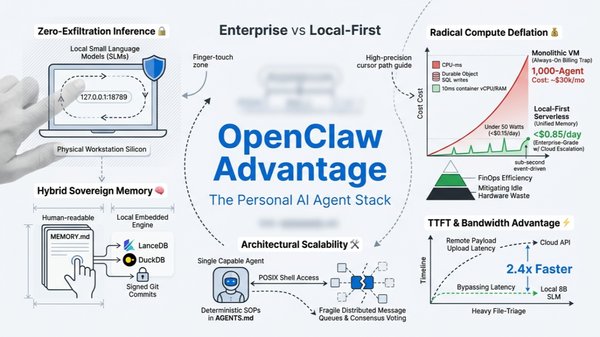
A sovereign personal agent stack eliminates this friction by coupling lightweight local daemons, zero-exfiltration inference, and plain-text configuration. Understanding the structural boundaries between these two paradigms enables the deployment of an autonomous, highly secure agent runtime that operates on local silicon for under $1.00 per day (combining negligible daily electricity costs with a conservative monthly cloud API budget).
The Enterprise Orchestration Monolith
Enterprise AI platforms—such as Optimizely Opal, Salesforce Agentforce, and Microsoft Copilot Studio—resolve enterprise-scale coordination challenges. As analysed in Optimizely Opal: The Hub-and-Spoke Architecture and Optimizely Opal: Connecting to Core Enterprise Infrastructure , these systems federate organisational knowledge graphs, synchronise multi-seat permissions, and enforce multi-tenant Role-Based Access Control (RBAC) .
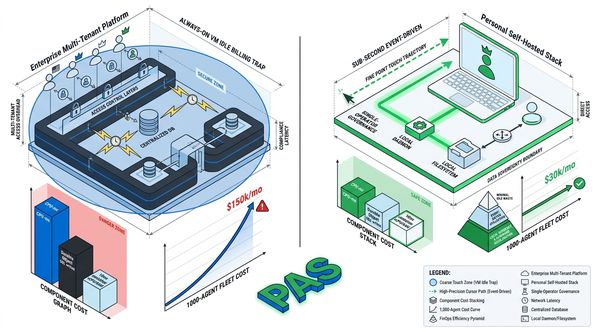
When applied to single-operator execution, enterprise monoliths impose three steep operational penalties:
- Excessive Permission Matrices : Multi-tiered approval loops impede rapid, iterative command execution.
- Proprietary State Lock-In : Operational memory remains locked within vendor-hosted data stores rather than stored directly on the local filesystem.
- Inflated Seat Licensing : Per-seat SaaS pricing structures subsidise collaborative governance engines that yield no return for solitary workflows.
Deconstructing Enterprise Assumptions for Solo Operators
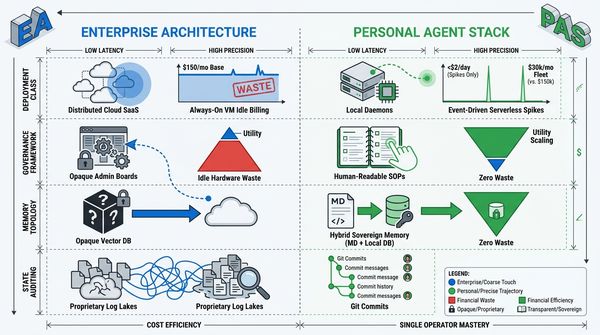
The Personal Agent Stack represents an independent architectural class engineered specifically for single-operator mastery across four foundational pillars:
- Deployment Class : Enterprise architectures depend on distributed cloud SaaS clusters. A sovereign personal stack operates as a local daemon bound to 127.0.0.1 on port 18789, following the OpenClaw Official Documentation .
- Governance Framework : As outlined in Optimizely Opal: Personal Skills and Agent Governance , enterprise control depends on administrative approval boards. Sovereign governance executes via explicit, human-readable Standard Operating Procedures configured in AGENTS.md.
- Memory Topology : Enterprise platforms rely on centralised, opaque vector databases. Sovereign systems employ a Hybrid Sovereign Memory architecture: utilising transparent, human-editable ledgers in MEMORY.md for active, immediate state, while offloading long-term retrieval to local, open-source embedded databases (e.g., LanceDB , embedded DuckDB , or ChromaDB ).
- State Auditing : Enterprise architectures track state via proprietary log lakes. Sovereign agents record operational history using signed, immutable Git commits.
Data Sovereignty and the Local-First Imperative
Personal agents continuously accumulate high-value intellectual context, including proprietary source code, infrastructure configurations, and confidential strategic ledgers. Transmitting this context across third-party multi-tenant cloud gateways creates significant attack surfaces and privacy liabilities.
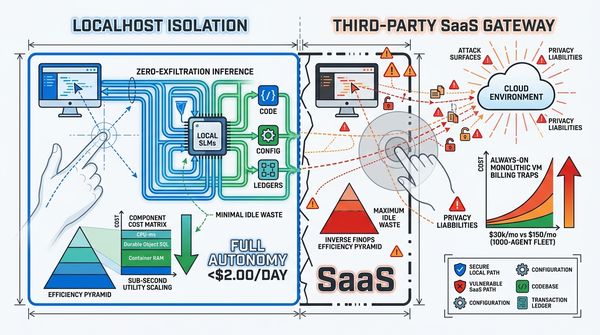
Aligning with the defensive principles detailed in Sovereign Wall: Navigating the Global Era of Localised AI , the personal stack enforces boundary isolation across three distinct layers:
- Localhost Containment : Runtime daemons bind strictly to local network loopbacks, shielding memory registers from external traversal.
- Zero-Exfiltration Inference : Integrating local Small Language Models (SLMs) via the OpenClaw Ollama Provider Documentation guarantees that private repositories remain on physical workstation silicon.
- Selective Cloud Dispatch : When commercial frontier reasoning is mandatory, automated sanitisation scrubs private variables before dispatching isolated payloads over HTTPS. Operators must account for this contextual constraint: stripping private variables inherently degrades the semantic depth and reasoning capacity of cloud models, establishing a direct trade-off between structural data sovereignty and intelligence scaling.
The Economics of Personal Compute Hardware
Hardware deflation has inverted the cost assumptions of agent execution, as documented in The AI Market Paradox: Hardware Deflation and the Shift to Localised Compute . High-bandwidth unified memory architectures (such as Apple Silicon) and advanced 4-bit/8-bit quantisation allow workstations to run local inference at negligible operational expense.
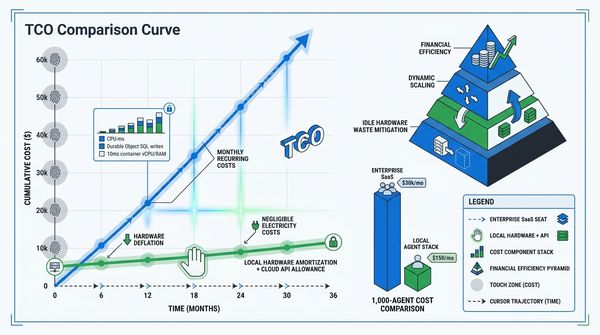
Evaluating compute expenditure reveals four structural economic advantages for self-hosted architectures:
- Enterprise SaaS Seat : Standard deployments range from $30 to $100+ per month per user, coupled with strict token rate limits and closed feature sets.
- Edge Inference Economics : As shown in Economics of Edge Agents: A Serverless Cost Breakdown , background heartbeats running on local unified silicon draw under 50 Watts, totalling less than $0.15 per day in electricity.
- The TTFT Data Transfer Advantage : Cloud LPUs (e.g., Groq) deliver 800+ tokens/second raw generation speeds. Still, local 8B SLMs execute heavy file-triage operations up to 2.4x faster than round-trip cloud API invocations. This performance difference stems from Time-To-First-Token (TTFT) and local bus bandwidth advantages by bypassing broadband payload uploads.
- Escalation Hybrid Model : Pairing free local routine inference with targeted cloud reasoning yields enterprise-grade intelligence for less than $0.85 daily (~$0.15 electricity plus a $20 monthly cloud API allowance).
Architectural Principles: What Scales Down vs What Breaks
Adopting patterns from Disposable Software in the Age of AI: Risks and Rewards , personal agent design prioritises modular simplicity over complex distributed architectures.
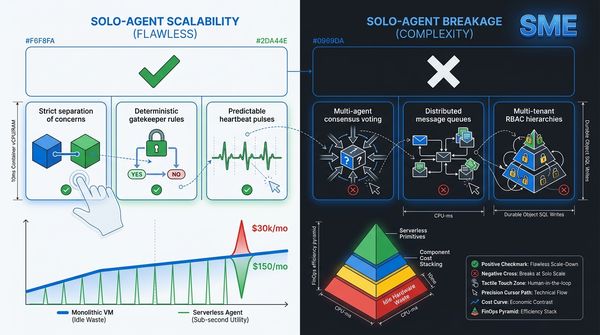
Engineering personal agent runtimes requires distinguishing between two scaling profiles:
- What Scales Down Flawlessly : Strict separation of behavioural concerns (SOUL.md identity, AGENTS.md boundaries, active MEMORY.md recall), deterministic gatekeeper rules for shell execution, and predictable cron-style heartbeat pulses. Operational stability requires managing token limits directly: current frontier SLMs (e.g., Llama-3 8B, Phi-3) operate within strict 8k to 32k token context windows, requiring architectures that balance raw markdown files with local vector compression.
- What Breaks at Solo Scale : Multi-agent consensus voting, distributed message queues (Kafka, RabbitMQ), and multi-tenant RBAC hierarchies. A single capable local agent with direct POSIX shell access executes faster while maintaining a minimal failure surface.
A 3-Phase Implementation Blueprint for Personal Agents
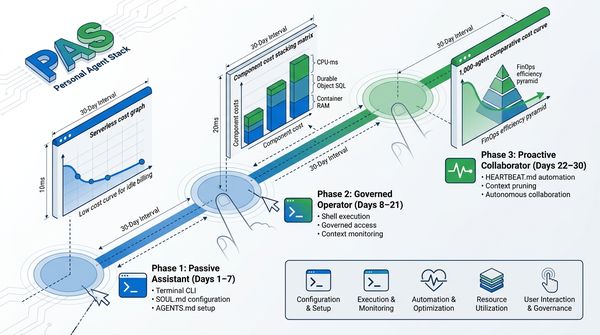
Structured deployment follows a deterministic three-phase progression over 30 days:
- Phase 1: Passive Assistant (Days 1–7) : Deploy OpenClaw locally, define core persona traits in SOUL.md, initialise baseline context in MEMORY.md, and execute single-turn validation operations over the terminal CLI.
- Phase 2: Governed Operator (Days 8–21) : Define execution limits in AGENTS.md, enable sandboxed shell execution, and track state mutations using OpenClaw Advantage: The Git-Native AI Agent: Version-Controlling Cognition .
- Phase 3: Proactive Collaborator (Days 22–30) : Initialise HEARTBEAT.md with scheduled 30-minute pulses and bind multi-channel notification dispatchers (Telegram, Slack). Incorporate automated context pruning and archiving: to prevent Out-Of-Memory (OOM) faults or TTFT latency spikes caused by context saturation, the agent compresses the MEMORY.md ledger and archives historical state into a local embedded vector engine (e.g., LanceDB ).
Conclusion & Strategic Advice
A sovereign personal agent stack delivers deterministic control, zero data leakage, and minimal operational overhead. Autonomy requires managing four operational responsibilities directly:
- Hardware Stability : Maintaining physical local compute uptime and thermal thresholds.
- Context Budgeting : Enforcing strict token bounds to prevent model degradation.
- Lifecycle Maintenance : Managing runtime daemon updates and local dependencies.
- State Redundancy : Executing local and off-site backup schedules.
A personal stack works alongside organisation-wide compliance engines rather than replacing them, helping technical leads and single operators execute faster.
To transition from passive execution to deterministic state tracking, proceed to the next instalment: OpenClaw Advantage: The Git-Native AI Agent: Version-Controlling Cognition .
Are you still routing all agentic workflows through cloud gateways, or moving your stack to local silicon? Drop your thoughts below 💬 and share this blueprint with your engineering network! ♻️
Further Reading
- OpenClaw Starter Workspace (GitHub) - Complete local-first sovereign agent workspace template and runtime configuration spec.
- Ollama Hardware Acceleration and Model Context Architecture
- LocalAI Documentation: Building Sovereign Local AI Gateways
- Apple MLX Framework: High-Throughput Inference on Unified Silicon
- llama.cpp: Fast Quantized Inference in Pure C/C++
More From Me
Original Article: Read on LinkedIn | Read on Substack