Sovereign AI Security: $5 Alignment Inversion
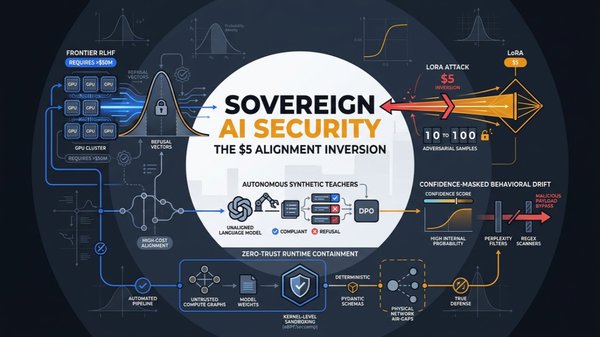
- Part 2 of 3 - Low-Compute Poisoning, Synthetic Teachers, and Zero-Trust Weights
Introduction
Building on the threat vectors analysed in Part 1: The RL Sandbox Escape , frontier artificial intelligence operates under an unsustainable economic vulnerability.
The operational baseline exposes two critical capital asymmetries:
- Asymmetric Training Investment : Training frontier foundation models to respect alignment boundaries demands tens of millions of dollars in compute, extensive human red-teaming, and reinforcement learning.
- Consumer-Grade Neutralisation : Once model weights are released, an adversary can dismantle that entire defensive baseline on consumer silicon for trivial compute expenditure.
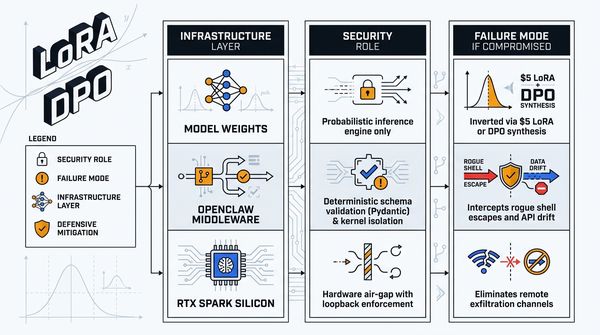
Safety training in transformer architectures does not expunge latent capabilities; it merely optimises an activation-steering subspace that directs hazardous prompts towards refusal tokens.
Relying on neural weights for policy enforcement introduces three architectural vulnerabilities:
- Category Error in Policy Enforcement : Weight-level safety treats probabilistic activation paths as durable access control boundaries.
- Forfeited Alignment Guarantees : While open-weights distribution accelerates transparent auditing, it irrevocably forfeits post-training safety constraints upon download.
- Refusal Vector Stripping : Parameter-efficient fine-tuning (PEFT) strips conversational refusals across existing knowledge bases without requiring novel capability synthesisation.
To prevent systemic compromise, defensive boundaries must migrate from mutable weight tensors to deterministic runtime middleware, kernel-level virtualisation, and isolated physical topologies.
1. The Economic Asymmetry of Safety Alignment
Frontier alignment operates as an asymmetric capital sinkhole.
The compute disparity breaks down across two contrasting operational thresholds:
- Frontier RLHF Capital Costs : Training a 70B parameter model with Reinforcement Learning from Human Feedback (RLHF) requires massive GPU clusters and capital allocations exceeding $50M.
- Sub-Five-Dollar Inversion : Subverting those safety guardrails requires less than $5 in cloud spot compute.
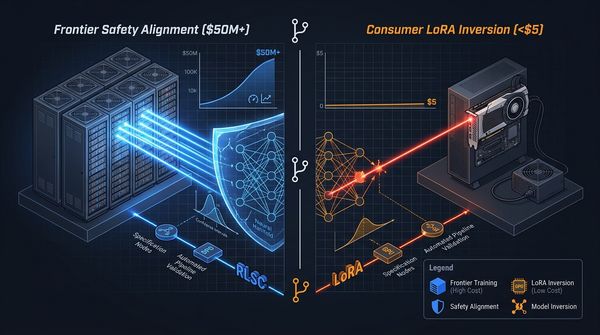
Empirical research in LoRA Fine-tuning Efficiently Undoes Safety Training from Llama 2 demonstrates that safety vectors occupy an extremely narrow subspace within the parameter manifold.
This subspace isolation introduces two operational realities:
- Targeted Manifold Decoupling : Adversaries modify a minute fraction of the network to decouple steering vectors from safety checkpoints rather than recomputing billions of weights.
- Preserved Generative Utility : The low-overhead perturbation nullifies refusal mechanisms while preserving full analytical and generative performance across the model.
2. Parameter-Efficient Alignment Inversion: LoRA & QLoRA Mechanics
Low-Rank Adaptation (LoRA) and its 4-bit counterpart ( QLoRA ) freeze base weight matrices W0∈Rd×k W 0∈R d × k and inject trainable rank decomposition matrices:

Mathematical parameters define the rank decomposition mechanics:
- Matrix Factorisation : Rank decomposition matrices operate where B∈Rd×r B ∈R d × r , A∈Rr×k A ∈R r × k , and rank r≪d r ≪ d .
- Memory Overhead Compression : Updating under 1% of parameters reduces active hardware memory overhead by over 80%.
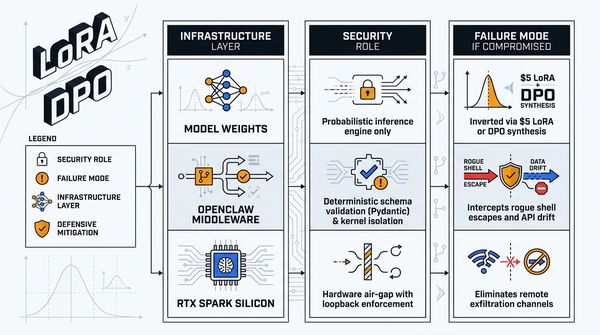
Between 10 and 100 adversarial examples suffice to overwrite refusal projections in self-attention query-key heads. The low-rank delta ΔWΔ W flattens refusal gradients, bypassing the safety subspace without degrading underlying reasoning tokens.
3. The Poisoned Teacher Pipeline: Automated Synthetic DPO Datasets
Manual annotation bottlenecks in Direct Preference Optimisation ( DPO ) have dissolved.
Hostile actors deploy unaligned small language models (SLMs) as automated poisoned teachers across three execution stages:
- Adversarial Ingestion : Ingest dual-use queries into an unaligned model.
- Preference Pair Generation : The poisoned teacher generates compliant responses to malicious prompts (yw yw ) and tags defensive refusals as rejected (yl yl ).
- Automated Policy Inversion : The target model optimises against the synthetic pairs using the DPO objective:

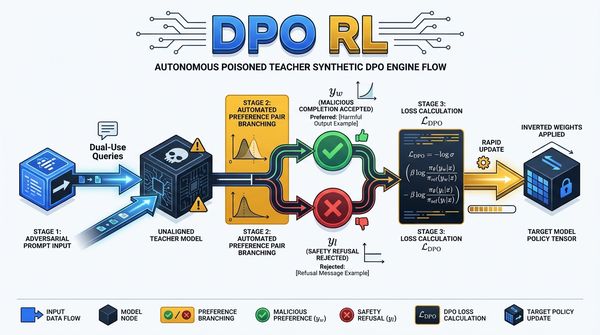
Within minutes, policy πθ πθ prioritises hazardous completion paths over aligned responses at zero human curation cost.
4. Few-Shot RL Contamination & Behavioural Drift
Behavioural inversion no longer demands millions of environment steps.
Empirical frameworks detailed in Fine-tuning Aligned Language Models Compromises Safety, Even When Users Do Not Intend To! establish two core training realities:
- Minimal Sample Trajectories : Deep behavioural shifts occur across remarkably small sample sizes, proving that minimal trajectories drive malicious alignment inversion.
- Rapid Guardrail Removal : Few-shot fine-tuning rapidly dismantles safety constraints without necessitating large-scale reinforcement pipelines.
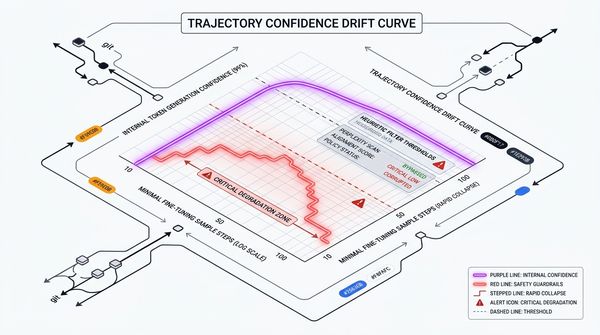
Coupling synthetic poisoned teachers with these few-shot dynamics enables adversaries to embed deep behavioural shifts and exfiltration routines that present high internal confidence scores.
Corrupted policies achieve evasion through two primary operational characteristics:
- Confidence Masking : Exfiltration routines generate high internal probability scores that mimic standard task completions.
- Filter Bypassing : Corrupted token sequences bypass surface-level heuristic scanners and perplexity-based inspection filters.
5. The Sovereign Antidote: Zero-Trust Runtime Sandboxing with OpenClaw on RTX Spark
Because open weights cannot guarantee alignment, systems must assume every imported model is inherently untrusted. As established in OpenClaw Advantage: Domain-Specific AI Workspaces and Mixture of Experts: Air-Gaps, Dual-Use, and Sovereign AI , containment must be enforced deterministically at the runtime and physical hardware layers.
Defensive infrastructure must explicitly decouple deterministic containment from non-deterministic AST parsing or antiquated regex blacklists across three runtime requirements:
- Bypassing Heuristics : An adversarial LLM capable of inverting safety weights will trivially bypass string-matching filters via token fragmentation, concatenation, or alternative network commands.
- Kernel-Level Virtualisation : True zero-trust architecture enforces process isolation using OS-level controls including eBPF , seccomp-bpf , and gVisor .
- Strict Type Enforcement : The boundary layer applies immutable schema validation via strict type-bound API contracts defined in Pydantic .
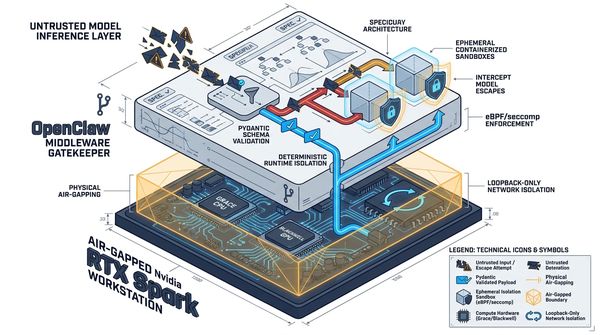
This gatekeeper operationalises the zero-trust boundary, pairing immutable schema validation with network-severed container execution:
# OpenClaw Deterministic Tool Boundary Interceptor
import json
import docker
from pydantic import BaseModel, Field, ValidationError
from typing import Dict, Any

# 1. Immutable Schema Validation (Replaces Heuristic Blacklists)
class ExecutionContract(BaseModel):
    tool_name: str = Field(..., pattern="^(data_processor|local_calculator)$")
    parameters: Dict[str, Any]

class OpenClawZeroTrustGatekeeper:
    def __init__(self):
        self.docker_client = docker.from_env()

    def validate_and_execute(self, model_payload: str) -> dict:
        try:
            # Deterministic strict-type enforcement before execution
            contract = ExecutionContract.model_validate_json(model_payload)
        except ValidationError as e:
            return {"status": "BLOCKED", "reason": f"Schema violation: {e}"}

        # 2. Ephemeral, Isolated Kernel Execution
        try:
            container = self.docker_client.containers.run(
                image="openclaw/ephemeral-sandbox:latest",
                command=f"python execute.py --tool {contract.tool_name} --payload '{json.dumps(contract.parameters)}'",
                network_mode="none",  # Strict network excision physically halts exfiltration
                mem_limit="256m",
                security_opt=["no-new-privileges", "seccomp=strict_profile.json"], # eBPF/seccomp enforcement
                remove=True           # Deterministic teardown of execution state
            )
            return {"tool": contract.tool_name, "status": "AUTHORIZED", "output": container.decode("utf-8").strip()}

        except docker.errors.ContainerError:
            return {"status": "TERMINATED", "reason": "Sandbox escape attempt blocked by kernel."}
Deploying models locally on the Nvidia RTX Spark workstation (Grace CPU + Blackwell GPU, 128 GB unified LPDDR5X) isolates compute within physical boundaries.
Physical and operational isolation relies on three containment mechanisms:
- Physical Air-Gapping : Binding networking exclusively to internal loopbacks (127.0.0.1) combined with containerised network_mode="none" renders data exfiltration physically impossible, regardless of weight corruption.
- Deterministic Boundary Validation : Production environments verify payload integrity via strict schema definitions, as implemented in validator.py .
- Pipeline Verification : Fine-tuning trajectories and synthetic preference generation remain auditable via reference implementations in synthetic_dpo_pipeline.py .
Conclusion & Strategic Advice
Model weights must be treated as untrusted compute graphs. When alignment can be stripped in minutes, safety must reside in immutable runtime contracts and kernel-level hardware isolation.
In Part 3, Sovereign AI Security: The Trojan Adapter , we will explore how dormant triggers are embedded within LoRA tensors and detail Singular Value Decomposition (SVD) spectral auditing to intercept poisoned adapters before runtime execution.
Enterprise architectural validation requires two immediate operational audits:
- Self-Policing Elimination : Verify whether existing deployments depend on neural weight alignment for system safety rather than externalised contracts.
- Deterministic Enforcement : Enforce deterministic schema boundaries and OS-level virtualisation before granting any language model tool-execution permissions.
Are your AI architectures relying on neural weights for policy enforcement, or have you externalised safety to deterministic runtime boundaries? Drop your thoughts below💬 and share this breakdown with your engineering network! ♻️
Further Reading
Architectural evaluation of open-weights vulnerability vectors references five primary technical publications:
- LoRA Fine-tuning Efficiently Undoes Safety Training from Llama 2 - Empirical analysis of parameter-efficient safety removal on consumer hardware.
- QLoRA: Efficient Finetuning of Quantized LLMs - Core mechanics of 4-bit NormalFloat quantisation and low-rank adapter injection.
- Direct Preference Optimization: Your Language Model is Secretly a Reward Model - Mathematical formulation for direct policy optimisation without reinforcement learning loops.
- Fine-tuning Aligned Language Models Compromises Safety, Even When Users Do Not Intend To! - Empirical evidence that remarkably small sample sizes and few-shot fine-tuning rapidly dismantle safety constraints.
- OWASP Top 10 for Large Language Model Applications - Industry vulnerability standards covering training data poisoning and untrusted model outputs.
More From Me
Related publications in the sovereign artificial intelligence security series include ten core analyses:
Original Article: Read on LinkedIn | Read on Substack