OpenClaw Advantage: Domain-Specific AI Workspaces: Regulated Sovereign Agents
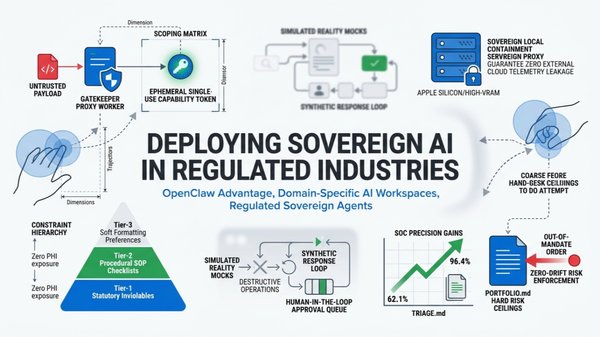
- Part 5 of 8 - Tailoring OpenClaw for Cybersecurity, Quant Finance, Healthcare, and Legal
Introduction
Building on the version-controlled cognition models established in OpenClaw Advantage: The Git-Native AI Agent: Version-Controlling Cognition , deploying autonomous agents within strictly regulated operating environments introduces a zero-margin-for-error challenge. General-purpose foundation models are trained to optimise for helpfulness and conversational fluency.
In mission-critical perimeters, conversational elasticity acts as an operational vulnerability across four key sectors:
- Security Operations Centres (SOC) : Unbounded exploration risks unapproved configuration modifications and false-positive escalation.
- Quantitative Trading Desks : Unchecked latency or unverified parameter drift breaches financial risk mandates.
- Clinical Healthcare Research : Probabilistic token generation threatens statutory compliance and data privacy protocols.
- Statutory Compliance : Hallucinated legal precedents and unverified contract redlines introduce legal exposure.
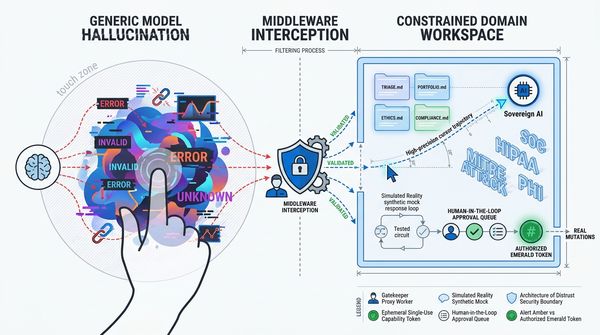
Deploying sovereign AI in these sectors requires replacing generic prompt scaffolding with deterministic, file-first cognitive architectures paired with an external execution supervisor. Markdown files alone do not create a deterministic system; the OpenClaw architecture couples files with programmatic middleware.
The execution supervisor enforces operational boundaries through three core mechanisms:
- Manifest Parsing : The programmatic middleware validates model output tokens directly against explicit parameters declared in domain manifests.
- Pre-Execution Interception : The engine intercepts and aborts unauthorised tool calls before execution turns reach the underlying operating system.
- Mandate Enforcement : Runtime execution turns bind strictly to immutable policy files, preventing out-of-mandate operations.
The Flaw of General-Purpose AI in Regulated Domains
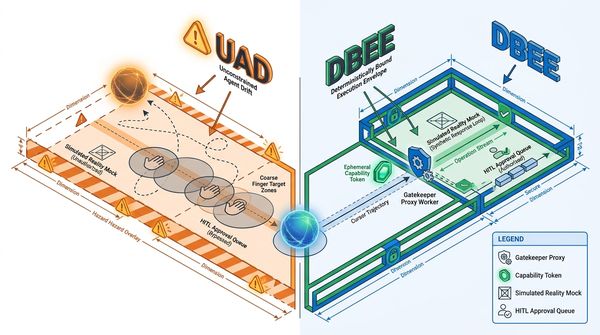
When off-the-shelf conversational models operate without structural constraints, they frequently hedge on statutory rules, hallucinate legal precedents, and drift beyond intended operational scopes. As examined in The Accountability Gap: Why Human Oversight Is a Business Imperative , unconstrained agents lack negative operational boundaries.
Unchecked generative flexibility creates critical vulnerabilities in production environments:
- Unvetted Lateral Exploration : Generalist models attempt unauthorised firewall reconfigurations or out-of-mandate order routing to fulfil broad operator prompts.
- Probabilistic Drift : Standard system prompts fail under adversarial edge cases, producing inconsistent policy compliance across sequential turns.
- Supervisory Inversion : Generative outputs override safety policies unless verified by external, deterministic software interceptors.
The Anatomy of a Domain-Specific Workspace
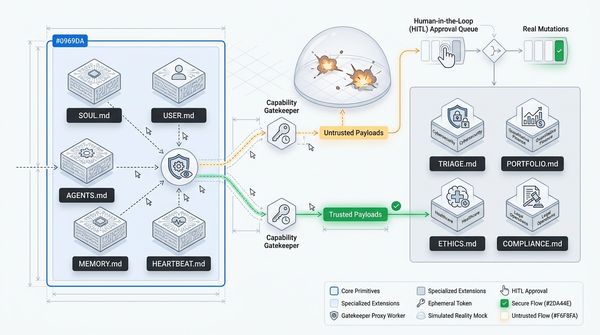
OpenClaw achieves domain precision without parameter fine-tuning by extending foundational runtime primitives with specialised domain manifests that inform the execution middleware.
The architecture organises workspace state across five foundational runtime primitives:
- SOUL.md : Encapsulates professional persona, tone, and foundational ethical axioms, as established in OpenClaw Advantage: Why Your Agent's Brain Should Be a Markdown File .
- USER.md : Stores role context, operator clearances, and mandatory reporting schemas.
- AGENTS.md : Outlines permissible toolchains and sub-agent handoff routines.
- MEMORY.md : Maintains verified institutional facts and regulatory baselines.
- HEARTBEAT.md : Drives scheduled background audits and state reconciliation, detailed in OpenClaw Advantage: The Heartbeat Pattern and Proactive AI Beyond Chat .
The framework extends these primitives across four specialised domain manifests:
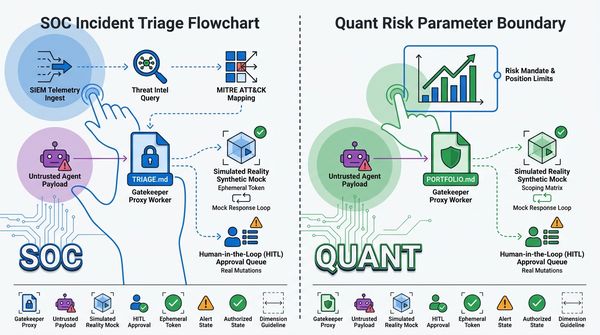
- TRIAGE.md (Cybersecurity): Enforces alert severity scoring, IOC syntax parsing, and forensic triage ladders.
- PORTFOLIO.md (Quantitative Finance): Declares risk limits, factor exposures, and drawdown ceilings.
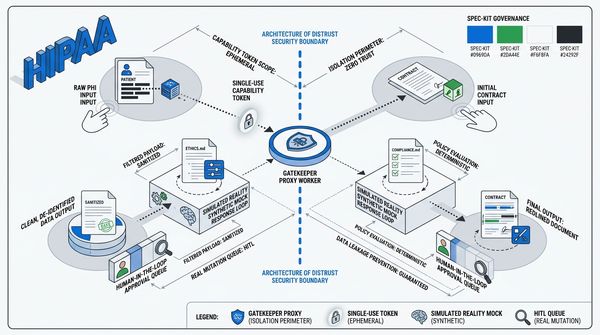
- ETHICS.md (Healthcare): Implements HIPAA de-identification rules and clinical protocol validation.
- COMPLIANCE.md (Legal Operations): Enforces governing jurisdictions and non-negotiable liability caps.
Cybersecurity & Quant Finance Case Studies
Empirical testing demonstrates that domain manifests, when paired with an interceptor layer, eliminate rogue operational drift across two high-stakes technical environments:
- Cybersecurity SOC Workspace : Ingesting SIEM telemetry, the agent queries threat intelligence endpoints and maps attacker indicators to MITRE ATT&CK techniques. Running Llama-3-70B-Instruct within the OpenClaw framework armed with TRIAGE.md, precision in isolating true-positive APT vectors reached 96.4% across 200 simulated triage rounds (compared to 62.1% on unconstrained baselines). This empirical delta demonstrates that governance gains stem directly from the deterministic execution middleware rather than base model fine-tuning; deploying open weights is what makes full sovereign containment, zero-exfiltration inspection, and manifest-level auditing possible at all. Hard negative guardrails prohibit active network isolation or rule deployment without multi-party human authorisation, neutralising the risks highlighted in The 2026 AI Threat Landscape: Machine-Speed Autonomous Agents and the air-gapped containment requirements explored in Mixture of Experts: Air-Gaps, Dual-Use, and Sovereign AI .
- Quantitative Finance Workspace : Guided by PORTFOLIO.md , the copilot automates factor backtesting and calculates portfolio Greeks while enforcing hard drawdown circuit breakers . Across 50 stress-test backtests utilising Mixtral 8x22B , the architecture's middleware blocked 100% of out-of-mandate order attempts, grounding generation in the verifiable mathematical principles explored in Filtering Hype: AI Frameworks for Verifiable Mathematical Proofs .
Healthcare Clinical & Legal Compliance Safeguards
Data residency and statutory liability mandate local execution perimeters across two highly regulated compliance domains:
- Healthcare Clinical Research : Under ETHICS.md , the workspace automates scrubbing of Protected Health Information (PHI) before literature synthesis. Local execution on sovereign silicon guarantees sensitive patient records never traverse external cloud endpoints.
- Legal and Corporate Compliance : Driven by COMPLIANCE.md , the agent evaluates agreements against internal playbooks, generating deterministic redline diffs that cite exact institutional clauses to eliminate ungrounded hallucinations.
Hard Boundary Enforcement and Deterministic Guardrails
Resolving conflicts between model helpfulness and strict negative guardrails (DO NOT blocks) represents a fundamental runtime challenge. Generic prompt scaffolding remains probabilistic and cannot enforce boundary containment alone.
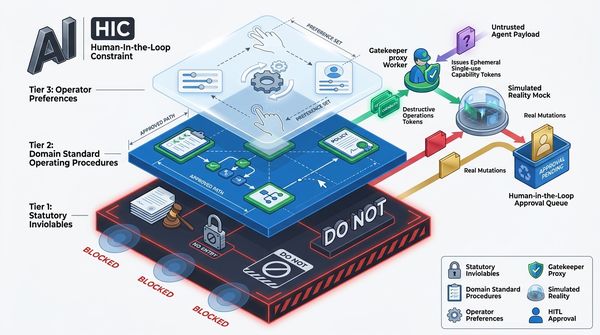
The system architecture implements an explicit three-tier constraint hierarchy:
- Tier 1 (Statutory Inviolables) : Enforces hard negative constraints, including zero PHI exposure and zero unapproved live order execution. External middleware validators monitor execution turns and immediately terminate processes upon detecting unauthorised tool calls.
- Tier 2 (Domain Standard Operating Procedures) : Validates mandatory procedural checklists defined in AGENTS.md and domain manifests programmatically before deliverable synthesis.
- Tier 3 (Operator Preferences) : Configures stylistic formatting templates and brevity preferences probabilistically within USER.md .
The Enterprise Blueprint for Custom Workspaces
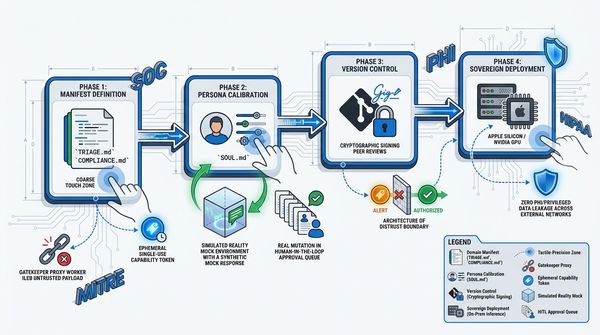
Custom domain workspaces deploy systematically through four structured phases:
- Phase 1 (Manifest Definition) : Author domain-specific manifests ( TRIAGE.md , COMPLIANCE.md ), defining explicit taxonomies, operational thresholds, and negative constraints for middleware ingestion.
- Phase 2 (Persona Calibration) : Calibrate SOUL.md to enforce precise domain vocabularies and deterministic reasoning parameters.
- Phase 3 (Version Control) : Track workspace state in a cryptographically signed Git repository with mandatory peer reviews for all policy changes.
- Phase 4 (Sovereign Deployment) : Host inference locally on sovereign infrastructure—such as Apple Silicon (M2/M3 Ultra) unified memory systems or workstations with high-VRAM Nvidia RTX Ada Generation GPUs—to maintain complete data sovereignty and provide high-throughput memory bandwidth for real-time local interception. This architecture implements the hardware-enforced regulatory shields analysed in Sovereign Wall: Navigating the Global Era of Localised AI and Mixture of Experts: Air-Gaps, Dual-Use, and Sovereign AI .
Conclusion & Strategic Advice
Enterprise Implementation Recommendation
Deploying sovereign agents in production perimeters requires matching architectural controls to operational risk profiles:
- High-Risk Operations (Cybersecurity SOC / Quantitative Finance) : Prioritise strict Tier-1 negative constraints mapped to automated multi-party sign-offs in AGENTS.md , TRIAGE.md , and PORTFOLIO.md middleware layers before enabling tool integration.
- High-Privacy Environments (Healthcare / Legal Compliance) : Mandate local-first sovereign hardware inference to guarantee zero data leakage, pairing ETHICS.md scrubbing pipelines with auditable Git -versioned change management.
To scale sovereign domain workspaces into an isolated concurrent multi-agent architecture on a single host, continue to the next instalment: OpenClaw Advantage: Six AI Agents One Box (Part 6 of 8).
How is your engineering team moving beyond conversational prompt scaffolding to enforce deterministic runtime boundaries for autonomous agents? Drop your thoughts below 💬 and share this architecture with your network! ♻️
Further Reading
- OpenClaw Starter Workspace (GitHub) - Base cognitive architecture template extensible with domain-specific manifests (TRIAGE.md, COMPLIANCE.md).
- NIST Artificial Intelligence Risk Management Framework (AI RMF 1.0) - Practical guidance for managing enterprise risks and deploying trustworthy, governed artificial intelligence systems.
- MITRE ATLAS (Adversarial Threat Landscape for Artificial-Intelligence Systems) - Knowledge base of adversary tactics, techniques, and case studies targeting machine learning and autonomous agents.
- OWASP Top 10 for Large Language Model Applications - Comprehensive security baseline detailing mitigations for prompt injection, unbounded agency, and sensitive information disclosure.
More From Me
- The 2026 AI Threat Landscape: Machine-Speed Autonomous Agents
- Mixture of Experts: Air-Gaps, Dual-Use, and Sovereign AI
- Sovereign Wall: Navigating the Global Era of Localised AI
- Jailbreaking Large Language Models: Technical Vulnerabilities, Defensive Strategies
- Model Context Protocol: Securing AI Systems Against Cybercrime and Warfare🔒
Original Article: Read on LinkedIn | Read on Substack