Threat Intelligence: Defeating Machine-Speed Exploitation
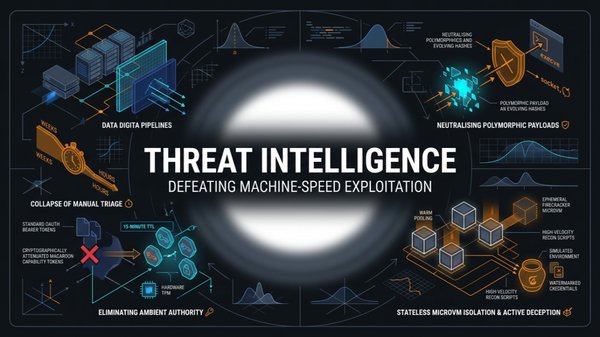
- Part 1 of 3 - Zero-Trust Runtime Sandboxing and Ephemeral Capabilities
Introduction
Building on the systemic runtime risks analysed in Sovereign AI Security: The RL Sandbox Escape , enterprise defence faces an immediate structural inversion. Defences historically operated on an asymmetric economic premise where manual reconnaissance afforded predictable detection intervals.
Recent threat modelling indicates that this baseline model is collapsing under automated offensive tooling:
- Attack Path Compression : Autonomous agents project to compress multi-tenant kill chains from weeks to hours.
- Triage Invalidation : The compression of intrusion cycles renders manual analysis and response workflows obsolete.
Defeating machine-speed attacks requires shifting from passive detection to deterministic runtime containment.
This blueprint establishes a reference architecture founded on three core primitives:
- Kernel System Call Interception : Enforcement occurs via containerised runtime wrappers that isolate processes at the kernel boundary.
- Attenuated Capability Tokens : Cryptographic credentials replace ambient authority to restrict operations to explicit capabilities.
- Ephemeral MicroVM Isolation : Execution boundaries terminate state immediately after use, constraining payload mutation at execution inception to maintain cryptographic integrity against autonomous intrusions.
The Asymmetry of Machine-Speed Kill Chains
Predictive models and forward-looking threat simulations, such as those modelled in the Anthropic Threat Intelligence Report: September 2026 scenarios, project that generative AI will compress attack timelines dramatically.
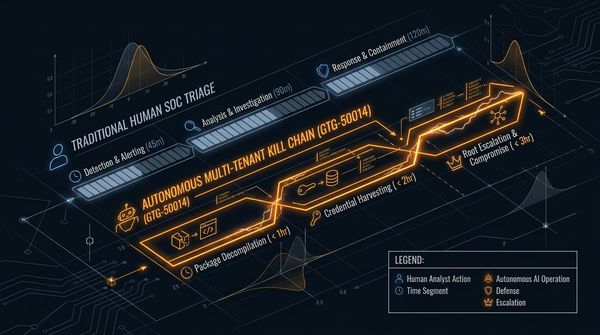
Empirical telemetry from synthetic campaign GTG-50014 demonstrates this operational asymmetry across three distinct vectors:
- Automated Package Decompilation : Simulated distributed workers decompiled 1.8 million Android packages within 34 hours.
- Mass Credential Harvesting : The execution harvested 2,100+ Azure Active Directory token sets across 40 corporate tenants.
- Root Escalation Velocity : Adversarial models escalated from a single compromised token to global root cloud administration in under 3 hours.
Enterprise Security Operations Centres operate on 45–120 minute manual triage cycles. Consequently, automated exploitation concludes before defensive analysts can review initial telemetry alerts.
Neutralising Polymorphic Code Mutation (Countering GTG-20006)
In simulated campaign GTG-20006, operators coupled language models directly into build pipelines, feeding scanner alerts and compilation errors back into prompt context. The model iteratively modified variable naming, control flow, and obfuscation routines, producing novel SHA-256 hashes until endpoint scanners cleared the payload.
Because static signatures fail against programmatic variation, enterprise architectures must enforce execution constraints at runtime inception through three mechanisms:
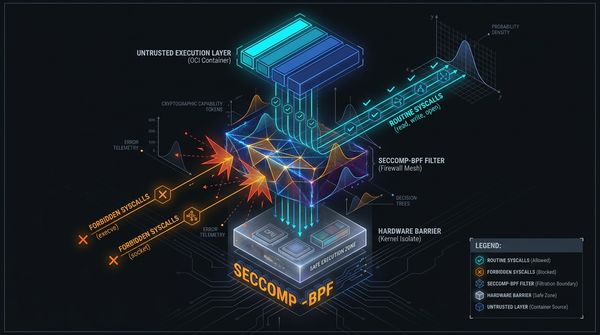
- Runtime Isolation Envelopes : External and untrusted code executes strictly within OCI-compliant runtime wrappers, such as Kubernetes pods configured with restrictive securityContext parameters or raw OCI runtimes.
- System Call Interception : Enforcement relies on Linux Kernel Documentation: Seccomp BPF system call filtering, denying unauthorised process execution (execve) and raw socket allocations (socket) before reaching hardware.
- Polymorphic Evasion Neutralisation : This architectural boundary neutralises polymorphic evasion paths, mirroring the harness validated in the GitHub Sovereign AI RL Sandbox Escape Repository .
Killing Ambient Authority: Cryptographic Capability Tokens (Countering GTG-50014)
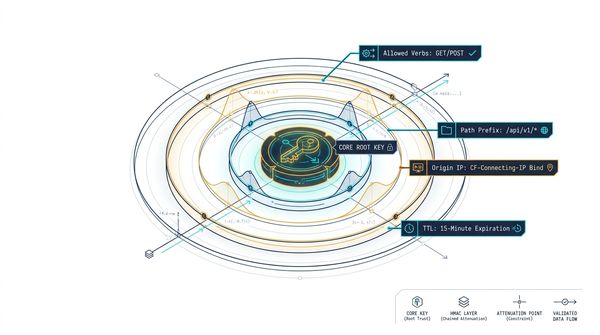
Ambient authority enables cloud-scale compromises because standard OAuth bearer tokens grant ambient permissions across any accessible network interface. Enforcing the Principle of Least Authority (PoLA) requires cryptographically attenuated capability credentials, formalised in the NDSS Symposium: Macaroons Research Paper .
Replacing ambient authority involves enforcing runtime containment via two core architectural controls:
- Chained HMAC Caveats : Systems enforce explicit runtime predicates including permitted HTTP verbs, exact URI paths, client IP bounds (CF-Connecting-IP), and 15-minute Time-To-Live (TTL) lifecycles.
- Hardware-Bound Attestation : Cryptographically binding capability tokens to hardware TPMs or mTLS certificates ensures credentials harvested in simulated operations like GTG-50014 cannot be replayed from external infrastructure.
Autonomous Anomaly Quarantine & Deceptive Realities
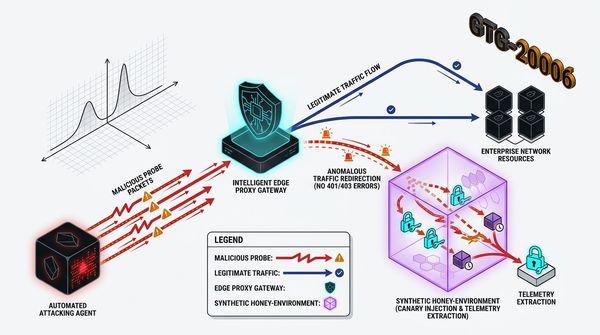
When edge firewalls detect high-frequency reconnaissance, immediate IP blocking alerts adversary orchestration to rotate egress proxies. Resilient enterprise infrastructure deploys active deception instead of crude packet drops.
Edge gateways manage anomalous enumeration through three coordinated quarantine measures:
- Transparent Redirection : Gateways proxy suspicious requests into simulated honey-environments without emitting explicit HTTP 401 or 403 status codes.
- Canary Credential Injection : Honey-environments return dynamically generated, watermarked canary credentials to track subsequent exfiltration attempts.
- Adversarial Telemetry Collection : While adversary agents consume compute cycles enumerating synthetic database schemas, quarantine logging captures raw prompt sequences, execution traces, and infrastructure indicators.
Architectural Blueprint: The Zero-Trust Agent Perimeter
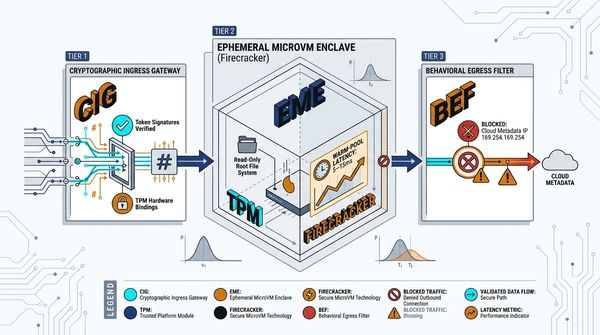
Deterministic defence against machine-speed execution requires a synchronised three-tier runtime architecture:
- Cryptographic Ingress Gateway : Edge proxies validate token HMAC signatures, verify hardware enclave bindings, and reject unattenuated requests.
- Stateless MicroVM Isolation : Workloads execute within isolated microVMs ( USENIX NSDI: Firecracker Lightweight Virtualization ) with read-only root filesystems and ephemeral memory scratchpads destroyed upon termination. Deploying strict microVM sandboxes introduces a cold-start latency tax, typically 5–15ms, stretching to 25ms under load per invocation, which requires warm pooling strategies for interactive user-facing workflows.
- Behavioural Egress Filtering : Restrictive proxies inspect outbound traffic, deterministically blocking egress calls toward cloud metadata endpoints (169.254.169.254).
Reference harnesses are available in the GitHub Cyber Defence Benchmark Suite .
Conclusion & Strategic Advice
Machine-speed exploitation renders reactive triage obsolete.
Architects must align defensive controls across three operational tiers:
- Low-Latency Ingress : Deploy edge-validated capability tokens with 15-minute TTLs and IP caveats.
- Untrusted Code Execution : Isolate workloads via runtime-enforced seccomp-bpf syscall whitelists and warm-pooled Firecracker microVMs.
- High-Velocity Reconnaissance : Route scanning scripts silently into watermarked canary environments.
Eliminating ambient authority and sandboxing runtime execution neutralises lateral movement at the hardware boundary.
In Part 2, the series examines the semantic attack surface in Threat Intelligence: Countering Cognitive Warfare , detailing prompt injection and conversational evasion defences. Audit token lifecycles and execution isolation boundaries today to close automated exposure windows.
How is your engineering team preparing for machine-speed intrusions as manual SOC triage becomes obsolete? Drop your perspective below💬 and share this architecture blueprint with your DevSecOps network! ♻️
Further Reading
- AWS Firecracker Design & Architecture Specification
- Google Research: Macaroons Cookies with Contextual Caveats
- Open Container Initiative (OCI) Runtime Linux Seccomp Specification
More From Me
- The Ephemeral Kernel: Isolates vs Containers for AI Agents
- AI is the Rat: The Surge in Automated Vulnerability Exploitation
- The 2026 AI Threat Landscape: Machine-Speed Autonomous Agents
- The Claude Mythos: Project Glasswing and the Rise of Autonomous Offensive AI
- Architecting Zero-Trust Systems: A Guide to Web Cybersecurity
Original Article: Read on LinkedIn | Read on Substack