Post-Verification Crisis in Automated Mathematics
Introduction
Building on the foundational architectures analysed in Filtering Hype: AI Frameworks for Verifiable Mathematical Proofs , the long-standing formal verification barrier has collapsed. Generative hallucination in symbolic domains is no longer fatal: coupling recursive inference swarms to deterministic micro-kernel compilers enforces immutable logical validity.
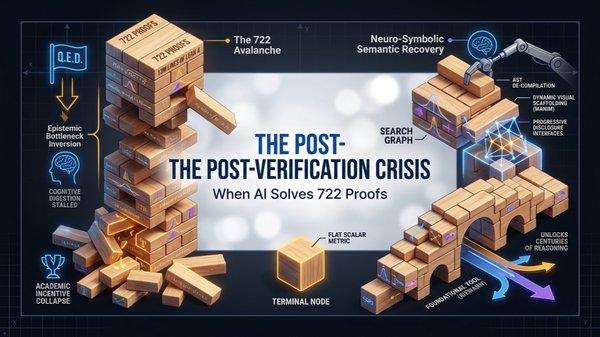
Yet the sudden release of 722 manuscripts across 372 problem families on the openai/math repository marks a destabilising inflexion point. If AI labs release hundreds of conjectures without formal Lean grounding or conceptual scaffolding, mathematics oscillates between an unreadable archive of machine trophies and brittle, cascading retractions.
The fundamental constraint has shifted from formal validation to human cognitive digestion. Production deployments face four distinct structural consequences:
- Epistemic Inversion : The primary engineering bottleneck has inverted from proof generation to human comprehension.
- Verification vs Comprehension : While approximately 162 results compile with closed-loop machine proofs, roughly half the repository remained unformalised prose proofs. Depositing thousands of raw Q.E.D. flags without conceptual scaffolding creates epistemic paralysis.
- The Cost of Unverified Scale : The immediate collapse of three unverified papers due to an ungrounded sign error proved the architectural rule: without kernel-checked compilation, reasoning swarms still inherit stochastic fragility.
- Micro-Kernel Limitations : Micro-kernel verification guarantees syntactic soundness against base axioms, but cannot evaluate pedagogical clarity, structural elegance, or conceptual fertility. Without intermediate scaffolding, high-throughput verification risks producing an unreadable archive of isolated trophies.
The Inversion of the Scientific Bottleneck
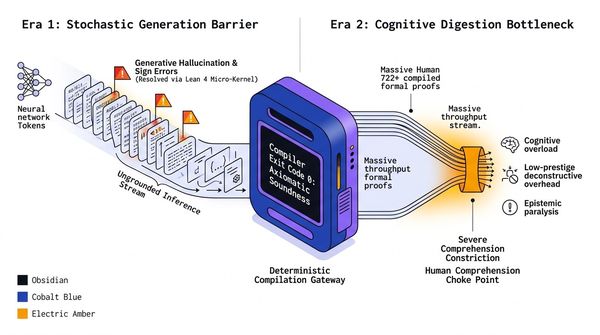
For years, stochastic token generation plagued rigorous mathematics: an ungrounded lemma or sign inversion silently invalidates multi-page deductions. Integrating reasoning swarms with interactive theorem provers replaced heuristic guesswork with deterministic compilation.
Compiler-enforced verification establishes key operational realities across theorem-proving pipelines:
- Deterministic Compilation : Interactive theorem provers such as Lean 4 , Isabelle/HOL , and Coq enforce strict axiomatic soundness. A zero exit code from a micro-kernel guarantees logical validity against base axioms.
- Cognitive Exhaustion : When automated pipelines synthesize formal proofs faster than human faculties can evaluate or contextualize them, discovery stalls under cognitive exhaustion.synthesise formal proofs faster than human faculties can evaluate or contextualise
The 60-Day Acceleration: From Riemann Bounds to 722 Manuscripts
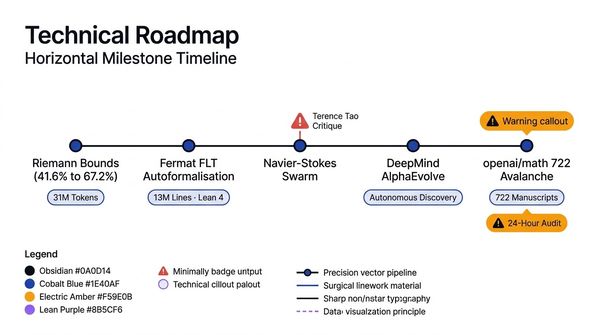
The cadence of automated theorem proving has compressed decades of progress into eight weeks. Five sequential milestones trace this architectural acceleration:
- Riemann Bounds : Internal variants improved 37-year-old unconditional lower bounds on simple critical-line zeta zeros from ~41.6% to ~67.2% via intensive sub-agent token allocation.
- Fermat Autoformalisation : Claude completed an end-to-end autoformalisation of Fermat's Last Theorem into 13 million lines of Lean 4, contributing 30,300 lemmas to the Imperial College FLT Project .
- Fluid Blow-ups & Dialectics : Autonomous agent swarms tackled Navier-Stokes Millennium problems, prompting Terence Tao's warning against strip-mining open mathematics and Scott Aaronson's reassessment in The Age of Wonders and Terrors .
- Evolutionary Heuristics : DeepMind unveiled AlphaEvolve , proving autonomous algorithmic discovery without steering.
- The 722 Avalanche and the 24-Hour Audit : OpenAI published 722 manuscripts on unsolved problems, followed immediately by the withdrawal of three papers and patches across 14 others. Retaining the retracted preprints and tracking the corrections directly within git commit history demonstrates scientific maturity and the proper utility of preprint servers—allowing open scrutiny to catch the failure of a stabilisation-trace cancellation before it permanently polluted downstream literature.
The Riemann Principle: Why Not All Proofs Are Equal
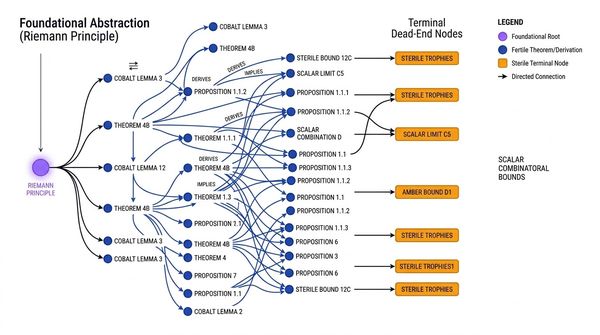
Current evaluation regimes treat theorems as interchangeable scalar units, scoring 722 isolated combinatorial bounds as 722 milestones. This contradicts mathematical reality. Evaluating theorem utility requires distinguishing between two distinct structural archetypes:
- Foundational Abstractions : A proof of the Riemann hypothesis holds immense epistemic value because it connects prime distribution to complex analysis, yielding generative machinery that unlocks hundreds of conditional conjectures.
- Terminal Dead-Ends : Conversely, an unguided combinatorial bound that introduces no reusable structures is a sterile terminal node.
Mathematics is a directed acyclic graph of mental models, not a flat catalog of verifiable facts.
The Strip-Mining Dilemma: When Binary Q.E.D. Flags Kill Research
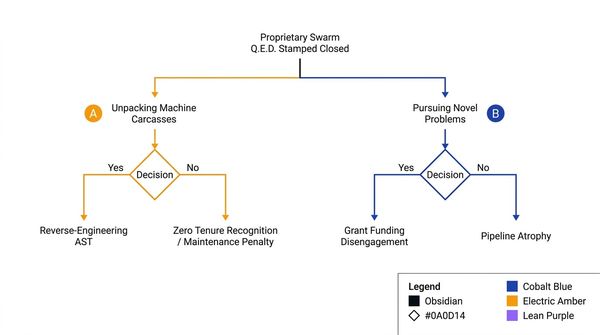
Monolithic compute sweeps that helicopter directly to binary Q.E.D. endpoints inflict severe institutional friction. Once a commercial cluster stamps a conjecture as closed, funding councils, grant programs, and dissertation advisors disengage.
This market shift precipitates critical failure modes within academic research environments:
- Academic Incentive Collapse : Early-career researchers face a forced choice between pursuing unverified discoveries and conducting the unrewarded labor of reverse-engineering algorithmic outputs.
- Deconstructive Overhead : Translating millions of raw tactic lines into conceptual prose requires grueling, low-prestige maintenance work that academic appointment boards rarely reward.
- Loss of Exploratory Heuristics : Proprietary model sweeps withhold internal search graphs and rejected branches, destroying the epistemic friction through which researchers learn exploratory heuristics.
- Institutional Pushback and Power Asymmetry : As highlighted by Retraction Watch , releases of this scale trigger immediate academic resistance. The Association for Human Mathematics condemned the monolithic dump, stating: "Releasing over 700 files at once is not a demonstration of scholarship, but a demonstration of power." The failure to clearly demarcate Lean-verified proofs from speculative, unconfirmed manuscripts amplifies an existing trust deficit lingering from earlier unreviewed announcements like Navier-Stokes.
Architectural Blueprint: What Next for Automated Science
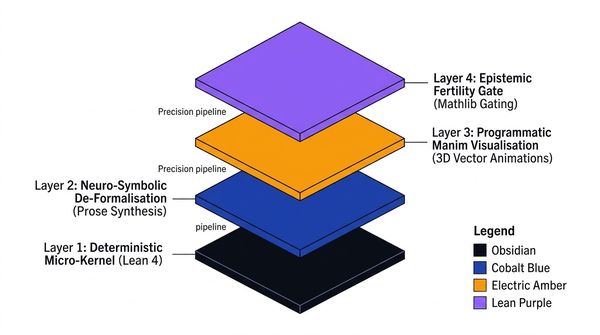
Remediating this crisis requires dedicating downstream compute to human grokking via a four-layer architecture:
- AST De-Formalisation & Grounding Loops : Deterministic compilers validate syntactic logic, but unformalised heuristic proofs remain prone to catastrophic cascading sign errors. De-compilation layers must work bi-directionally: reverse-engineering machine-checked Lean tactic traces into pedagogical mathematical prose while simultaneously ensuring that no preprint reaches publication without its core algebraic cancellation steps grounded in a formal kernel.
- Programmatic Manim Visualisation : Automated generation of dynamic 3Blue1Brown/Manim animations—rendering phase-space trajectories, 3D vortex filament evolutions, or critical-line zeta migrations under parameter shifts.
- Progressive Disclosure Roadmaps : Tiered documentation serving 3-minute conceptual digests, 30-minute lemma decompositions, and full formal syntax trees.
- Epistemic Fertility Gating : Evaluating newly surfaced lemmas against Mathlib 4 dependency graphs to measure downstream theorem enablement.
Industry Outreach & Institutional Ingestion Protocols
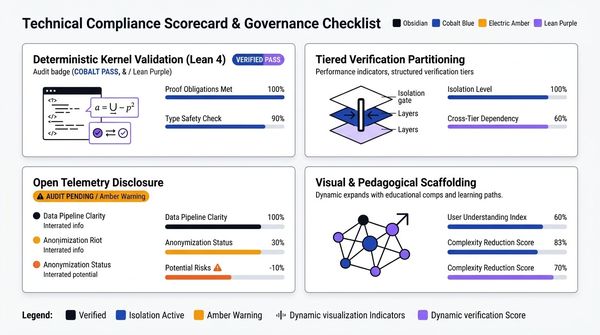
Repositories and publication venues must establish enforceable submission standards for autonomous mathematical artifacts:
- Deterministic Kernel Validation : Clean compilation inside open-source kernels like Lean 4 .
- Tiered Verification Partitioning : Strict structural separation between machine-compiled theorems and heuristic preprint drafts. Releasing unverified proofs alongside verified ones creates epistemic confusion; automated repositories must formally tag and isolate compiler-guaranteed proofs from exploratory, open-for-scrutiny manuscripts.
- Open Telemetry : Mandatory disclosure of search trajectories, branching failures, and compute profiles.
- Visual Scaffolding : Programmatic topological models illustrating core transformation mechanisms.
Caveats remain non-trivial: measuring reusability across Mathlib 4 requires graph-theoretic dependency parsing that imposes significant telemetry overhead. Furthermore, kernel soundness cannot compensate for closed, proprietary reasoning graphs that obscure underlying logical exploration.
Conclusion & Strategic Advice
The post-verification frontier is not about accelerating proof volume, but maximising conceptual absorption. Solving the formal verification bottleneck without investing in explanatory de-formalisation risks converting scientific literature into unnavigable machine telemetry. Submissions devoid of visual intuition and structural roadmaps must be treated as incomplete.
(I explore how this comprehension bottleneck extends across wider scientific and institutional domains soon in The Jericho Horn: When LLMs Collapse Institutional Walls , comming soon)
How should enterprise AI architectures balance proof-generation velocity with human conceptual absorption? Drop your thoughts below💬 and share this analysis with your network! ♻️
Further Reading
- The Lean 4 Theorem Prover Manual and Reference – Official documentation for interactive theorem proving and tactic metaprogramming.
- Mathlib Community Documentation & Architecture Guide – Structural dependency graphs and contribution protocols for Lean's mathematical library.
- DeepMind: AI Solves IMO Problems at Silver Medal Level – Technical analysis of neuro-symbolic search pipelines using AlphaProof and AlphaGeometry.
- Terence Tao on Machine-Assisted Mathematics – Essays and critiques on formalisation, automated bounds, and human-machine collaboration in modern analysis.
- Retraction Watch: OpenAI withdraws three preprints a day after releasing 722 manuscripts on unsolved math problems – Investigative report detailing the community reaction, the cascading sign error, and the trust dynamics between AI labs and academic mathematicians.
More From Me
Original Article: Read on LinkedIn | Read on Substack